
History of Tunnels: From Ancient Waterways to Modern Megaprojects
Tunnels are among humanity’s oldest engineered structures. Long before modern machinery, communities were already cutting passages through soil and rock to reach water, drain land, extract minerals, defend settlements, and cross natural barriers. Some of the earliest planned tunnels date back thousands of years, when builders relied on stone or metal tools, fire, timber supports, simple levels, and careful observation.
Water was one of the strongest early motivations. Underground channels reduced evaporation, protected supplies, and carried water beneath hills toward farms and growing cities. Over time, mining, warfare, canals, railroads, and urban expansion created new reasons to build underground. Each use demanded better surveying, stronger supports, improved ventilation, and faster excavation.
The history of tunnels therefore mirrors the development of engineering itself. Hand-dug galleries gave way to gunpowder, pneumatic drills, tunneling shields, dynamite, and reinforced linings. In the twentieth century, tunnel boring machines transformed excavation into a coordinated mechanical process. Today, automated equipment, precast concrete segments, digital monitoring, and detailed geological models make it possible to construct long rail, road, utility, and underwater tunnels on a scale earlier builders could scarcely imagine.
What Does the Word “Tunnel” Mean?
The English word tunnel developed from the Middle French tonnelle, a diminutive of tonne, meaning a barrel or cask. The term was initially associated with narrow, enclosed, or funnel-like forms before it acquired its modern meaning: a passage constructed through earth, rock, or another obstruction.
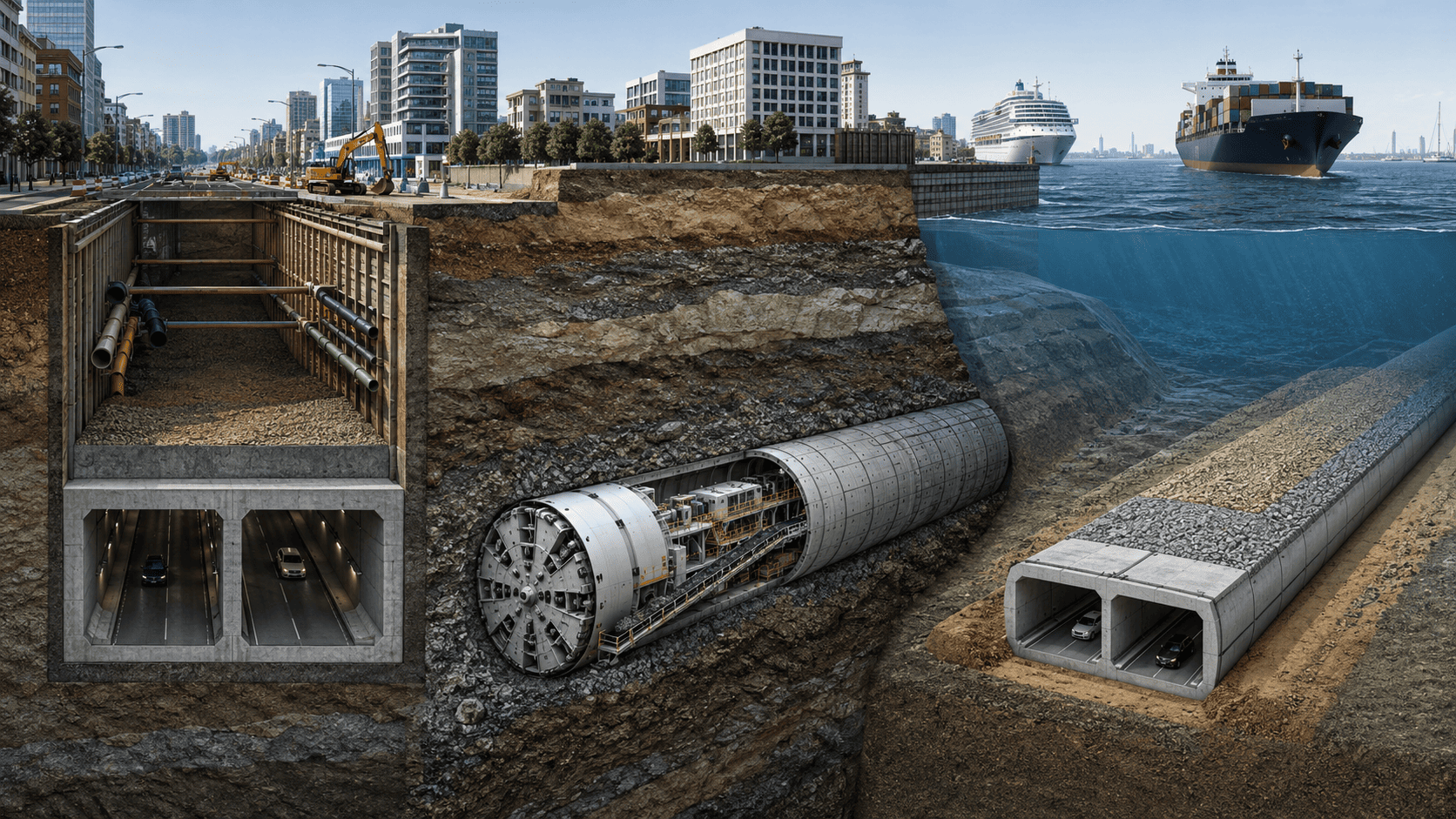
In engineering, a tunnel is generally a covered passage whose length is substantially greater than its width. It may run beneath the ground, through a mountain, or under a river or sea. Many tunnels are excavated directly into soil or rock, but construction does not always occur entirely underground. A cut-and-cover tunnel, for example, is created by digging an open trench, building the enclosed passage inside it, and then replacing the material above it.
A conduit is usually smaller and intended primarily to carry water, sewage, cables, or other utilities rather than people or vehicles. Some ancient water conduits, however, required extensive underground excavation and therefore form an important part of the history of tunnels.
Natural tunnels also exist. Flowing water, volcanic activity, erosion, and changes within rock formations can produce underground passages without human intervention. These belong primarily to geological history. The history examined here concerns intentionally created passages and the evolving knowledge, tools, and construction methods used to build them.
A Chronological History of Tunnels
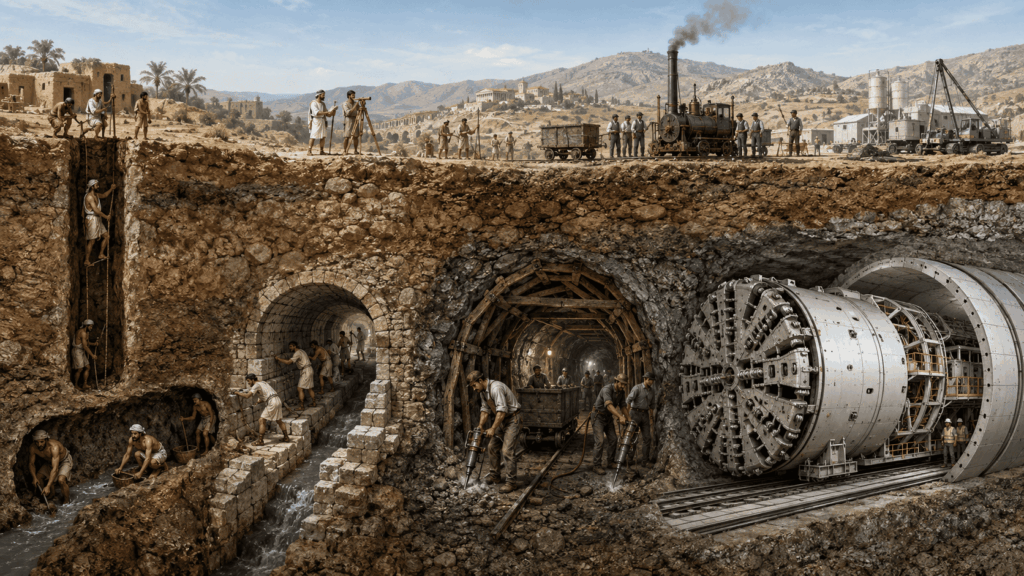
The history of tunnels is a record of people solving the same basic problem in increasingly ambitious ways: how to pass through ground that blocks access to water, minerals, territory, or transportation routes. Early builders worked with stone tools, fire, timber supports, and careful observation. Later societies added surveying instruments, explosives, mechanical drills, protective shields, and finally tunnel boring machines. Each advance allowed tunnels to become longer, deeper, safer, and more useful to expanding communities.
Prehistoric Beginnings and the First Artificial Tunnels
Humans used natural caves long before they could construct underground passages. In some places, prehistoric communities enlarged cave entrances, connected chambers, or cut short routes through soft rock. Neolithic miners also sank shafts and drove narrow galleries to reach flint, chert, pigments, salt, and other valuable materials. These excavations required an understanding of rock stability, ventilation, lighting, and spoil removal, even though they were not tunnels in the modern transportation sense.
Identifying the first artificial tunnel is difficult. Archaeologists must distinguish a deliberately excavated passage from a natural cavity that people merely occupied or modified. Many early works also collapsed, filled with sediment, or were reused by later cultures. Definitions further complicate the question: a mining gallery, tomb passage, drainage channel, and pedestrian tunnel may all be human-made underground spaces, but they served different purposes.
For that reason, the earliest history of tunneling is better understood as a gradual transition. People first adapted existing underground spaces, then learned to excavate short passages, and eventually created planned tunnels with controlled direction, slope, and destination. Water management became one of the strongest forces behind that transition.
Ancient Water Tunnels in Mesopotamia, Persia, Greece, and Rome
As settlements grew in dry regions, reliable water supplies became essential. Communities in Mesopotamia and the wider Middle East built canals, drains, and underground channels to move water while reducing evaporation and protecting the flow from contamination or attack. Some early systems were shallow and dug from the surface; others required workers to advance through soil or rock.
The Persian qanat transformed this principle into a durable regional technology. A qanat is a gently sloping underground channel that taps groundwater at a higher elevation and carries it by gravity toward farmland or a settlement. Vertical shafts provided access for excavation, ventilation, and maintenance. Because most of the water remained underground until it reached its destination, qanats could support agriculture and permanent communities in arid landscapes with limited losses to heat and evaporation. The technique spread in different forms across the Middle East, North Africa, Central Asia, and beyond.
Greek engineers demonstrated that tunnels could also be aligned across substantial distances. On the island of Samos, the sixth-century BCE Tunnel of Eupalinos carried water through Mount Kastro. Crews excavated from opposite sides, using geometric planning to bring the headings together inside the mountain. The achievement showed that surveying, rather than trial and error alone, could guide a major underground project.
Roman engineers expanded tunneling across an empire. Although Roman aqueducts are often pictured on high arches, much of their length ran at ground level or underground. Tunnels carried water through ridges, fed cities and baths, drained lakes and marshes, and supported mining. Builders used access shafts to create additional working faces, remove debris, and check the gradient. They also constructed road passages and military works. Roman practice combined accurate leveling, standardized masonry, durable linings, and organized labor on a scale that would influence later European engineering.
Tunneling in the Middle Ages and Renaissance
Tunnel construction did not disappear after the western Roman Empire declined, but large civic projects became less common in parts of Europe. Mining preserved much of the practical knowledge. Workers followed mineral veins through mountains, drove drainage adits into hillsides, and sank shafts to reach deeper deposits. Timbering supported weak ground, while simple ventilation arrangements and water-lifting devices allowed mines to extend farther below the surface.
Elsewhere, underground water systems continued to be built and maintained. Qanats remained vital across Persia and neighboring regions, while communities in Europe, Asia, and the Islamic world excavated channels for water supply, mills, drainage, and irrigation. Fortified towns and armies also used tunnels for protected movement, storage, escape, and siege warfare.
During the Renaissance and early modern period, improved maps, compasses, levels, and mathematical surveying made alignment more reliable. Mining manuals began recording techniques that had previously passed mainly through apprenticeship. Better pumps helped remove groundwater, and stronger hoisting systems carried workers and excavated material through shafts. These developments did not immediately create very long transportation tunnels, but they provided the knowledge, tools, and specialized workforce needed for the industrial expansion that followed.
The Canal and Railroad Tunnel Era
The Industrial Revolution changed both the purpose and scale of tunneling. Growing industries needed dependable routes for coal, raw materials, manufactured goods, and passengers. Canal builders cut tunnels through hills when a surface route would require excessive locks, long detours, or steep changes in elevation. Horses or workers initially moved boats through some early canal tunnels, and ventilation was limited because the traffic produced little smoke.
Railroads created more demanding conditions. Trains could not climb steep grades or turn as sharply as roads, so engineers often had to drive nearly level passages directly through mountain barriers. Railway tunnels also needed larger, more uniform profiles, stable track beds, drainage, and enough ventilation to clear smoke from steam locomotives.
Nineteenth-century projects became testing grounds for mechanical drills, compressed-air equipment, explosives, and more systematic geology. Crews advanced simultaneously from portals and intermediate shafts, increasing the number of working faces. Major works such as the Mont Cenis Tunnel through the Alps and the Hoosac Tunnel in Massachusetts demonstrated both the promise and the danger of industrial tunneling. Progress was still slow, accidents were frequent, and unexpected water or unstable ground could overwhelm a project. Even so, these tunnels proved that long mountain crossings could become permanent parts of national transportation networks.
The need to coordinate hundreds or thousands of workers also changed the profession itself. Survey records, geological observations, cost estimates, and construction schedules became formal parts of tunnel management. Governments and railway companies financed works that could take decades and outlast their original designers. Tunneling was no longer only a craft practiced by miners; it was becoming a distinct branch of civil engineering with specialized contractors, equipment, and technical knowledge.
Subways, Road Tunnels, and Underwater Crossings
Industrial cities soon faced a different obstacle: congestion at the surface. London opened the Metropolitan Railway in 1863, the world’s first underground urban railway. Its earliest sections were largely built by cut-and-cover, a method in which a street is opened, the railway structure is constructed in a trench, and the surface is restored above it. The approach was practical at shallow depth but highly disruptive to buildings, traffic, and utilities.
Deeper routes became possible through improved tunneling shields. A tunneling shield is a movable protective structure that supports the excavation face while workers or machinery remove the ground and build a lining behind it. Marc Isambard Brunel’s Thames Tunnel, opened in 1843, established the basic principle for shield-driven construction beneath soft, water-bearing ground. Later shields helped subway builders pass below streets and property without excavating continuously from the surface.
Electric traction transformed urban tunneling because electric trains produced no steam exhaust. Deep-level subway networks expanded in London and were followed by systems in cities such as Budapest, Paris, Boston, and New York. Ventilation remained important for heat, dust, and passenger comfort, but engineers no longer had to clear locomotive smoke from every enclosed route.
The spread of automobiles created a new class of road tunnels. These required broad lanes, lighting, drainage, traffic control, and powerful ventilation systems to remove vehicle exhaust. At the same time, engineers improved methods for crossing waterways. Some tunnels were bored through the ground beneath a river or seabed; others were assembled from prefabricated sections placed in a dredged trench and covered. By the twentieth century, underground crossings had become alternatives to bridges where shipping clearance, weather, military concerns, or dense development made a surface structure less suitable.
The Machine-Mined Era and Modern Megaprojects
Early attempts to mechanize full-face excavation appeared in the nineteenth century, but many machines failed when cutters, power systems, or ground-control methods could not cope with changing rock. Modern tunnel boring machines, commonly called TBMs, became increasingly effective during the twentieth century. A TBM uses a rotating cutterhead to break soil or rock while systems behind the head remove excavated material, support the tunnel, and often install its permanent lining.
Different machines evolved for hard rock, soft soil, and water-bearing ground. Earth-pressure-balance and slurry shields stabilize loose ground by controlling pressure at the excavation face. In many projects, robotic equipment places precast concrete lining segments into rings immediately behind the shield, creating a finished structural shell as the machine advances. Laser guidance, electronic surveying, continuous monitoring, and computerized controls have made alignment and ground management far more precise.
These technologies enabled tunnels that earlier generations could only propose. Japan’s Seikan Tunnel opened in 1988 beneath the Tsugaru Strait. The Channel Tunnel began rail service in 1994, physically linking Britain and continental Europe. Switzerland’s 57.1-kilometer Gotthard Base Tunnel opened in 2016, providing a low-gradient railway route beneath the Alps. Such megaprojects depend on more than excavation speed: they require geological investigation, international financing, logistics, ventilation, emergency systems, and years of coordinated construction.
Large modern projects are usually divided into several interconnected underground systems rather than a single passage. Parallel running tunnels may be linked by cross passages, while separate access shafts, service galleries, drainage channels, ventilation structures, and emergency areas support operation. TBMs may advance from multiple launch sites, and excavated rock can be carried out by conveyor instead of carts or locomotives. The machine is only one part of a larger construction system that coordinates excavation with surveying, lining installation, logistics, and continuous observation of the surrounding ground.
How Tunnel Planning and Design Evolved
From Early Surveying to Geotechnical Investigation
The earliest tunnel builders relied on direct observation, measuring cords, plumb lines, water levels, and practical knowledge of local ground. These tools were simple, but they allowed workers to control direction and slope with surprising accuracy. The ability to excavate from opposite sides of a hill and meet underground was especially important because it reduced construction time and improved ventilation and access. It also required more than physical labor: builders had to transfer surface measurements into the mountain and correct small errors before they became impossible to fix.
As projects grew longer, surveying became more systematic. Compasses, optical levels, theodolites, and later electronic instruments allowed engineers to establish precise alignments between portals, shafts, and underground working faces. Modern tunnel surveys use laser guidance, satellite-based positioning at the surface, and continuous monitoring to keep excavation on course.
Planning also expanded beyond geometry. Earlier builders learned about rock and groundwater mainly through exposed surfaces, nearby mines, and experience gained during excavation. Modern projects begin with geological mapping, boreholes, laboratory tests, groundwater studies, and geophysical surveys. Engineers combine these findings in a geotechnical model, a three-dimensional interpretation of the soil, rock, faults, water conditions, and pressures expected along the route. Because underground conditions can never be known perfectly, the design must also allow monitoring and adjustment as excavation proceeds.
Why Engineers Chose Tunnels Instead of Bridges
The choice between a tunnel and a bridge has always depended on geography, transportation needs, engineering limits, and cost. Through mountains, tunnels can provide shorter routes and gentler grades, which became crucial for canals and railroads. Beneath rivers or coastal channels, they may preserve shipping lanes and avoid bridge closures caused by strong winds, ice, or severe weather.
In cities, tunnels became increasingly attractive as surface land grew scarce and expensive. They allowed railways, roads, sewers, and utility networks to pass below buildings and crowded streets. Tunnels can also reduce visual intrusion and protect routes from surface conditions, although they usually require greater spending on excavation, ventilation, drainage, lighting, and emergency systems.
Historical estimates were often unreliable because engineers had limited information about hidden geology. Modern planning compares construction cost, operating expense, environmental effects, travel time, safety, maintenance, and the risk of unexpected ground conditions before selecting an underground route.
The Evolution of Tunnel Construction Methods
Hand Excavation, Fire-Setting, and Cut-and-Cover
For most of human history, tunnels were excavated by hand. Workers used stone hammers, antler picks, bronze or iron tools, chisels, and wedges to loosen soil and rock. Progress was slow, and the size of a passage depended on how much material could be removed and how safely the surrounding ground could be supported. In weak soil, timber frames helped prevent collapse; in hard rock, crews followed natural fractures whenever possible.
Fire-setting provided an early way to break resistant rock. Workers heated the rock face with a fire and then allowed it to cool or quenched it with water. The rapid temperature change created cracks that could be widened with picks and wedges. The method was effective in mines and some early tunnels, but it produced smoke, heat, and dangerous working conditions.
Cut-and-cover was another ancient solution. Builders opened a trench from the surface, constructed walls and a roof, and then covered the finished passage. Because it avoided prolonged excavation through unknown ground, the method was well suited to shallow water channels, drains, and, centuries later, the first urban subway lines. Its main disadvantage was disruption at the surface.
Gunpowder, Dynamite, Compressed Air, and Tunneling Shields
Gunpowder introduced controlled blasting into mining and tunneling during the early modern period. Holes were drilled into the rock face, packed with explosive material, and fired to break larger volumes than hand tools could remove. Blasting greatly increased progress, although early charges were difficult to control and could damage the surrounding rock.
Dynamite, patented by Alfred Nobel in 1867, offered a more powerful and manageable explosive. Combined with pneumatic drills, it accelerated major railroad and mountain tunnels. Crews could drill a pattern of holes, blast the face, remove the broken rock, install supports, and repeat the cycle. This became known as the drill-and-blast method.
Soft, water-saturated ground required a different approach. A tunneling shield protected workers and supported the excavation face while the tunnel lining was assembled behind it. In some projects, compressed air was used to balance groundwater pressure and prevent water and soil from rushing into the excavation. The method made difficult river crossings possible, but prolonged exposure to high air pressure could cause decompression sickness among workers.
Tunnel Boring Machines and Sprayed Concrete
The first full-face boring machines often failed because their cutters, power systems, and supporting equipment could not adapt to changing geology. During the twentieth century, stronger cutter materials, hydraulic systems, electric motors, and improved ground-control techniques turned the tunnel boring machine into a practical construction system.
A modern TBM excavates the entire circular face with a rotating cutterhead. Depending on the ground, the machine may grip solid rock, support loose soil with pressure, remove spoil by conveyor or slurry pipes, and install precast concrete segments as it advances. This continuous process can reduce vibration and produce a more uniform profile than repeated blasting, although a TBM is expensive to build and may be difficult to adapt if conditions differ sharply from forecasts.
Sprayed concrete, often called shotcrete, changed how freshly excavated rock could be supported. Concrete is projected at high speed onto the exposed surface, where it forms a stabilizing layer. Used with rock bolts, steel mesh, and monitoring instruments, it allows engineers to support the ground soon after excavation and adjust the reinforcement to observed conditions. This approach became central to methods that treat the surrounding rock as part of the tunnel’s structural system.
Underwater and Immersed-Tube Construction
An underwater tunnel may be bored through soil or rock beneath a riverbed or seabed, using a shielded TBM to control water pressure. The tunnel remains within the ground and is lined as excavation advances.
An immersed-tube tunnel is built differently. Large watertight sections are prefabricated, floated to the crossing, lowered into a dredged trench, joined underwater, and covered with protective material. This technique is often suitable for relatively shallow waterways with level approaches. Bored tunnels usually disturb the waterway less at the surface, while immersed tubes may offer shorter construction routes but require dredging, marine operations, and carefully sealed joints.
How Tunnel Types Expanded Over Time
Water, Sewer, and Utility Tunnels
The earliest tunnels often served a single essential purpose: moving water. Ancient irrigation channels, qanats, and underground aqueducts carried water from springs or groundwater sources to farms and settlements. As cities became larger, underground construction expanded from supply systems to drainage and sewage networks. These tunnels helped remove wastewater, reduce flooding, and improve public health.
Industrialization created additional demands below ground. Utility tunnels began carrying steam pipes, electricity cables, gas lines, and later telephone and fiber-optic networks. Some were designed as accessible galleries so workers could inspect and repair services without repeatedly opening streets. Modern utility tunnels may combine power, communications, water, and district heating within the same protected corridor.
Rail, Road, and Urban Transit Tunnels
Transportation tunnels developed according to the needs of each vehicle. Railway tunnels required relatively gentle gradients, stable track alignment, drainage, and enough clearance for trains. During the age of steam, ventilation was essential because smoke and gases could accumulate rapidly in enclosed spaces.
Urban transit systems introduced different pressures. Subway tunnels had to pass beneath streets, buildings, and existing utilities while providing stations, ventilation shafts, emergency exits, and connections between lines. Electric trains made deep underground systems more practical by eliminating locomotive smoke.
Road tunnels required wider profiles, stronger ventilation, lighting, traffic-control systems, and fire protection. Their design also had to account for vehicle emissions, breakdowns, and the movement of emergency services. As traffic increased, many road crossings were built with separate tubes for opposing directions.
Double-Deck and Multipurpose Tunnels
Limited urban space encouraged engineers to use tunnels for more than one function. Double-deck tunnels place traffic or rail lines on separate levels, increasing capacity without requiring a wider excavation. Other projects combine transportation with utility corridors, drainage channels, or emergency routes.
Multipurpose tunnels are especially valuable in dense cities, where underground space is costly and surface disruption is difficult. Some systems are designed to carry traffic during normal conditions and divert stormwater during extreme rainfall. This approach reflects a broader change in tunnel design: underground infrastructure is no longer always built for one isolated service, but as part of an integrated urban network.
Safety and Security in Tunnel History
Ventilation, Fire Protection, and Structural Safety
Early tunnels were dangerous environments. Workers and travelers faced unstable ground, poor lighting, accumulated smoke, toxic gases, and sudden flooding. In mines and long transportation tunnels, limited airflow could make breathing difficult and reduce visibility. Builders initially relied on shafts, open portals, fires, and natural air movement, but longer tunnels eventually required mechanical ventilation.
The arrival of steam railways made the problem more severe because locomotive smoke and carbon monoxide collected underground. Ventilation shafts, fans, and operating rules were introduced to move polluted air outside. Later, road tunnels required even more powerful systems to control vehicle exhaust. Modern ventilation also helps manage heat and direct smoke away from evacuation routes during a fire.
Structural safety evolved in a similar way. Timber supports were gradually supplemented or replaced by masonry, cast iron, steel, sprayed concrete, rock bolts, and reinforced concrete linings. Drainage channels, waterproof membranes, pumping stations, and pressure-resistant seals reduced the danger posed by groundwater. Fire-resistant materials, protected cables, emergency lighting, and continuous sensors became standard as accidents showed how quickly heat, smoke, or structural damage could spread through an enclosed passage.
Emergency Exits and Security Systems
Early tunnels often had few escape options beyond their entrances or construction shafts. As tunnels became longer and carried more passengers, designers began adding cross passages, refuges, service galleries, and dedicated emergency exits. Parallel tunnels could support each other during an evacuation, allowing people to move from an affected tube into a protected route.
Communication also became central to safety. Telephones, radios, public-address systems, emergency signals, and later digital networks allowed operators to detect problems and coordinate a response. Cameras, heat detectors, air-quality sensors, and automated traffic controls now provide continuous surveillance of many major tunnels.
Security planning expanded beyond accidental hazards to include unauthorized access, sabotage, and deliberate attacks. Controlled entrances, patrols, monitoring centers, and emergency procedures became part of tunnel operation. The historical pattern is consistent: each failure exposed a weakness, and that weakness led to stronger standards for ventilation, fire resistance, evacuation, structural monitoring, and coordinated rescue.
Landmark Tunnels That Changed Engineering
Certain tunnels became landmarks not simply because they were long, but because they solved problems that had defeated earlier builders. They show how tunneling advanced through better surveying, stronger excavation tools, improved knowledge of geology, and more complex safety systems.
Ancient Milestones: Siloam and Eupalinos
The Siloam Tunnel in Jerusalem, also known as Hezekiah’s Tunnel, carried water from the Gihon Spring to the Pool of Siloam. Cut through approximately 1,750 feet (533 meters) of rock, it is especially important because an ancient inscription describes two crews approaching one another and meeting underground. Its winding course suggests that the builders adapted their route as work progressed, yet they still completed a continuous gravity-fed channel. The project illustrates how water security could justify a difficult excavation with the tools and surveying knowledge available in antiquity.
The sixth-century BCE Tunnel of Eupalinos on the Greek island of Samos represented a different achievement. Extending about 3,400 feet (1,036 meters) through a mountain, it was excavated from both ends to supply the ancient city with water. The two headings met despite beginning on opposite sides of the ridge. Deliberate changes in direction helped reduce the risk that small alignment errors would cause the crews to pass one another. The tunnel became an early demonstration that geometry and organized surveying could control a large underground project.
Industrial-Age Breakthroughs: Thames, Hoosac, and Mont Cenis
The Thames Tunnel in London, constructed between 1825 and 1843, was the first tunnel successfully completed beneath a navigable river. Marc Isambard Brunel’s tunneling shield supported the soft ground at the excavation face while workers dug in protected compartments and masons built a brick lining behind them. Although flooding repeatedly interrupted construction, the shield established the principle behind later machines used in unstable, water-bearing soil.
In Massachusetts, the 4.75-mile Hoosac Tunnel became a proving ground for industrial excavation. Work lasted from 1851 to 1875 and exposed the limitations of hand drilling and black powder. Engineers later adopted compressed-air Burleigh drills, electric firing systems, and nitroglycerin-based explosives. These technologies increased the rate of advance and helped establish the drill-and-blast cycle used in later hard-rock projects. The tunnel also demonstrated the value—and danger—of intermediate shafts, mechanical ventilation, and large-scale construction logistics.
The Mont Cenis Tunnel, now commonly called the Fréjus Rail Tunnel, connected France and Italy through the Alps. Construction began in 1857, machine drilling was introduced in 1861, and the route opened in 1871. Pneumatic drills powered by compressed air allowed crews to bore blasting holes faster than hand labor. Its completion proved that a long international railroad tunnel could cross a major mountain range and encouraged other Alpine projects.
Modern Landmarks: Channel, Seikan, and Gotthard Base
The Seikan Tunnel connected the Japanese islands of Honshu and Hokkaido beneath the Tsugaru Strait when it opened in 1988. Its 33.5-mile (53.85-kilometer) route required extensive geological investigation, drainage, grouting, and service passages in ground affected by high water pressure. It showed that a permanent rail connection could be constructed beneath a difficult strait where severe weather made maritime travel unreliable.
The Channel Tunnel, inaugurated in 1994, linked Britain and France with two rail tunnels and a central service tunnel. Eleven tunnel boring machines worked from both coasts through carefully selected chalk marl. Cross passages and the separate service tunnel strengthened maintenance, evacuation, and emergency access. Beyond its engineering scale, the project demonstrated the financing, treaty-based coordination, and technical standardization required for a binational underground link.
Switzerland’s 35.5-mile (57.1-kilometer) Gotthard Base Tunnel opened in 2016 as a low-gradient railway beneath the Alps. Excavation proceeded from several access points, using both TBMs and drill-and-blast methods to address changing rock. Two single-track tubes, frequent cross passages, emergency stations, and extensive monitoring formed an integrated system rather than a single bore. The project showed that modern tunneling depends as much on logistics, risk management, and safety design as on the machines cutting the rock.
Mining, Military, and Secret Tunnels
Mining Tunnels and the Origins of Engineering Techniques
Mining pushed underground construction forward long before modern transportation tunnels appeared. An adit is a nearly horizontal passage driven into a hillside to reach a mineral deposit, provide drainage, or improve ventilation. A shaft is a vertical or steeply inclined opening used to move workers, equipment, ore, and waste between the surface and deeper workings.
As mines extended farther underground, builders had to solve problems that later became central to civil tunneling. Timber supports and masonry stabilized weak ground. Drainage adits, pumps, and sumps controlled water. Furnaces, shafts, and mechanical fans moved fresh air through long galleries. Carts, rails, hoists, and later conveyors improved the removal of excavated material. Mining also encouraged the development of surveying, blasting patterns, pneumatic drills, and methods for coordinating work from multiple levels. Railway, water, and road tunnel engineers later adapted many of these practices.
Military and Siege Tunnels
Armies used tunnels both to attack fortifications and to protect movement. During a siege, miners excavated beneath walls or towers and created a chamber supported by timber. Burning or removing the supports could cause the ground—and the defensive structure above it—to collapse. Defenders responded with countermines, tunnels intended to locate and disrupt enemy excavations.
Gunpowder changed siege tunneling by allowing attackers to place explosive charges beneath fortified positions. In later wars, underground works expanded into command posts, hospitals, ammunition stores, shelters, and protected communication routes. During World War I, opposing forces dug extensive tunnel systems beneath the Western Front and detonated mines under enemy lines. These operations required careful surveying, ventilation, drainage, listening equipment, and quiet excavation. The technical experience gained in military tunneling later influenced underground construction, particularly in difficult ground and confined spaces.
Secret Tunnels for Escape, Smuggling, and Resistance
Secret tunnels served people who needed to cross barriers without detection. They were built beneath prisons, borders, city walls, and occupied territory for escape, smuggling, communication, or resistance. Their builders often worked with limited tools and little room for spoil disposal, making concealment as important as structural stability.
The Cu Chi tunnel network in Vietnam supported movement, storage, medical care, and defense, while escape tunnels beneath the Berlin Wall demonstrated how underground routes could bypass heavily controlled borders. Similar passages have been used to move prohibited goods or connect hidden rooms with safer exits.
Although these tunnels were usually smaller and less durable than major public works, they demanded practical solutions for direction, airflow, shoring, drainage, and secrecy. They reveal another side of tunnel history: underground engineering was shaped not only by governments and industry, but also by communities adapting constrained spaces to survive, resist, and move unseen.
Natural Tunnels and Early Human Inspiration
Natural tunnels existed long before people began excavating passages of their own. Flowing water can gradually erode openings through soil or rock, especially where rivers follow fractures or softer layers. In limestone regions, slightly acidic groundwater dissolves the rock over long periods, creating caves, underground channels, arches, and connected passage systems.
Volcanic activity produces another type of natural tunnel. When the surface of a lava flow cools and hardens while molten material continues moving beneath it, the remaining lava may drain away and leave a hollow lava tube. Coastal erosion can also cut sea caves through headlands until openings form on opposite sides.
These formations gave early humans shelter, storage space, access routes, and places for ritual or burial. Communities sometimes widened entrances, leveled floors, joined chambers, or cut new passages into existing caves. Although there is no direct evidence that every early artificial tunnel was copied from a natural example, caves demonstrated that usable spaces could exist beneath mountains and hills.
Natural passages therefore form part of the background to the history of tunnels. They preceded engineered excavations and showed humans both the possibilities and the dangers of moving through enclosed ground.
Major Tunnel Disasters and the Lessons They Taught
Accidents That Changed Tunnel Design and Regulation
Tunnel disasters have repeatedly exposed weaknesses that were difficult to recognize during ordinary operation. The 1999 fires in the Mont Blanc and Tauern road tunnels, followed by the 2001 Gotthard Road Tunnel fire, showed how quickly smoke, heat, and disabled vehicles could turn an enclosed route into a deadly environment. These events accelerated European efforts to establish common safety requirements for major road tunnels. The resulting measures emphasized risk assessments, independent oversight, emergency planning, reliable communications, inspections, and coordination between tunnel operators and rescue services.
Fires in the Channel Tunnel also influenced operating procedures. Investigations examined the difficulty of detecting fires inside freight vehicles, the management of trains after an alarm or power failure, and the movement of passengers into the separate service tunnel. Recommendations strengthened surveillance, detection, staff training, incident control, and evacuation planning. The Channel Tunnel’s three-tunnel arrangement showed the safety value of a protected service passage connected to the running tunnels by cross passages.
Construction accidents produced different lessons. Flooding and collapses during early subaqueous and mountain projects demonstrated the need for better geological investigation, stronger temporary supports, controlled excavation pressure, and dependable pumping. Modern designs therefore consider not only the completed structure but also every temporary stage of construction.
Recurring Causes: Flooding, Fire, Collapse, and Ventilation Failure
The same hazards appear throughout tunnel history. Water can enter through fractured rock, permeable soil, failed seals, or an exposed excavation face. Collapse may result from weak ground, excessive pressure, poor support, or unexpected faults. Fire is especially dangerous because smoke and heat are confined, visibility disappears, and access for firefighters is limited. Inadequate ventilation can also allow toxic gases to accumulate during construction or operation.
Modern tunnel safety treats these risks as connected. Drainage and pumping protect structural stability; fire-resistant linings slow damage; ventilation controls air and smoke; sensors provide early warning; and cross passages create evacuation and rescue routes. The lasting lesson from major disasters is that safe tunneling depends on redundancy: when one system fails, another must preserve enough time and access for people to escape and responders to intervene.
The Future of Tunneling
Future tunneling will depend less on a single breakthrough machine than on the integration of automation, robotics, real-time data, and lower-carbon construction. Tunnel boring machines are becoming more automated, while remote-controlled or robotic equipment can perform inspection, surveying, lining work, and other tasks in areas that expose workers to dust, unstable ground, heat, or moving machinery.
Sensors installed on excavation equipment and tunnel linings can track pressure, vibration, deformation, groundwater, temperature, and machine performance. Combined with digital models, these measurements allow engineers to compare actual conditions with forecasts and adjust excavation or support before small changes become serious problems. Automated guidance and ground-detection systems may also help machines respond more effectively to changing geology.
Reducing environmental impact is another priority. Projects are testing lower-carbon concrete, more energy-efficient equipment, and systems that classify excavated rock and soil for reuse in concrete, embankments, landscaping, or other construction instead of sending it to disposal sites. Better material planning can reduce both waste and transportation emissions.
Cities may increasingly use underground space for multipurpose infrastructure that combines transit, utilities, stormwater control, energy systems, or emergency functions. At the same time, improved machines, monitoring, and geological modeling could support longer and deeper tunnels beneath mountains, crowded urban areas, and bodies of water. The central challenge will remain unchanged: expanding underground infrastructure while controlling cost, uncertainty, worker risk, and environmental effects.
Related Entries: