
Ancient Bridges: History, Engineering, and Surviving Examples
Ancient bridges are crossings built by early civilizations to move people, animals, goods, and water across rivers, valleys, and other natural obstacles. The first structures were simple timber beams, stepping stones, and stone slabs, but builders gradually developed arches, masonry piers, and suspended walkways suited to more demanding terrain.
From Mycenaean roads and Roman infrastructure to Chinese crossings and Inca rope bridges, these works reflected local materials and engineering knowledge. This article examines their origins, construction methods, regional traditions, and the remarkable examples that still survive today.
Ancient Bridges: Origins and Early Forms
The earliest bridges were practical responses to natural barriers rather than planned works of engineering. Over time, people moved from using convenient features in the landscape to building crossings that supported repeated travel, trade, and the movement of animals or carts.
Natural Crossings and the First Human-Made Bridges
A fallen tree could provide a route across a narrow stream, while exposed rocks served as stepping stones. Early communities copied these natural solutions by placing logs across water, arranging stones at regular intervals, or building wooden walkways over marshes and shallow channels. These structures had limited spans and were vulnerable to floods, decay, and shifting ground, but they established the idea of creating a continuous path over an obstacle.
Early Timber, Stone, and Corbel-Arch Designs
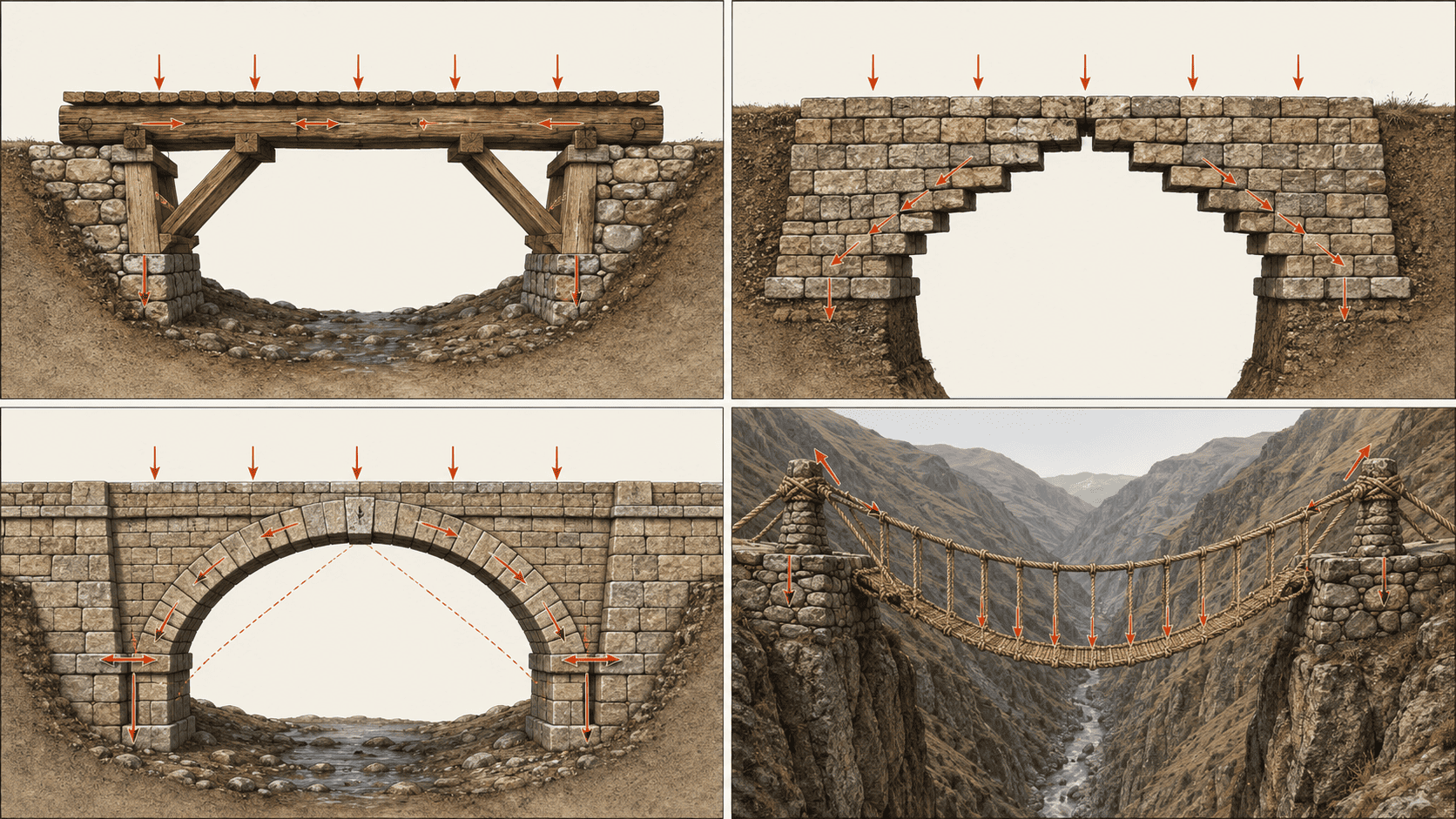
Timber was easy to shape and transport, making it useful for beam bridges and raised walkways. Stone offered greater durability, although large slabs were heavy and could span only short distances without extra supports. Builders also developed the corbel arch, formed by placing successive stone courses slightly farther inward until they met near the top.
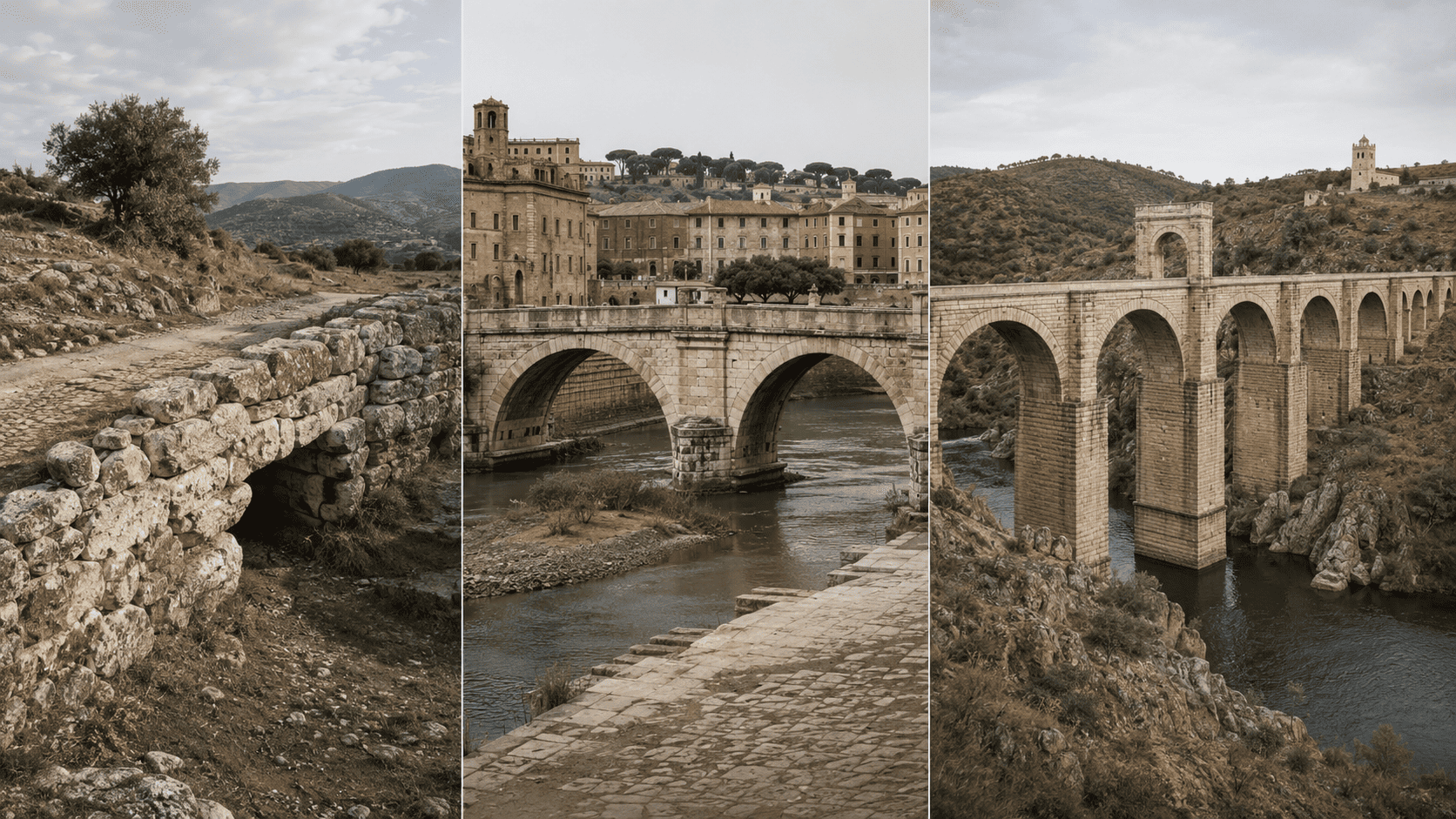
The Arkadiko Bridge in Greece is a surviving example of this method. Built during the Mycenaean Bronze Age, it used massive stone blocks to carry an ancient road across a small watercourse. Its construction shows that ancient bridges had evolved from temporary crossings into deliberately planned parts of transportation networks.
Roman Bridges and Arch Engineering
Roman engineers transformed bridge building by combining the arch with durable materials and standardized construction methods. Their bridges supported military movement, trade, public administration, and the expansion of road networks across the empire.
The Roman Arch and Longer Spans
A true arch is built from wedge-shaped blocks called voussoirs, which transfer weight outward and downward toward the supporting piers and abutments. Unlike a flat stone beam, which can crack when spanning a wide opening, an arch works mainly under compression. This allowed Roman builders to cross broader rivers with structures capable of carrying heavy traffic.
Multiple arches could be placed in sequence, creating long bridges while distributing loads across several piers. Openings in the piers sometimes reduced water pressure during floods and helped prevent damage from strong currents.
Stone, Pozzolana, and Roman Construction Methods
Romans commonly used cut stone for visible arches and exterior surfaces, while mortar and concrete strengthened the internal structure. Pozzolana, a volcanic ash mixed with lime and water, produced a hydraulic mortar that could harden in damp conditions. This was particularly useful for foundations and piers built near or within rivers.
Temporary wooden frameworks, known as centering, supported each arch during construction. Once the central keystone was placed and the arch became self-supporting, the framework could be removed.
Bridges, Roads, and Aqueducts
Roman bridges were components of larger infrastructure systems. Road bridges connected cities, ports, forts, and agricultural regions, while aqueduct bridges carried water channels across valleys. Their value came not only from their engineering, but also from the economic and administrative networks they helped maintain.
Ancient Bridge Traditions Around the World
Ancient bridge building developed in many regions as communities adapted local materials and structural ideas to rivers, valleys, and trade routes. Roman masonry was influential, but it was only one of several traditions.
Ancient Bridges in India
Early Indian texts, including the Arthashastra, refer to bridges and other public works used to support transportation, defense, and commerce. Builders relied heavily on materials available nearby, especially timber and bamboo, while stone was used where stronger foundations or more permanent crossings were needed. Because wood and plant fibers decay quickly, relatively little physical evidence from the earliest periods survives.
Ancient Bridges in China
Chinese builders developed crossings from timber beams, stone, boats, and masonry arches. Large wooden bridges were known by the Warring States period, while floating bridges linked boats or pontoons to create temporary routes across wide rivers. The Zhaozhou Bridge, completed during the Sui dynasty rather than antiquity, is a later surviving example of the advanced stone-arch tradition that emerged from these earlier practices.
Pre-Columbian Inca Rope Bridges
Inca engineers used braided plant fibers to suspend walkways across steep Andean gorges where masonry piers would have been impractical. The cables were anchored to stone abutments and renewed regularly by local communities. These bridges connected sections of the Inca road system, allowing messengers, soldiers, and goods to move through difficult mountain terrain.
Early Bridge Building in Africa
Evidence for ancient African bridges is uneven, partly because many crossings were made from perishable wood, reeds, or earth. Communities likely used log spans, raised timber walkways, causeways, and stone-lined crossings according to local landscapes. Later documented African bridges should not automatically be treated as ancient, but they demonstrate long-standing regional knowledge of building with renewable materials and adapting crossings to seasonal waterways.
Famous Ancient Bridges Still Standing Today
Although many early crossings disappeared, several ancient bridges remain visible or usable. Together, they show how different societies matched structural design to roads, terrain, and river conditions.
| Bridge | Location | Approximate date | Design |
|---|---|---|---|
| Arkadiko Bridge | Argolis, Greece | c. 1300–1190 BC | Corbel-arch stone bridge |
| Pons Fabricius | Rome, Italy | 62 BC | Two-span masonry arch bridge |
| Pont Julien | Provence, France | c. 3 BC | Three-span masonry arch bridge |
| Alcántara Bridge | Extremadura, Spain | AD 104–106 | Six-span masonry arch bridge |
| Ponte di Tiberio | Rimini, Italy | AD 14–21 | Five-span masonry arch bridge |
Arkadiko Bridge, Greece
The Arkadiko Bridge belonged to a Mycenaean road linking Tiryns with Epidaurus. Its broad roadway was suitable for wheeled traffic, showing that it formed part of an organized transportation route rather than serving only local pedestrians. Massive, irregular stones were fitted without mortar around a narrow corbeled opening.
Pons Fabricius, Italy
Built by the Roman road official Lucius Fabricius, Pons Fabricius connects Rome’s eastern riverbank with Tiber Island. Its two main arches have carried traffic across part of the Tiber for more than two millennia. Continued pedestrian use makes it an unusually direct link between ancient infrastructure and the modern city.
Pont Julien, France
Pont Julien carried the Via Domitia across the Calavon River in Roman Gaul, helping connect Italy with territories farther west. Its three semicircular arches rest on streamlined piers. Openings above the piers allowed floodwater to pass through, reducing pressure on the bridge during high flows.
Alcántara Bridge, Spain
Constructed over the Tagus River under Emperor Trajan, the Alcántara Bridge is one of the most monumental surviving Roman crossings. Six stone arches support a roadway high above the river gorge, while a triumphal arch rises over the central pier. Its scale demonstrates how Roman engineers combined practical transportation with imperial architecture.
Ponte di Tiberio, Italy
Work on Rimini’s Ponte di Tiberio began under Augustus and ended under Tiberius. Built from Istrian stone, its five arches carried routes associated with the Via Aemilia and Via Popilia. Repairs over the centuries have preserved the structure, which now serves pedestrians and remains a defining landmark of Rimini.
How Ancient Bridges Were Built
Ancient bridge construction depended on available materials, the width of the crossing, and the strength of the water below.
Materials: Timber, Stone, Brick, and Early Concrete
Timber was light, workable, and useful for short spans, but it decayed, burned, and required replacement. Stone was more durable and resisted compression well, although quarrying and moving large blocks demanded substantial labor. Brick provided regular building units where suitable stone was scarce. Early concrete and mortar helped bind masonry, fill internal spaces, and strengthen foundations.
Structural Forms: Beams, Corbel Arches, True Arches, and Rope Suspension
Beam bridges placed logs or stone slabs between supports and worked best across narrow gaps. Corbel arches extended successive layers of stone inward until they nearly met. True arches used wedge-shaped blocks to direct loads toward piers and abutments, allowing wider crossings. In mountainous regions, rope suspension bridges carried lightweight decks between secure anchor points where constructing piers was impractical.
Foundations, Piers, and Water Management
Foundations were often the most difficult part of construction. Builders had to reach stable ground beneath river sediment and protect piers from erosion. Temporary barriers or cofferdams could keep water away from the work area. Piers were often given pointed upstream faces to divide the current, while relief openings reduced pressure during floods and allowed debris to pass.
Why Some Ancient Bridges Survived
The survival of an ancient bridge usually reflects a combination of sound engineering, favorable conditions, and continued human care. Structures that remained useful were more likely to be repaired instead of abandoned.
Compression-Based Design
Stone arches are especially durable because they carry loads mainly through compression. Each block presses against the next, directing the weight toward the piers and abutments at either end. When these supports remain stable, the arch can withstand heavy traffic for centuries. Well-proportioned openings and sturdy foundations also reduce the damage caused by floods, shifting soil, and repeated loading.
Durable Materials, Maintenance, and Reconstruction
Stone, brick, and Roman concrete generally survived weather and fire better than timber or plant-fiber bridges. However, few surviving structures remain completely unchanged. Builders replaced damaged blocks, reinforced foundations, reopened blocked waterways, and reconstructed sections destroyed by floods or warfare. Some bridges were also adapted for new roads and heavier vehicles. Their present condition therefore reflects both the quality of the original design and generations of maintenance, restoration, and partial rebuilding.
The Legacy of Ancient Bridges
Ancient bridges established principles that continued to shape later engineering. Beam construction remained useful for timber crossings, while the masonry arch influenced bridges built during the Renaissance and well into the industrial era. Later engineers replaced stone and wood with iron, steel, and reinforced concrete, allowing longer spans and heavier loads, but they still relied on careful load distribution, stable foundations, and effective water management. Surviving ancient bridges also became practical references for studying durability. Their legacy lies not in a single design, but in the systematic approach to materials, structure, terrain, and transportation that later bridge builders continued to refine.
Related Entries: