
18 Famous Bridge Designers and Their Iconic Bridges
Famous bridge designers include civil engineers, structural engineers, and architects whose ideas changed how bridges are built and experienced. Some became influential through technical innovations, others through recognizable forms, and many through landmark projects that redefined cities and transportation networks.
The term bridge designer can describe the engineer responsible for structural safety and load-bearing systems, the architect shaping a bridge’s appearance and relationship to its surroundings, or a team combining both roles. The 18 figures below show how engineering knowledge and architectural vision have advanced together across different eras.
Thomas Telford
Thomas Telford was one of the leading civil engineers of the Industrial Revolution, shaping Britain’s transportation network through roads, canals, harbors, and bridges. His Menai Suspension Bridge, completed in 1826, carried traffic across the Menai Strait with a main span of 579 feet. By combining wrought-iron chains with carefully designed stone towers, Telford demonstrated that suspension bridges could cross far wider waterways than many earlier structures, helping establish principles later used in long-span bridge design around the world.
Santiago Calatrava
Santiago Calatrava is an architect, structural engineer, and artist known for turning bridge infrastructure into sculptural landmarks. His designs often feature inclined pylons, sweeping white forms, and structural elements inspired by wings, bones, and other organic shapes. The Margaret Hunt Hill Bridge in Dallas uses a dramatic arched pylon and radiating cables to create a distinctive city symbol. His Peace Bridge in Calgary takes a different approach, enclosing pedestrians and cyclists within a red tubular form that shows how contemporary bridge design can balance function, engineering, and visual identity.
Christian Menn
Christian Menn was a Swiss structural engineer who helped redefine modern concrete bridge design by balancing efficiency with visual elegance. The Ganter Bridge combined prestressed concrete with cable-stayed principles to create a new structural form for a difficult Alpine setting. His Sunniberg Bridge used slender piers, a curved deck, and carefully arranged cables, showing how structural clarity could produce both economical performance and architectural grace.
Jean Muller
Jean Muller advanced bridge construction through precast segmental concrete, a method that assembles structures from factory-made sections. He helped refine match casting, in which each segment is cast against the previous one so their adjoining faces fit precisely during erection. The technique improved speed, quality control, and geometric accuracy. The Confederation Bridge, built from precast components, demonstrates large-scale potential of segmental construction in harsh conditions.
Eugene Figg
Eugene Figg was an influential American bridge engineer who advanced cable-stayed and segmental construction in the United States. His firm helped design the Sunshine Skyway Bridge, whose concrete pylons and fan-shaped cables became a Florida landmark. The Natchez Trace Parkway Bridge demonstrated another side of his work, using slender concrete arches and carefully controlled proportions to blend structural efficiency with the surrounding landscape.
Gustave Eiffel
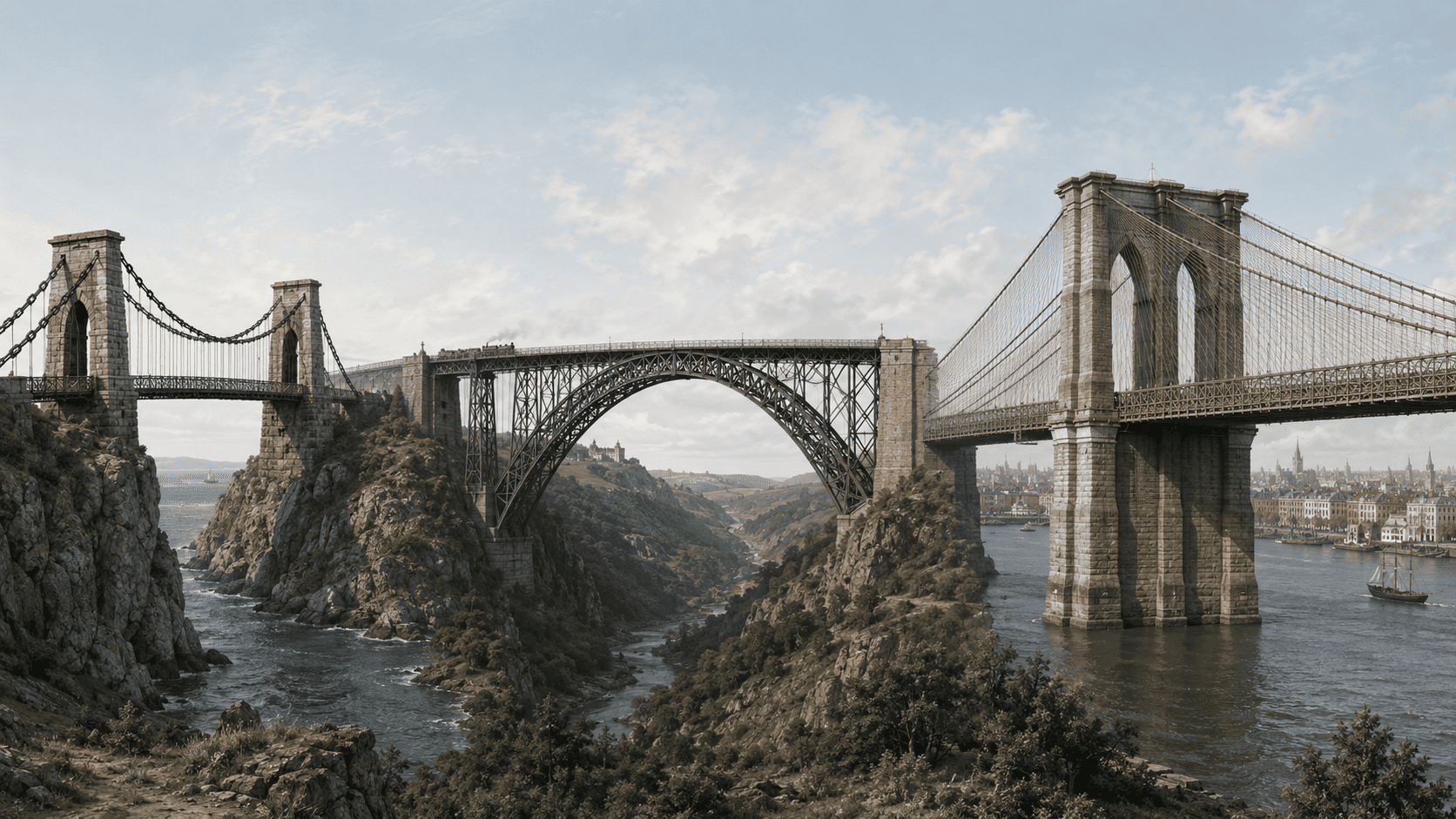
Gustave Eiffel was far more than the engineer associated with the Eiffel Tower. He built his reputation through innovative metal structures that combined strength, economy, and visual clarity. The Maria Pia Bridge over Portugal’s Douro River used a sweeping iron arch to cross a deep valley, while France’s Garabit Viaduct refined the same structural idea on a larger scale. Together, these projects demonstrated Eiffel’s command of iron construction and helped advance long-span arch bridge design in the nineteenth century.
Othmar Ammann
Othmar Ammann was one of the most influential bridge engineers of the twentieth century, shaping New York’s skyline and transportation network through bold, economical designs. His George Washington Bridge set a new standard for long-span suspension bridges, combining immense scale with structural simplicity. He also designed the Bayonne Bridge, whose steel arch was among the world’s longest when completed. Ammann’s work helped define modern American bridge engineering and influenced generations of designers working with suspension and arch systems.
Conde McCullough
Conde McCullough designed many landmark bridges along Oregon’s U.S. Route 101, giving the coastal highway a distinctive regional identity. He combined practical reinforced-concrete structures with graceful arches, decorative details, and carefully proportioned forms. The Yaquina Bay Bridge is a leading example, blending engineering efficiency with an appearance designed to complement its dramatic coastal setting.
Robert Maillart
Robert Maillart transformed reinforced-concrete bridge design by treating structure and appearance as a single problem. Rather than hiding heavy supports beneath decorative forms, he used thin slabs, curved arches, and hollow structural elements to reduce material while making loads visually understandable. His Salginatobel Bridge in Switzerland is still studied because its slender three-hinged concrete arch follows the flow of forces with remarkable clarity. The result shows how engineering efficiency can produce lasting architectural elegance.
John Roebling
John Roebling helped transform suspension bridge engineering by developing strong wire-rope cables capable of supporting longer and heavier spans. His most famous project, the Brooklyn Bridge, combined steel-wire suspension cables, masonry towers, and diagonal stays to create a rigid and durable crossing over the East River. Although Roebling died before construction began, his structural concept guided the project under his son Washington Roebling. The bridge demonstrated the possibilities of steel cable systems and influenced later generations of long-span suspension bridge engineers.
Joseph Strauss
Joseph Strauss served as chief engineer of the Golden Gate Bridge, coordinating the complex effort that turned the crossing into one of America’s defining infrastructure projects. Although the bridge was the work of a broader team—including engineers Charles Alton Ellis and Leon Moisseiff, architect Irving Morrow, and others—Strauss guided its development and public promotion. Completed in 1937, the bridge demonstrated the scale, durability, and visual impact possible in modern suspension design, becoming a model for major long-span crossings.
Zaha Hadid
Zaha Hadid approached bridge design as architecture in motion, using flowing lines and dramatic forms to give infrastructure a strong visual identity. Her Sheikh Zayed Bridge in Abu Dhabi features sweeping steel arches that rise and fall like desert dunes, creating a dynamic profile across the channel. Rather than functioning only as a transportation link, the bridge acts as an urban landmark, showing how large-scale engineering can also express movement, place, and architectural character.
Fritz Leonhardt
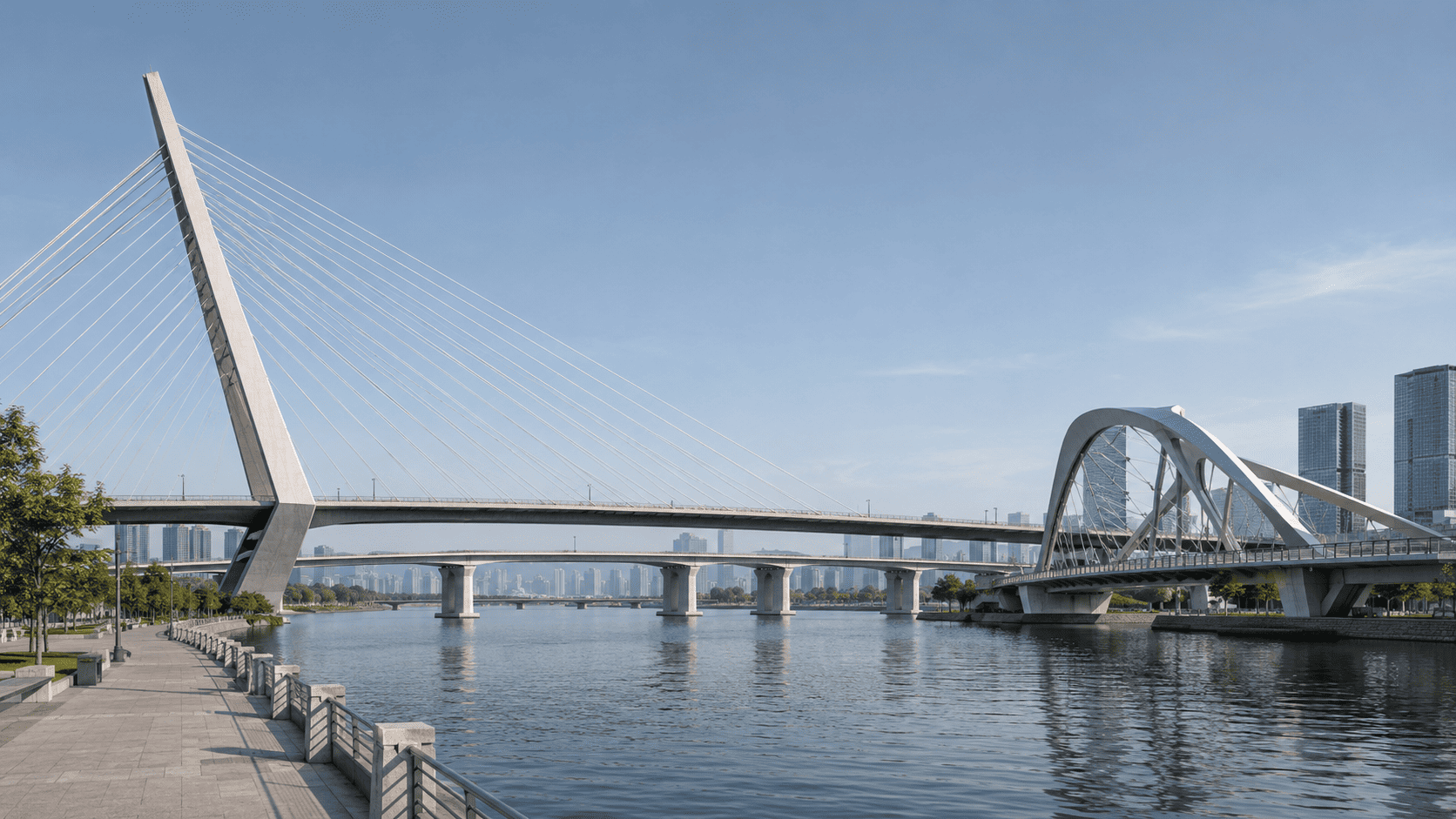
Fritz Leonhardt shaped postwar bridge engineering through advances in cable-stayed systems, prestressed concrete, and lightweight structural design. He promoted slender decks, efficient load paths, and restrained forms that reduced unnecessary material without sacrificing strength. His work helped establish the modern cable-stayed bridge as a practical option for major crossings. Leonhardt’s technical approach showed that structural economy and visual lightness could reinforce each other rather than compete.
Jörg Schlaich
Jörg Schlaich was known for lightweight structures that made complex engineering appear clear and economical. His bridges often used slender cables, masts, and tensioned elements to carry loads with minimal material. In pedestrian projects, he also considered movement, views, and the rhythm of crossing. By combining structural experimentation with human-centered design, he showed that technical innovation could improve both performance and the user experience.
William Christopher Brown
William Christopher Brown advanced suspension bridge design through the streamlined steel box-girder deck, an aerodynamic cross-section that reduces wind resistance and structural weight. Applied to the Severn Bridge, this approach replaced the deeper trussed decks common on earlier spans. By improving stability against wind-induced movement, Brown’s work influenced later long-span bridges, including the Bosphorus and Humber crossings.
Ralph Modjeski
Ralph Modjeski became one of the most influential American bridge engineers of the late nineteenth and early twentieth centuries. As both designer and consultant, he contributed to major crossings over the Mississippi, Delaware, and other waterways, including the Benjamin Franklin Bridge. His work combined practical construction knowledge with increasingly ambitious steel spans. Modjeski also trained and influenced younger engineers, extending his impact beyond the bridges that carried his name.
Isambard Kingdom Brunel
Isambard Kingdom Brunel was a central figure in the Industrial Revolution, helping transform British transportation through railways, steamships, tunnels, and bridges. The Clifton Suspension Bridge, designed to span the Avon Gorge, became the clearest expression of his ambition in bridge engineering. Its long suspended roadway and dramatic setting demonstrated how infrastructure could overcome difficult terrain while creating a memorable landmark. Although completed after Brunel’s death, the bridge preserved his vision and influenced the public image of Victorian engineering for generations.
James Buchanan Eads
James Buchanan Eads was a pioneering American engineer whose work expanded bridge construction in the nineteenth century. His Eads Bridge across the Mississippi River at St. Louis used steel arches when iron was still more common in major structures. Completed in 1874, it also relied on deep pneumatic caissons for its foundations. The project combined new materials, demanding construction methods, and an ambitious span, establishing Eads as a major figure in American civil engineering.
How Famous Bridge Designers Changed Engineering and Architecture
Famous bridge designers transformed transportation by making crossings longer, lighter, safer, and more visually meaningful. Advances in steel cables, reinforced concrete, segmental construction, and aerodynamic decks allowed engineers to span wider rivers and valleys with fewer supports.
Improved understanding of wind, load distribution, and structural movement increased stability in increasingly ambitious bridges. At the same time, architects and engineers began treating bridges as parts of the urban landscape rather than purely functional structures. Their work established a lasting model in which technical performance, material efficiency, public identity, and architectural expression could be developed together.
Related Entries: