
14 Famous Tunnels Around the World
Famous tunnels stand out for very different reasons. Some set records for length, while others are remembered for the difficulty of building through mountains, beneath seas, or across unstable ground. A few changed the history of underground construction, and others became notable because they combine unusual functions or create a distinctive visual experience.
This selection brings together railway, road, undersea, hydraulic, and scientific tunnels from different periods and regions. Together, they show how engineers have used underground space to improve transportation, manage water, protect cities, connect isolated communities, and support research that could not take place on the surface.
Famous Tunnels at a Glance
| Tunnel | Country | Type | Main Use | Known For |
|---|---|---|---|---|
| Gotthard Base Tunnel | Switzerland | Rail | Passenger and freight | Longest railway tunnel |
| Channel Tunnel | England/France | Undersea rail | International travel | Linking Britain and continental Europe |
| Lærdal Tunnel | Norway | Road | Highway traffic | Longest road tunnel |
| Tokyo Bay Aqua-Line | Japan | Tunnel-bridge system | Highway traffic | Artificial island and hybrid design |
| Eisenhower Tunnel | United States | Mountain road | Interstate traffic | High-altitude Continental Divide crossing |
| Spiralen Tunnel | Norway | Spiral road | Recreational access | Helical route inside a mountain |
| Guoliang Tunnel Road | China | Cliff road | Village access | Hand-carved rock openings |
| SMART Tunnel | Malaysia | Road/stormwater | Traffic and flood control | Dual-purpose urban infrastructure |
| Bund Sightseeing Tunnel | China | Tourist tunnel | Visitor transit | Light and sound effects |
| Seikan Tunnel | Japan | Undersea rail | Inter-island travel | Long submarine rail section |
| Marmaray Tunnel | Turkey | Immersed rail | Urban transit | Europe-Asia connection |
| Thames Tunnel | England | Under-river rail | Urban rail | First navigable-river tunnel |
| Hezekiah’s Tunnel | Jerusalem | Water tunnel | Water supply | Ancient hydraulic engineering |
| Large Hadron Collider Tunnel | France/Switzerland | Scientific | Particle research | Circular accelerator underground |
1. Gotthard Base Tunnel, Switzerland
The Gotthard Base Tunnel carries high-speed passenger and freight trains beneath the Swiss Alps on a nearly level route between Erstfeld and Bodio. A base tunnel passes through the lower part of a mountain range, reducing steep grades and allowing trains to move faster while using less energy. Opened in 2016, the 35.5-mile tunnel is the world’s longest railway tunnel.
Its construction required engineers to excavate through several types of Alpine rock, manage intense heat underground, and work beneath as much as approximately 7,500 feet of mountain. Most excavation was completed with tunnel boring machines, enormous rotating machines that cut through rock while helping install the tunnel lining.
By creating a more direct north-south rail corridor, the Gotthard Base Tunnel shortened travel times and increased freight capacity between northern and southern Europe. It also supports Switzerland’s effort to move heavy cargo from highways to rail, reducing road traffic through sensitive Alpine regions.
2. Channel Tunnel, England and France
The Channel Tunnel provides a permanent rail link between Folkestone in England and Coquelles near Calais in France. Opened in 1994, it carries Eurostar passenger trains, freight trains, and shuttle trains that transport cars and trucks beneath the English Channel.
The system consists of three parallel bores: two single-track rail tunnels and a smaller service tunnel between them. Cross-passages connect the service tunnel to the rail tunnels, providing access for maintenance and emergencies. The entire tunnel is about 31.4 miles long, while approximately 23.5 miles run beneath the seabed. That distinction matters because the Channel Tunnel is especially notable for the length of its undersea section, not for being the world’s longest railway tunnel overall.
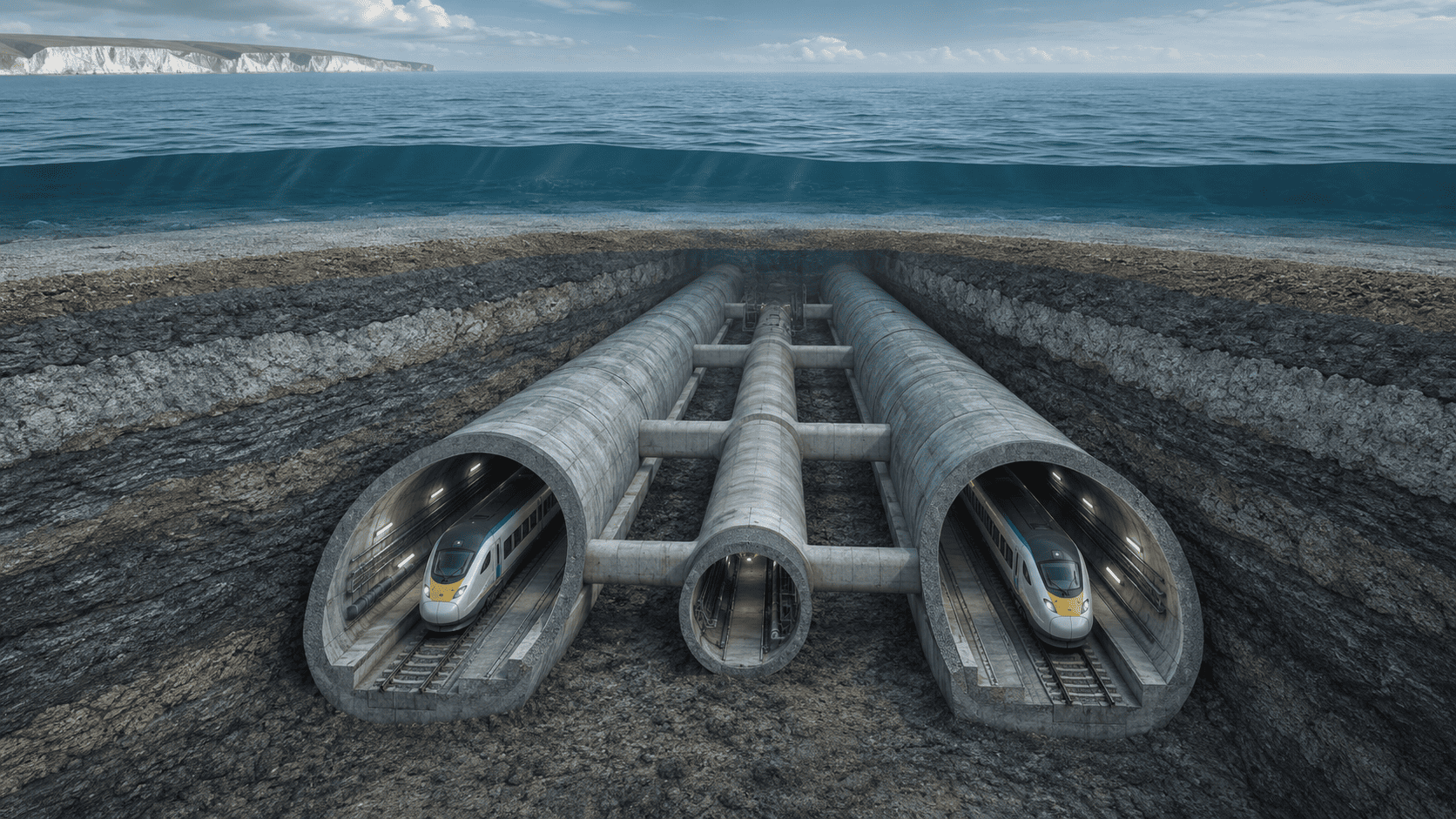
By replacing part of the sea crossing with direct rail travel, the tunnel transformed movement between Britain and continental Europe. It supports high-speed passenger service, international freight, and vehicle transport while avoiding weather-related delays associated with ferries. Its scale, safety systems, and cross-border coordination made it one of the defining European infrastructure projects of the twentieth century.
3. Lærdal Tunnel, Norway
The Lærdal Tunnel carries the E16 highway between Lærdal and Aurland in western Norway. Opened in 2000, it extends 15.2 miles (24.5 kilometers), making it the world’s longest road tunnel. Its scale presented not only ventilation and fire-safety challenges, but also a human one: how to keep drivers attentive during a journey lasting about 20 minutes underground.
To reduce monotony, engineers divided the route into four sections with three large rock caverns. Blue and yellow lighting gives these spaces the appearance of daylight entering through a mountain opening, creating visual breaks that help drivers judge their progress. Gentle curves also prevent the roadway from becoming one seemingly endless straight line.
A mechanical ventilation system moves air through the tunnel, while monitoring equipment helps operators manage traffic and emergencies. These features make Lærdal notable not simply for its length, but for treating driver comfort and concentration as essential parts of tunnel engineering.
4. Tokyo Bay Aqua-Line, Japan
The Tokyo Bay Aqua-Line is not a single tunnel but a 9.4-mile highway system linking Kawasaki and Kisarazu across Tokyo Bay. Opened in 1997, it combines an approximately 6-mile underwater tunnel on the Kawasaki side with a 2.7-mile bridge approaching Kisarazu.
The two sections meet at Umihotaru, an artificial island built above the bay. It serves as a rest area, observation point, and transition between the enclosed tunnel and the elevated bridge. A separate artificial ventilation structure, known as Kaze no Tō, helps move air through the underwater roadway.
This hybrid design allowed engineers to preserve major shipping routes while avoiding a bridge across the entire bay. The Aqua-Line shortened the road journey between the two shores and created a more direct connection between communities around the Tokyo metropolitan region. Its combination of tunnel, bridge, and engineered islands makes it one of the world’s most recognizable cross-bay transportation projects.
5. Eisenhower Tunnel, Colorado
The Eisenhower–Johnson Memorial Tunnel carries Interstate 70 beneath the Continental Divide about 60 miles west of Denver. Its twin bores extend roughly 1.7 miles through the Rocky Mountains at an average elevation of 11,112 feet, making the crossing one of the highest major highway tunnels in the United States.
The westbound Eisenhower Bore opened in 1973, followed by the eastbound Johnson Bore in 1979. Construction crews faced unstable rock, groundwater, low temperatures, and the reduced oxygen levels associated with high-altitude work. Large sections required steel and concrete supports to control movement within the mountain.
Operating the tunnel remains demanding. Heavy snowfall, ice, rapidly changing weather, and peak ski-season traffic require continuous monitoring, ventilation, snow removal, and emergency planning. By providing a direct route under the divide, the tunnel avoids the steeper and more exposed journey over Loveland Pass and keeps a vital east-west freight and travel corridor open through Colorado’s mountains.
6. Spiralen Tunnel, Norway
The Spiralen Tunnel winds upward through Bragernesåsen, a hill overlooking Drammen, Norway. Instead of following a straight route, the road forms six broad loops inside the rock, gaining about 535 feet in elevation before reaching the summit. This helical design allows vehicles to climb gradually within a limited horizontal area.
Construction began partly to obtain stone for roads and other local projects. The excavation also created a direct route to the hilltop, where visitors can access walking trails, viewpoints, and recreational areas above the city.
Spiralen is not famous for exceptional length or heavy traffic capacity. Its appeal comes from the unusual experience of driving through a mountain in a continuous spiral and emerging at an elevated landscape overlooking Drammen.
7. Guoliang Tunnel Road, China
The Guoliang Tunnel Road was carved through the Taihang Mountains in Henan Province to connect the isolated village of Guoliang with the outside world. Before its construction, residents depended on a steep and difficult mountain path for access.
Beginning in 1972, local villagers excavated the route largely by hand, using hammers, chisels, and basic tools. The tunnel opened to traffic in 1977 after years of demanding work through solid rock. Irregular openings cut into the cliff face provided daylight, ventilation, and places to remove excavated material. They also created the road’s distinctive appearance along the mountainside.
The project is famous because it represents community-built infrastructure rather than a large government engineering program. Its narrow roadway, rough rock surfaces, and exposed cliffside location reflect the limitations under which it was constructed. More importantly, the tunnel gave residents a practical vehicle connection and reduced the village’s geographic isolation.
8. SMART Tunnel, Malaysia
Kuala Lumpur’s SMART Tunnel combines a roadway with a stormwater diversion system in one underground structure. SMART stands for Stormwater Management and Road Tunnel. Its highway section helps reduce traffic congestion near the city center, while the larger tunnel can redirect floodwater away from areas vulnerable to flash flooding.
During normal conditions, vehicles use two enclosed roadway decks, and a lower channel carries limited stormwater. During moderate storms, additional water can pass through the drainage section while traffic continues above. When severe flooding threatens, authorities close the road, remove vehicles, and allow the full tunnel—including the traffic decks—to carry water toward holding ponds and a discharge reservoir.
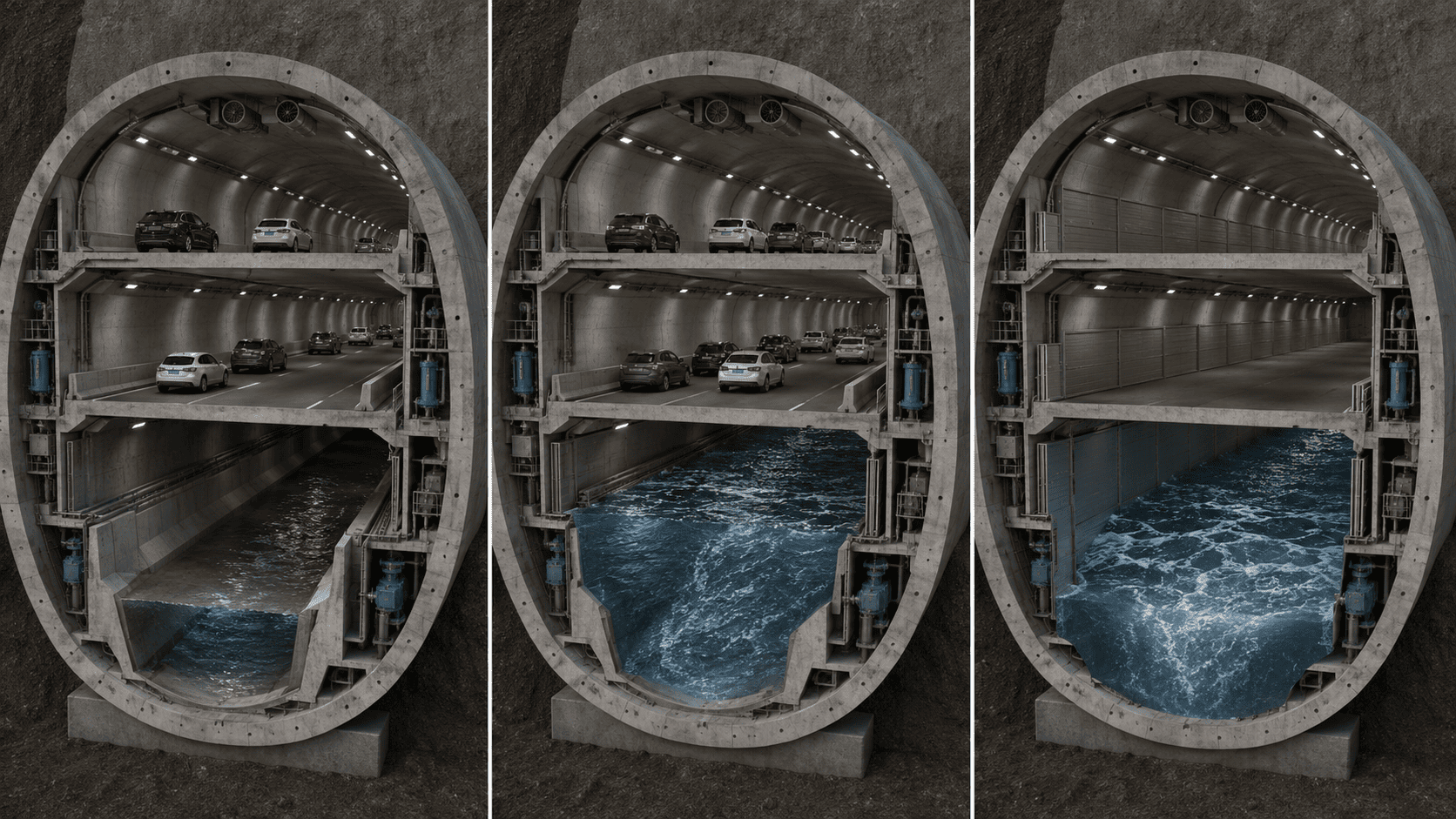
This operating system requires coordinated forecasting, traffic control, gates, pumps, ventilation, and emergency procedures. SMART is unusual because the same underground space addresses two urban problems that are normally handled by separate projects. Its adaptable design allows valuable infrastructure to serve daily transportation needs while providing additional capacity during major storms.
9. Bund Sightseeing Tunnel, Shanghai
The Bund Sightseeing Tunnel runs beneath the Huangpu River between Shanghai’s historic Bund and the Lujiazui financial district. Unlike a subway or major transportation tunnel, it operates primarily as a short tourist attraction using small automated passenger cars.
Its reputation comes from the journey itself. As the cars move underground, colored lights, projected images, sound effects, and illuminated displays create a staged audiovisual experience. The ride offers a distinctive way to cross between two of Shanghai’s best-known waterfront areas, but it serves a different purpose from the large rail and highway tunnels elsewhere on this list.
The Bund Sightseeing Tunnel is therefore famous for presentation and visitor experience rather than exceptional length, construction depth, or transportation capacity.
10. Seikan Tunnel, Japan
The Seikan Tunnel carries passenger and freight trains between Japan’s main island of Honshu and Hokkaido beneath the Tsugaru Strait. Opened in 1988, it extends about 33.5 miles, including a roughly 14.5-mile section beneath the seabed. Its lowest point lies approximately 787 feet below sea level, making the project notable for both its total length and depth.
Construction was complicated by fractured volcanic rock, heavy groundwater inflows, and the difficulty of investigating geology beneath an active marine channel. Rather than relying mainly on tunnel boring machines, crews used drilling, blasting, grouting, and advance pilot tunnels to locate weak ground and reduce water leakage.
The tunnel created a weather-independent rail connection between the two islands, replacing part of the reliance on ferries across a strait known for severe conditions. Although the Gotthard Base Tunnel later surpassed it in overall railway-tunnel length, Seikan retains one of the world’s longest undersea tunnel sections and remains a major achievement in marine engineering.
11. Marmaray Tunnel, Turkey
The Marmaray Tunnel carries commuter and intercity trains beneath the Bosphorus in Istanbul, creating a continuous rail connection between Europe and Asia. Opened in 2013, the central crossing combines land tunnels with a 0.9-mile immersed-tube section placed in a prepared trench on the seabed.
An immersed tunnel is assembled from prefabricated watertight sections that are floated into position, lowered underwater, joined together, and covered for protection. This method allowed construction beneath one of the world’s busiest waterways without blocking major shipping traffic.
Because Istanbul lies in an active seismic region, engineers designed the tunnel with flexible joints, waterproof connections, and systems intended to withstand strong ground movement. The crossing also required careful control of currents, seabed conditions, and archaeological discoveries near the construction sites. By integrating suburban rail lines on both sides of Istanbul, Marmaray improved urban transportation while establishing a direct railway route between two continents.
12. Thames Tunnel, London
The Thames Tunnel runs beneath the River Thames between Rotherhithe and Wapping in London. Completed in 1843, it was the first tunnel successfully built beneath a navigable river and marked a major advance in underground construction.
Engineer Marc Isambard Brunel used a tunneling shield, a large movable framework divided into working compartments. Miners excavated small sections of soil from within the shield while bricklayers constructed the tunnel lining behind them. This method provided more support than digging an unsupported opening through soft, waterlogged ground.
Construction remained hazardous. The river broke into the works several times, causing major delays, injuries, and deaths. Financial problems also halted the project for years.
Although it opened originally for pedestrians rather than trains, the Thames Tunnel later became part of London’s railway network. Its shield demonstrated a practical approach to tunneling through unstable soil and influenced the protective systems used in later subway, river, and transportation tunnels.
13. Hezekiah’s Tunnel, Jerusalem
Hezekiah’s Tunnel is an ancient water channel carved through bedrock beneath the City of David in Jerusalem. Extending about 1,750 feet, it redirected water from the Gihon Spring to the Pool of Siloam, helping protect the city’s water supply during periods of conflict. The tunnel is traditionally associated with the reign of King Hezekiah in the late eighth century BCE.
Its winding route remains especially intriguing because excavation teams appear to have worked from opposite ends and met underground. Without modern surveying equipment, maintaining direction through solid rock would have required careful planning, sound-based guidance, or methods that remain debated.
An inscription discovered near the southern end describes the moment when the two groups broke through and joined their passages. The tunnel continues to interest archaeologists and historians because its construction, chronology, and irregular alignment offer rare evidence of ancient hydraulic engineering.
14. Large Hadron Collider Tunnel, France and Switzerland
The Large Hadron Collider occupies a circular underground tunnel near Geneva that crosses the border between France and Switzerland. Unlike transportation tunnels, its purpose is scientific: the 16.7-mile ring houses a particle accelerator that sends proton beams in opposite directions at nearly the speed of light.
Powerful magnets guide and focus the beams before directing them into collisions inside large detectors. These experiments help researchers study fundamental particles and the forces that shape matter.
Exceptional precision was essential during installation. Small alignment errors could keep the beams from following the intended path or meeting correctly at collision points. Engineers also had to control vibration, temperature, groundwater, and the placement of thousands of interconnected components. The tunnel shows how underground engineering can support advanced scientific research rather than transportation or water systems.
Why These Famous Tunnels Still Matter
These tunnels show how underground engineering solves problems that surface routes cannot. Some shorten journeys through mountains or beneath seas, while others protect cities from flooding, secure water supplies, or create space for scientific equipment.
Their importance is not limited to size or records. Each project responds to geography, climate, geology, population growth, or technological ambition. Engineers had to manage unstable rock, water pressure, ventilation, safety, seismic risk, and human behavior under conditions that allowed little room for error.
Together, these examples reveal how tunnels connect regions, strengthen urban resilience, preserve resources, and support discoveries beyond transportation. They also demonstrate that successful infrastructure depends on matching construction methods to a specific environment and public need.
Related Entries: