
Undersea Tunnel: Types, Advantages, Challenges, and Notable Examples
An undersea tunnel is a transportation or utility passage built beneath the seabed to connect places separated by a sea, strait, bay, or coastal channel. Depending on its design, it may carry passenger trains, freight rail, cars, buses, maintenance vehicles, pipelines, cables, or other essential services. These tunnels are typically chosen where a bridge would interfere with shipping lanes, require excessively tall approaches, or create major visual and environmental impacts, and where ferry service would be too slow, weather-dependent, or limited in capacity.
The term undersea tunnel usually refers specifically to a structure constructed below the sea or seabed. Underwater tunnel is broader and may also describe tunnels beneath rivers, harbors, estuaries, and lakes. Although the terms are often used interchangeably, the distinction helps clarify the setting of a project. In practice, the feasibility of an undersea tunnel depends on geology, water depth, route length, traffic demand, construction technology, and the long-term cost of operation and maintenance.
Types of Undersea Tunnels
Undersea tunnels are generally classified by how they are built and supported. The choice depends on water depth, geology, crossing length, navigation requirements, environmental constraints, and the type of traffic the tunnel must carry.
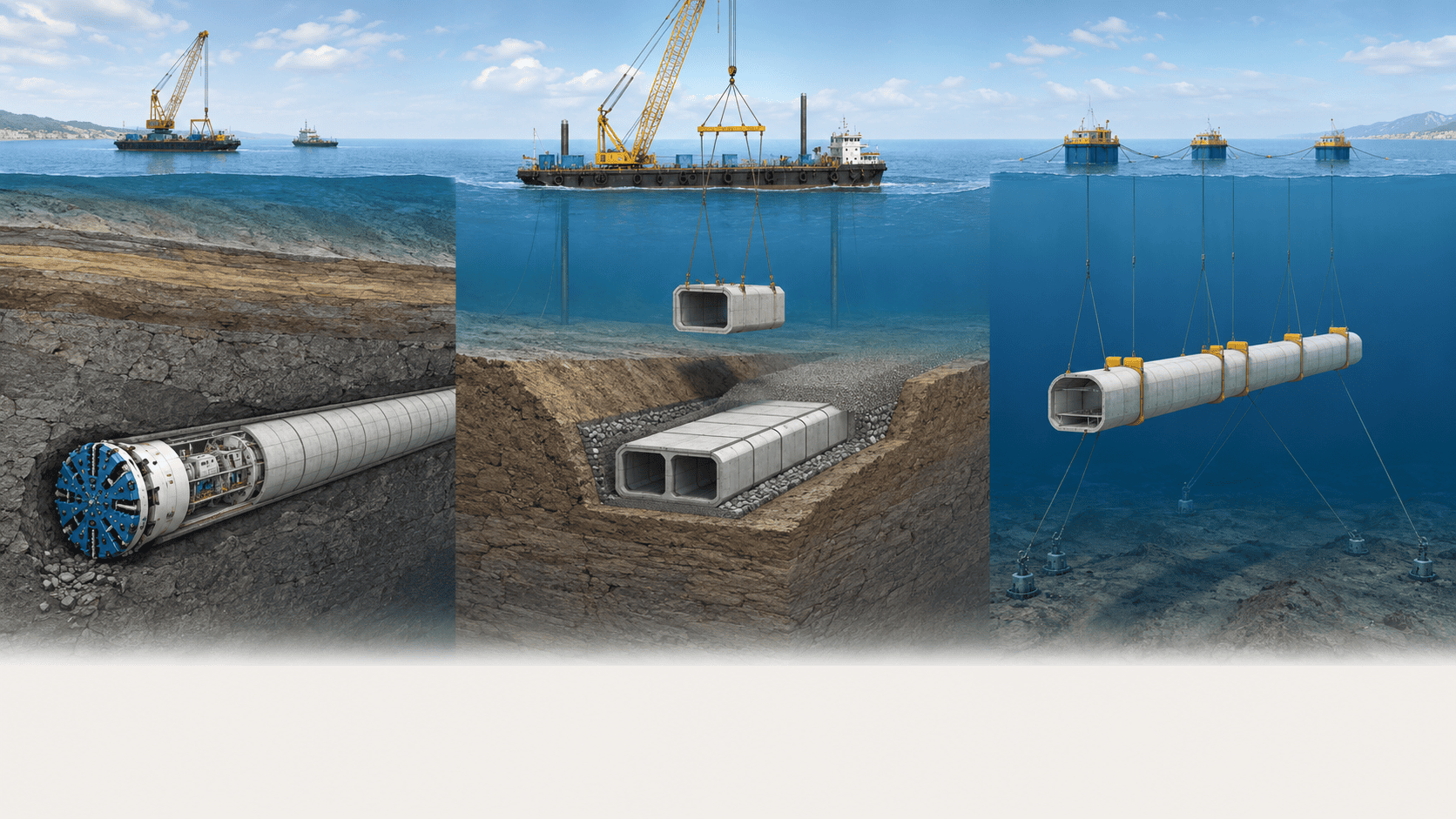
Bored Tunnels
Bored tunnels are excavated through rock or soil beneath the seabed. Modern projects commonly use tunnel boring machines, or TBMs, which cut through the ground while installing prefabricated lining segments behind the excavation face. These segments form a strong, watertight shell that resists groundwater pressure and protects the tunnel over its operating life.
Where the geology is too hard, fractured, or irregular for continuous machine excavation, engineers may use drilling and controlled blasting. Bored tunnels are well suited to deep or long crossings because they can pass below shipping channels without disturbing the seabed directly. The Seikan Tunnel in Japan and the Channel Tunnel between the United Kingdom and France are major examples of undersea tunnels built through excavation below the sea floor.
Immersed Tube Tunnels
Immersed tube tunnels are assembled from large prefabricated sections, usually made of reinforced concrete or steel. Each section is built in a dry dock, sealed temporarily, and floated to the crossing site. Engineers excavate a trench in the seabed, lower the sections into position, connect them underwater, and seal the joints.
Once installation is complete, the tunnel is covered with protective material to stabilize it and shield it from anchors, currents, and other external forces. This method is often used in relatively shallow bays, harbors, rivers, and coastal channels, especially where direct access from both shores is practical.
Submerged Floating Tunnels
A submerged floating tunnel would be suspended within the water rather than buried beneath the seabed. Buoyancy would support the structure, while cables, seabed anchors, or pontoons would hold it in a stable position.
This concept could reduce the need for deep excavation in fjords or very deep waters, where conventional tunnels or bridges may be difficult to build. Unlike bored and immersed tube tunnels, however, submerged floating tunnels remain largely conceptual. Their design must account for waves, currents, vessel impacts, structural movement, maintenance access, and long-term safety before widespread construction becomes practical.
Advantages of Undersea Tunnels
Undersea tunnels can provide a more reliable and less intrusive crossing than bridges or ferries when navigation, weather, urban development, or transport capacity are major concerns.
Compared With Bridges
An undersea tunnel keeps shipping lanes fully open because vessels can pass above the route without clearance restrictions. Bridges across busy waterways often require tall towers, long approach spans, or movable sections to allow large ships through. Those features can increase construction complexity, occupy valuable waterfront land, and create visual barriers in coastal cities.
Tunnels are also less exposed to strong winds, storms, and icing, which can disrupt bridge traffic or require temporary closures. Because the structure remains below the water and surrounding landscape, it can reduce visual impact and avoid elevated roadways near residential districts, airports, and ports. This makes an undersea tunnel especially useful where bridge height could interfere with aircraft operations or where fixed spans would restrict navigation.
Compared With Ferry Links
A tunnel creates a permanent connection rather than a scheduled service. Cars, trains, or freight can move through it continuously, without waiting for a vessel to arrive, load, cross, and unload. This reduces delays and supports more frequent, predictable travel.
Undersea tunnels are generally less dependent on rough seas, fog, high winds, and tidal conditions than ferry operations. They can also connect directly with existing highways or rail networks, improving capacity and making transfers unnecessary. For heavily traveled corridors, this continuous flow can support commuting, freight movement, and regional trade more efficiently than a ferry system.
Although construction requires a major initial investment, a tunnel can provide a high-capacity fixed link for decades where traffic demand is strong enough to justify it.
Disadvantages and Engineering Challenges
Despite their operational benefits, undersea tunnels are among the most demanding transport structures to plan, build, and maintain.
Compared With Bridges
A tunnel requires extensive geological and geotechnical investigations before construction can begin. Engineers must identify weak rock, fault zones, unstable sediments, groundwater pathways, and other conditions that could threaten excavation. If the geology is unsuitable, costs can rise sharply or the route may need to change.
Underground construction also limits access to the work area and makes emergencies more difficult to manage. Ventilation, drainage, lighting, fire protection, communications, and evacuation systems must operate continuously. Repairs are often slower and more disruptive than on a bridge because damaged components may be difficult to reach. These factors can result in longer construction schedules and higher technical risk.
Compared With Ferry Links
An undersea tunnel requires far greater initial investment than a ferry service. It may take years of studies, approvals, financing, and construction before the crossing opens. Once built, the route cannot be relocated if travel patterns or economic conditions change.
This lack of flexibility creates financial risk when projected traffic fails to materialize. Operators must also fund specialized maintenance, inspections, pumping systems, control centers, and emergency services throughout the tunnel’s life. A ferry route, by contrast, can often be expanded, reduced, or redirected more easily.
Water Pressure, Ventilation, and Emergency Safety
Hydrostatic pressure—the force exerted by surrounding water—increases with depth and places continuous stress on linings, joints, and seals. Water infiltration through fractures or construction joints must be controlled by waterproof barriers, drainage channels, and pumping stations.
Fault zones, soft ground, and seismic activity can complicate both excavation and long-term stability. In road tunnels, ventilation systems must remove vehicle emissions during normal operation and smoke during a fire. Safe evacuation may require cross-passages, protected service tunnels, emergency exits, and clearly separated escape routes.
Continuous monitoring is also essential. Sensors can detect structural movement, leakage, equipment failure, or unusual pressure changes. Corrosion caused by moisture and salt exposure adds another long-term challenge, particularly for steel components, electrical systems, and ventilation equipment.
List of Notable Undersea Tunnels
Undersea tunnels carry road traffic, passenger and freight trains, utilities, or combinations of these uses. Their dimensions are not always directly comparable: a published “total length” may include land approaches, while the undersea length covers only the portion beneath the water or seabed. Depth figures may also refer to distance below the water surface, sea level, or seabed. The table separates these measurements where reliable figures are commonly available; a dash indicates that a consistent separate value is not widely reported.
| Tunnel | Location | Body of Water | Primary Use | Construction Type | Total Length | Undersea Length | Maximum Depth | Opened | Why It Is Notable |
|---|---|---|---|---|---|---|---|---|---|
| Thames Tunnel | London, England | River Thames | Rail, originally pedestrian | Shield-bored | 0.40 km | — | — | 1843 | First completed tunnel beneath a navigable river. |
| Mersey Railway Tunnel | Liverpool–Birkenhead, England | River Mersey | Rail | Bored | 1.21 km | — | — | 1886 | One of the earliest underwater railway tunnels. |
| Severn Tunnel | England–Wales | Severn Estuary | Rail | Bored | 7.01 km | — | — | 1886 | Major early rail link beneath a tidal estuary. |
| Blackwall Tunnel, northbound | London, England | River Thames | Road | Shield-bored | 1.35 km | — | — | 1897 | Among the earliest underwater road tunnels. |
| Old Elbe Tunnel | Hamburg, Germany | River Elbe | Road and pedestrian | Shield-bored | 0.43 km | — | 24 m | 1911 | Pioneering vehicle and pedestrian crossing with elevators. |
| Holland Tunnel | New York–New Jersey, U.S. | Hudson River | Road | Shield-bored | 2.60 km | — | 28.3 m | 1927 | First long road tunnel with mechanical ventilation. |
| Detroit–Windsor Tunnel | Michigan–Ontario | Detroit River | Road | Immersed tube | 1.57 km | — | 13.7 m | 1930 | International road connection between the United States and Canada. |
| Queensway Tunnel | Liverpool–Birkenhead, England | River Mersey | Road | Bored | 3.24 km | — | — | 1934 | World’s longest road tunnel when completed. |
| Bankhead Tunnel | Mobile, Alabama, U.S. | Mobile River | Road | Immersed tube | 1.03 km | — | 12.2 m | 1941 | Includes flood-control doors for storm protection. |
| Kanmon Railway Tunnel | Honshu–Kyushu, Japan | Kanmon Straits | Rail | Bored | 3.60 km | — | — | 1942 | Japan’s first undersea railway tunnel. |
| Lincoln Tunnel | New York–New Jersey, U.S. | Hudson River | Road | Shield-bored | 2.40 km average | — | 30 m | 1937–1957 | Three-tube crossing built in successive stages. |
| Kanmon Roadway Tunnel | Honshu–Kyushu, Japan | Kanmon Straits | Road and pedestrian | Bored | 3.46 km | — | 58 m | 1958 | Once the world’s longest undersea road tunnel. |
| George Massey Tunnel | British Columbia, Canada | Fraser River | Road | Immersed tube | 0.63 km | — | 23 m | 1959 | First immersed-tube tunnel built in British Columbia. |
| Chesapeake Bay Bridge–Tunnel | Virginia, U.S. | Chesapeake Bay | Road | Immersed tubes | 1.6 km per tunnel | 3.2 km combined | — | 1964 | Combines bridges, artificial islands, and two tunnels. |
| Muskö Tunnel | Muskö, Sweden | Baltic coastal waters | Road | Drill-and-blast | 2.90 km | — | 65 m | 1964 | Connected a strategically important island to the mainland. |
| Transbay Tube | San Francisco–Oakland, U.S. | San Francisco Bay | Metro rail | Immersed tube | 5.80 km | 5.80 km | 41 m | Long underwater rapid-transit tube carrying BART trains. | |
| Cross-Harbour Tunnel | Hong Kong | Victoria Harbour | Road | Immersed tube | 1.86 km | — | — | 1972 | Hong Kong’s first fixed road crossing beneath the harbor. |
| Vardø Tunnel | Vardø, Norway | Bussesundet | Road | Drill-and-blast | 2.89 km | — | 88 m | 1982 | Norway’s first undersea road tunnel. |
| Seikan Tunnel | Honshu–Hokkaido, Japan | Tsugaru Strait | Rail | Drill-and-blast | 53.85 km | 23.30 km | 240 m | Longest tunnel overall with a major undersea section. | |
| Sydney Harbour Tunnel | Sydney, Australia | Sydney Harbour | Road | Immersed tube | 2.80 km | — | — | 1992 | Added a second major road crossing beside the harbor bridge. |
| Byfjord Tunnel | Stavanger, Norway | Byfjorden | Road | Drill-and-blast | 5.88 km | — | 223 m | Set a road-tunnel depth record when opened. | |
| Channel Tunnel | England–France | English Channel | Rail | TBM-bored | 50.45 km | About 37 km | About 115 m | 1994 | World’s longest continuous undersea railway section. |
| Hitra Tunnel | Trøndelag, Norway | Trondheimsleia | Road | Drill-and-blast | 5.65 km | — | 264 m | Deepest undersea road tunnel at its opening. | |
| Tokyo Bay Aqua-Line Tunnel | Kawasaki, Japan | Tokyo Bay | Road | Shield-bored | 9.6 km | About 9.6 km | About 60 m | 1997 | Forms the tunnel half of a bridge–tunnel expressway. |
| Great Belt Railway Tunnel | Zealand–Sprogø, Denmark | Great Belt | Rail | TBM-bored | 8.02 km | — | 80 m | Rail component of Denmark’s Great Belt fixed link. | |
| North Cape Tunnel | Magerøya, Norway | Magerøysundet | Road | Drill-and-blast | 6.87 km | — | 212 m | Provides year-round road access toward North Cape. | |
| Bømlafjord Tunnel | Vestland, Norway | Bømlafjorden | Road | Drill-and-blast | 7.89 km | — | 260 m | Deep subsea section of the Triangle Link. | |
| Eiksund Tunnel | Møre og Romsdal, Norway | Eiksund Strait | Road | Drill-and-blast | 7.77 km | — | 287 m | Former world depth record holder for road tunnels. | |
| Busan–Geoje Fixed Link Tunnel | Busan–Geoje, South Korea | Geoje Strait | Road | Immersed tube | 3.70 km | 3.70 km | 48 m | Exceptionally deep immersed-tube crossing. | |
| Qingdao Jiaozhou Bay Tunnel | Qingdao, China | Jiaozhou Bay | Road | Drill-and-blast | 7.81 km | — | 84 m | Major highway connection beneath Jiaozhou Bay. | |
| Marmaray Tunnel | Istanbul, Turkey | Bosphorus | Rail | Immersed tube and bored | 13.6 km | 1.39 km | About 60 m | 2013 | Rail link joining Europe and Asia beneath the Bosphorus. |
| Marina Coastal Expressway Tunnel | Singapore | Marina Bay | Road | Cut-and-cover and immersed works | 5.0 km | — | — | 2013 | Singapore’s first road tunnel extending beneath the seabed. |
| Port of Miami Tunnel | Miami, Florida, U.S. | Government Cut | Road | TBM-bored | 2.1 km | — | About 37 m | 2014 | Diverts port trucks away from downtown streets. |
| Eurasia Tunnel | Istanbul, Turkey | Bosphorus | Road | TBM-bored | 5.4 km | 3.34 km | 106 m | First highway tunnel directly linking Europe and Asia. | |
| Hong Kong–Zhuhai–Macau Tunnel | Pearl River estuary, China | Lingding Channel | Road | Immersed tube | 6.7 km | 6.7 km | About 44 m | Tunnel section of a 55-km bridge–island fixed link. | |
| Ryfylke Tunnel | Stavanger–Ryfylke, Norway | Høgsfjorden area | Road | Drill-and-blast | 14.3 km | — | 292 m | Longest undersea road tunnel currently in service. | |
| Eysturoy Tunnel | Faroe Islands | Tangafjørður | Road | Drill-and-blast | 11.24 km | — | 187 m | Features the world’s first undersea traffic roundabout. | |
| Boryeong Undersea Tunnel | Boryeong, South Korea | Yellow Sea | Road | Drill-and-blast | 6.93 km | — | 80 m | South Korea’s longest undersea road tunnel. | |
| East–West Metro River Tunnel | Kolkata–Howrah, India | Hooghly River | Metro rail | TBM-bored | 0.52 km underwater | 0.52 km | About 30 m | India’s first operational underwater metro crossing. | |
| Bangabandhu Tunnel | Chattogram, Bangladesh | Karnaphuli River | Road | TBM-bored | 3.32 km | — | 18–31 m | 2023 | First underwater road tunnel in South Asia. |
| Sandoy Tunnel | Faroe Islands | Skopunarfjørður | Road | Drill-and-blast | 10.8 km | — | 155 m | 2023 | Extended the Faroese fixed-link road network to Sandoy. |
| Silvertown Tunnel | London, England | River Thames | Road and bus | TBM-bored | 1.4 km | — | — | 2025 | Added capacity beside the Blackwall Tunnel. |
The table reflects tunnels with different engineering purposes and measurement conventions; its length and depth figures should therefore be compared within the stated categories rather than treated as a single ranking.
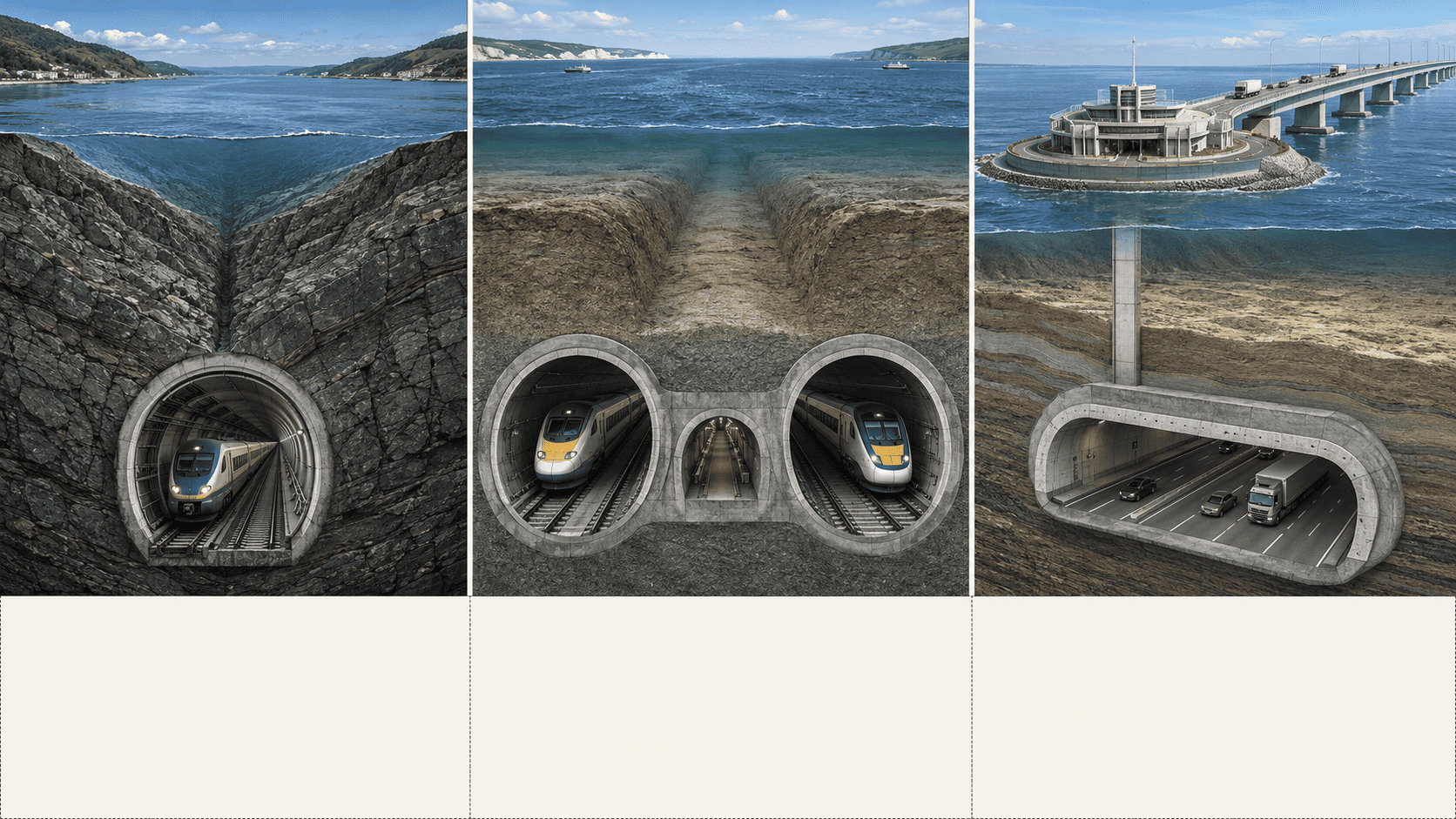
Seikan Tunnel
The Seikan Tunnel connects Japan’s main island of Honshu with Hokkaido beneath the Tsugaru Strait. Its 53.85-kilometer route includes 23.3 kilometers below the strait, reaching about 240 meters below the water surface. Engineers relied largely on drilling and blasting because fractured volcanic rock and heavy water inflows made excavation exceptionally difficult. The railway opened in 1988 after decades of investigation and construction. Seikan remains longer overall than the Channel Tunnel, although its undersea section is shorter than the Channel Tunnel’s continuous marine passage.
Channel Tunnel
The Channel Tunnel links Folkestone, England, with Coquelles, France. Each route is approximately 50 kilometers long, with about 37 kilometers beneath the English Channel and an average alignment roughly 40 meters below the seabed. The system contains two rail tunnels and a smaller service tunnel used for maintenance and emergencies. Tunnel boring machines excavated from both countries until the headings met beneath the Channel. Since opening in 1994, the link has carried passenger trains, freight trains, and shuttle services transporting road vehicles, giving it the world’s longest continuous undersea railway section.
Tokyo Bay Tunnel
The Tokyo Bay Tunnel forms the western portion of the Tokyo Bay Aqua-Line, a road link between Kawasaki and Kisarazu. The route combines approximately 9.6 kilometers of tunnel, an artificial island, and a 4.4-kilometer bridge. Shield machines excavated through soft marine ground under high water pressure, while the artificial island provided ventilation and a transition point between the tunnel and bridge. Opened in 1997 after roughly nine years of construction, the Aqua-Line substantially shortened the highway journey around Tokyo Bay and demonstrated how a bridge–tunnel system can adapt to navigation and geological constraints.
Proposed Undersea Tunnels
Future undersea tunnel projects range from active construction to long-term concepts that still require technical, environmental, or financial approval. Their status can change quickly, so projected dates remain provisional.
Road Tunnel Projects
Norway’s E39 Rogfast is under construction between Randaberg and Bokn. The approximately 27-kilometer tunnel will become the world’s longest and deepest undersea road tunnel and is intended to replace ferry crossings along the E39 coastal route. The Norwegian Public Roads Administration currently expects it to open in 2033.
The 18-kilometer Fehmarnbelt Tunnel between Denmark and Germany is also under construction. It will carry a motorway and railway through an immersed-tube structure. Construction began in 2020 on the Danish side and 2021 on the German side. Because of delays, the road connection is now expected to open before the railway, and a revised schedule has not yet been published.
Rail Tunnel Projects
The proposed Helsinki–Tallinn rail tunnel remains in planning and design rather than approved construction. It is intended to connect Finland with Estonia and the wider Rail Baltica network beneath the Gulf of Finland.
A fixed rail link beneath the Strait of Gibraltar remains under feasibility study. Spain and Morocco continue updating technical work for a possible tunnel between Europe and Africa, but no construction date has been confirmed.
An undersea tunnel creates a permanent connection beneath a body of water where bridges or ferry services may be impractical. It can support road, rail, freight, or utility networks while preserving navigation above. Its viability depends on geology, water depth, traffic demand, environmental constraints, financing, and long-term safety requirements. Because construction must control pressure, groundwater, ventilation, structural movement, and emergency access, these tunnels remain among the most technically complex infrastructure projects.
Related Entries: