
Tied Arch Bridge: Definition, Design, Types, and Examples
A tied arch bridge is a bridge design that uses a curved arch above the deck and a horizontal tie girder below to balance structural forces. The arch carries loads mainly through compression, while the tie girder resists the outward thrust that the arch would normally push into the abutments. This makes the tied arch bridge a strong and efficient option for medium-span crossings over rivers, roads, railways, and urban corridors.
Also known as a bowstring arch bridge, this bridge type is valued for both engineering performance and visual appeal. Its distinctive shape can create a landmark-like appearance while still providing a practical way to carry traffic, pedestrians, or trains across a clear span.
What Is a Tied Arch Bridge?
A tied arch bridge is a bridge in which the main arch rises above the deck and is connected to a horizontal tension member, often called the tie girder. Unlike a traditional arch bridge, which pushes outward against large abutments, a tied arch bridge uses the tie to absorb much of that horizontal force. This allows the bridge to carry loads efficiently while reducing the need for massive supports at each end.
Basic Definition
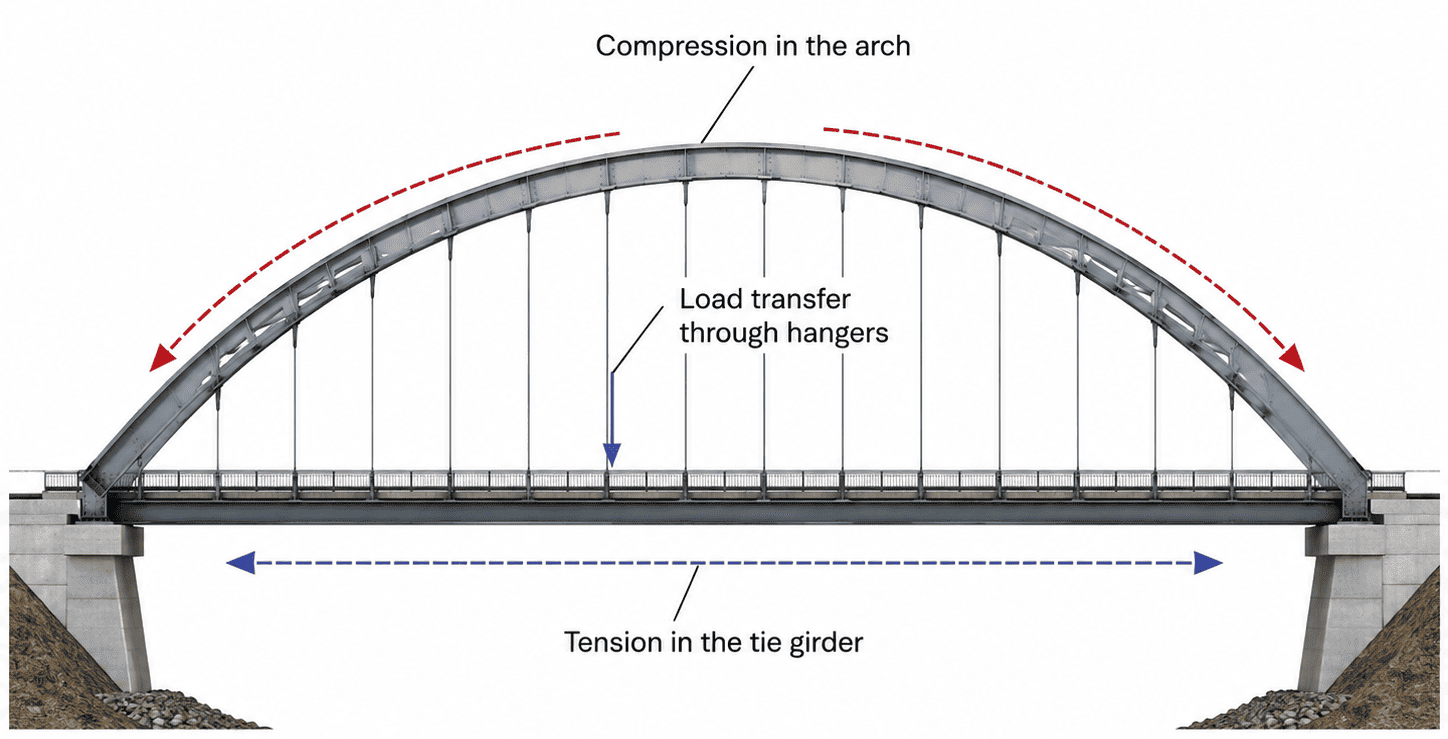
In simple terms, a tied arch bridge combines an arch, a deck, and vertical or inclined hangers. The arch carries much of the load through compression, meaning the force squeezes through the curved structure. The deck or tie girder works in tension, meaning it is pulled from both ends as it resists the outward thrust of the arch. Hangers connect the deck to the arch and help transfer the weight of traffic, pedestrians, or trains upward into the arch.
This design is useful when engineers want the strength and visual impact of an arch bridge but cannot rely on extremely large foundations or abutments to resist horizontal forces.
Why It Is Also Called a Bowstring Arch Bridge
A tied arch bridge is often called a bowstring arch bridge because its shape resembles a bow and string. The curved arch acts like the bow, while the tie girder below acts like the string. Together, they form a self-contained structural system that balances compression and tension.
The term “bowstring” is especially common when the arch and tie create a clear, bow-like outline. In modern usage, both names often describe the same general bridge type, although specific designs may vary in shape, materials, span length, and hanger arrangement.
How a Tied Arch Bridge Works
A tied arch bridge works by balancing two major structural forces: compression and tension. Compression is a pushing or squeezing force, while tension is a pulling force. In this bridge type, the arch, tie girder, and hangers work together so the loads from the deck can be carried safely across the span.
When vehicles, trains, or pedestrians move across the deck, their weight does not stay only in the roadway surface. The load is transferred through the hangers into the arch, then carried toward the ends of the bridge. At the same time, the tie girder helps contain the outward push created by the arch. This interaction is what makes the tied arch bridge efficient and visually distinctive.
The Role of the Arch
The arch is the main curved structural element. Its primary job is to carry loads through compression. As the bridge receives weight from the deck, the arch redirects those forces along its curved shape and toward the supports at each end.
Because arches naturally create outward thrust, a traditional arch bridge usually needs strong abutments to resist that force. In a tied arch bridge, however, much of that outward thrust is controlled internally by the tie girder. This allows the bridge to use the strength of an arch without depending entirely on massive ground supports.
The Role of the Tie Girder
The tie girder is the horizontal member that connects the ends of the arch. It works mainly in tension, meaning it is pulled as it resists the tendency of the arch to spread outward.
This tie is one of the defining features of the design. It helps keep the arch stable and allows the bridge to behave more like a self-contained structural system. In many designs, the deck itself may act as part of the tie system, depending on how the bridge is engineered.
The Role of Hangers
Hangers are the vertical or inclined members that connect the deck to the arch. Their job is to transfer loads from the deck upward into the arch.
These hangers are usually designed to work in tension. Their arrangement affects how loads move through the bridge, how evenly forces are distributed, and how the bridge looks from a distance.
Main Types of Tied Arch Bridges
Tied arch bridges can be built in several forms depending on the span, site conditions, visual goals, and structural requirements. While all of them use the same basic principle of an arch restrained by a tie, their shapes and arrangements can vary significantly.
Shouldered Tied Arch Bridge
A shouldered tied arch bridge has arch ribs that do not rise directly from the deck level at the ends. Instead, the arch begins from raised side portions or “shoulders,” giving the bridge a slightly different profile from a standard bow-shaped tied arch.
This form can be used when designers want to adjust the geometry of the arch, improve clearance, or create a specific visual effect. The shoulders may also help organize the transition between the main arch and the end supports.
Multi-Span Tied Arch Bridge
A multi-span tied arch bridge uses more than one tied arch span in the same structure. In some designs, each span behaves as a separate tied arch system. In others, the structure may be arranged so that several spans appear more continuous across multiple supports.
This type is useful when a bridge must cross a wider river, valley, rail corridor, or transportation route where a single span would be impractical. Multi-span designs can also create a rhythmic architectural appearance, especially when repeated arches are visible from a distance.
Single Tied Arch per Span
In a single tied arch per span, each bridge span has one main arch system supporting the deck. This is one of the clearest and most recognizable forms of a tied arch bridge because the structural idea is easy to see: one arch rises above the roadway, and the tie girder connects its ends.
This arrangement is often chosen when the bridge needs a strong central visual identity while keeping the structure relatively straightforward.
Tilted Tied Arch Bridge
A tilted tied arch bridge uses arches that lean inward, outward, or to one side instead of standing vertically above the deck. The tilt can be introduced for architectural expression, structural behavior, or site-specific reasons.
Because the geometry is less conventional, tilted arches usually require careful analysis to control twisting forces and uneven load distribution.
Twin Tied Arch Bridge
A twin tied arch bridge uses two parallel tied arches, typically one on each side of the deck. The arches may be connected by cross bracing, which helps improve stability and keeps the two sides working together.
This type is common when the bridge carries a wider deck or when designers want a balanced, symmetrical appearance. Twin arches can also make the structure feel more open because the deck is suspended between the two main arch ribs.
Tied Arch Bridge vs. Other Bridge Types
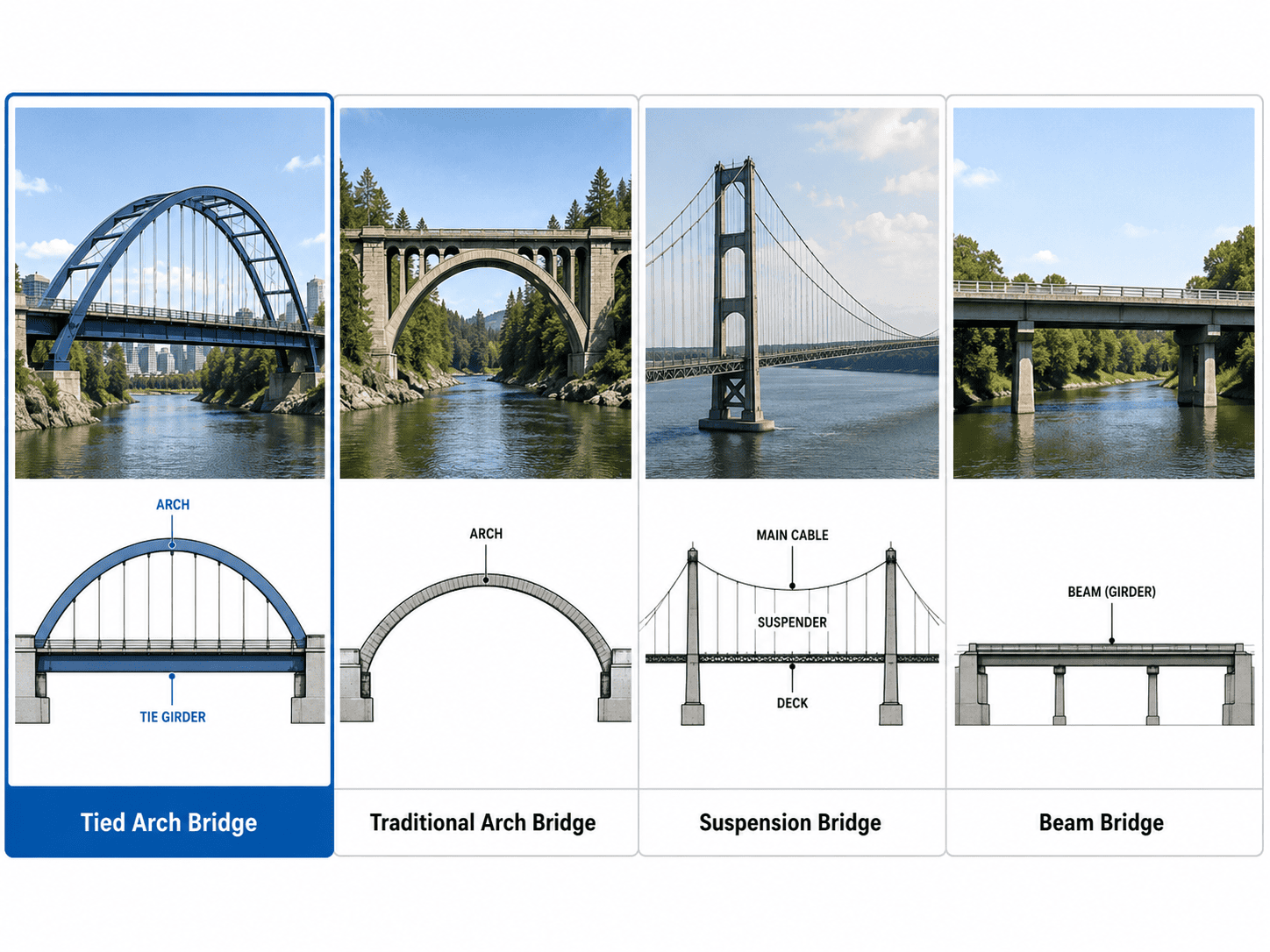
A tied arch bridge is often compared with other bridge types because it combines visual features of an arch with a structural system that controls horizontal forces differently. The main difference is how each bridge carries loads and transfers forces to the ground.
Tied Arch Bridge vs. Traditional Arch Bridge
A traditional arch bridge transfers loads through the arch and pushes outward against its abutments, which are the end supports that hold the bridge in place. Because of this outward thrust, traditional arch bridges usually need strong foundations or heavy masonry, concrete, or rock supports.
A tied arch bridge reduces that demand by using a tie girder to connect the ends of the arch. Instead of sending most of the horizontal force into the abutments, the bridge contains much of that force within its own structure. This makes tied arch bridges useful where soil conditions, space, or construction constraints make massive abutments less practical.
Tied Arch Bridge vs. Suspension Bridge
A suspension bridge carries its deck from large main cables that hang between towers. The cables work in tension and transfer forces to anchorages at each end of the bridge. Suspension bridges are often used for very long spans, especially where a wide body of water must be crossed.
A tied arch bridge usually serves shorter to medium spans compared with major suspension bridges. It does not rely on long main cables or huge end anchorages. Instead, it uses the arch, tie girder, and hangers as a more compact structural system.
Tied Arch Bridge vs. Beam Bridge
A beam bridge is one of the simplest bridge types. It uses horizontal beams or girders to carry loads directly to supports. Beam bridges are often economical for short spans, but they become less efficient as the distance between supports increases.
A tied arch bridge can cover longer spans with a more expressive shape. Its arch helps carry loads more efficiently across the opening, while the tie girder controls the outward force that the arch would otherwise create.
Key Components and Materials
The performance of a tied arch bridge depends on how its main components work together. Each part has a specific structural role, and the choice of materials affects strength, durability, cost, and appearance.
Arch Rib
The arch rib is the curved member that gives the bridge its recognizable shape. It carries much of the load through compression, which means forces are pushed along the arch toward its ends. Arch ribs may be built as solid steel sections, box girders, trusses, or reinforced concrete elements, depending on the span and design requirements.
The shape of the arch also matters. A well-designed curve helps distribute forces more smoothly and reduces unnecessary bending, which is the tendency of a member to flex under load.
Tie Girder and Deck
The tie girder connects the two ends of the arch and resists the outward pull created by the arch. In many tied arch bridge designs, the deck and tie system are closely related. The deck carries traffic, pedestrians, or rail loads, while the tie girder helps keep the arch from spreading outward.
Because this member works mainly in tension, it must be designed to handle strong pulling forces over the life of the bridge.
Hangers and Connections
Hangers connect the deck to the arch and transfer loads upward. They may be vertical, inclined, or arranged in a network pattern, depending on the bridge design.
Connections are also critical because they join the arch, hangers, tie girder, and deck into one working system. Poorly detailed connections can create weak points, especially where repeated traffic loads cause fatigue, which is damage caused by many cycles of stress over time.
Common Materials
Steel is widely used in tied arch bridges because it performs well in both tension and compression and allows for slender, elegant shapes. Concrete may be used for decks, foundations, or sometimes the arch itself. Modern designs often combine steel and concrete to balance strength, durability, construction efficiency, and long-term maintenance needs.
Advantages and Limitations of Tied Arch Bridges
A tied arch bridge offers a strong combination of structural efficiency, visual appeal, and flexibility, but it also comes with design and maintenance challenges. Its value depends on whether the site conditions, span length, loads, and budget match the strengths of the system.
Main Advantages
One of the main advantages of a tied arch bridge is that it can reduce the need for massive abutments. Because the tie girder helps resist the outward thrust of the arch, the bridge can be a practical option where soil conditions or available space make large end supports difficult.
This bridge type is also efficient for medium spans. The arch carries loads in compression, while the tie girder and hangers help distribute forces through the structure. This allows engineers to create a strong bridge with a relatively clear span below, which can be useful over rivers, roads, railways, or navigation channels.
Aesthetic value is another major advantage. The curved arch creates a recognizable profile that often becomes a visual landmark. For urban crossings, park bridges, and major transportation routes, this appearance can be an important part of the project.
Common Limitations
The same features that make a tied arch bridge efficient can also make it more complex to design. The arch, tie girder, hangers, deck, and connections must work together as a balanced system. If one part is poorly proportioned or detailed, it can affect the behavior of the whole bridge.
Construction can also be more demanding than for a simple beam bridge. The arch may require temporary supports, careful erection sequencing, or specialized fabrication. These requirements can increase cost and planning time, especially on sites with limited access.
Tied arch bridges are not usually the best solution for every span. Very short crossings may be more economical with beam bridges, while extremely long crossings may favor suspension or cable-stayed systems.
Maintenance Considerations
Maintenance is especially important because tied arch bridges include several highly stressed components. Hangers, connections, bearings, welds, and protective coatings need regular inspection.
Steel elements may require corrosion protection, especially in wet, coastal, or deicing-salt environments. Fatigue can also be a concern where repeated traffic loads affect hangers and connection details over many years.
Design and Construction Considerations
Designing a tied arch bridge requires more than choosing an attractive arch shape. Engineers must evaluate the span, site conditions, expected loads, construction method, and long-term performance of the structure. Because the arch, tie girder, hangers, and deck act together, design decisions in one part of the bridge can affect the behavior of the entire system.
Span Range and Site Conditions
Tied arch bridges are commonly considered for medium spans where a simple beam bridge may become inefficient, but a suspension or cable-stayed bridge would be unnecessary. They can be especially useful where the bridge must cross a river, roadway, railway, or navigation channel with limited intermediate supports.
Site conditions strongly influence the design. Soil strength, available space, clearance requirements, environmental exposure, and access for construction equipment all matter. One advantage of the tied arch system is that it can reduce horizontal demands on the abutments, but the foundations still must support vertical reactions and provide overall stability.
Loading and Structural Analysis
A tied arch bridge must be designed for several types of loads, including dead load, live load, wind, temperature effects, and sometimes seismic forces. Dead load is the permanent weight of the bridge itself, while live load refers to moving loads such as vehicles, trains, cyclists, or pedestrians.
Structural analysis helps engineers understand how these forces move through the arch, hangers, tie girder, deck, and connections. Special attention is often given to hanger forces, arch stability, deck stiffness, and the way loads are shared across the structure.
Fabrication and Erection
Construction planning is critical because tied arch bridges may require large steel components, precise geometry, and careful sequencing. Some arches are assembled off-site and lifted into position, while others are built in segments at the bridge location.
During erection, temporary supports or bracing may be needed until the arch, tie, hangers, and deck form a stable system. Proper alignment, welding, bolting, and protective coating are essential for strength, durability, and long-term maintenance.
Examples of Tied Arch Bridges
Many tied arch bridges are recognized not only for their engineering efficiency but also for their strong visual identity. Because the arch rises above the deck, these bridges often become landmarks in the cities or regions where they are built.
The Fremont Bridge in Portland, Oregon, is one of the best-known tied arch bridges in the United States. It carries Interstate 405 and U.S. Route 30 over the Willamette River and is notable for its large steel arch and urban setting. Its design shows how a tied arch can provide a major river crossing while creating a memorable skyline feature.
The Fort Pitt Bridge in Pittsburgh, Pennsylvania, is another prominent example. It crosses the Monongahela River near downtown Pittsburgh and uses a tied arch form suited to a dense urban environment with heavy traffic demands. Its location also makes it part of one of the city’s most recognizable transportation corridors.
The Daniel W. Hoan Memorial Bridge in Milwaukee, Wisconsin, is often associated with its long steel arch spans and distinctive appearance near the Lake Michigan waterfront. It demonstrates how tied arch bridges can be used for major highway infrastructure while still contributing to the visual character of a city.
The Hastings Bridge in Minnesota provides a modern example of a large tied arch bridge designed for highway traffic. Its main span crosses the Mississippi River, showing how this bridge type can serve wide waterways where intermediate supports may be limited or undesirable.
These examples show the versatility of the tied arch bridge in urban, highway, and river-crossing applications.
Brief History of Tied Arch Bridges
The tied arch bridge developed as engineers looked for ways to use the strength of the arch without relying entirely on large, heavy abutments. Traditional arch bridges had been used for centuries, especially in stone and masonry construction, but they required strong end supports to resist the outward thrust produced by the arch.
As iron and steel bridge construction advanced, engineers gained new ways to manage tension forces. This made it possible to connect the ends of an arch with a tie member, creating a more self-contained structural system. The tie helped control the horizontal forces that would otherwise push into the abutments, while the arch continued to provide efficient load-carrying capacity.
The bowstring arch form became especially important during the expansion of road and rail networks, where longer clear spans and faster construction methods were often needed. Over time, tied arch bridges evolved from relatively simple metal truss forms into modern steel and concrete structures with refined arch shapes, improved hanger systems, and better connection details.
Today, the tied arch bridge remains a practical and visually recognizable solution for highways, railways, pedestrian crossings, and urban landmarks.
Frequently Asked Questions About Tied Arch Bridges
What is the main purpose of a tied arch bridge?
The main purpose of a tied arch bridge is to carry loads across a span while controlling the outward thrust normally created by an arch. In a traditional arch bridge, that horizontal force is resisted mainly by the abutments. In a tied arch bridge, the tie girder connects the ends of the arch and helps contain that force within the bridge structure. This makes the design useful where engineers want the strength and appearance of an arch but need to reduce the demand on large end supports.
What is the difference between a tied arch bridge and a bowstring bridge?
In many contexts, the terms tied arch bridge and bowstring bridge refer to the same general bridge type. The word “bowstring” describes the shape: the curved arch resembles a bow, and the tie girder below resembles the string. However, some uses of “bowstring bridge” may refer more specifically to older truss-style forms, while “tied arch bridge” is often used as the broader technical term.
Are tied arch bridges strong?
Yes, tied arch bridges can be very strong when properly designed, built, and maintained. Their strength comes from the way the arch, tie girder, hangers, and deck share loads. The arch works mainly in compression, the tie girder works mainly in tension, and the hangers transfer loads from the deck to the arch. Like any bridge type, their performance depends on good engineering, quality materials, careful construction, and regular inspection.
Where are tied arch bridges commonly used?
Tied arch bridges are commonly used for road, rail, pedestrian, and urban crossings. They are often selected for medium spans over rivers, highways, rail corridors, and areas where clear space below the bridge is important. They are also popular in visible locations because the arch gives the structure a distinctive and often landmark-quality appearance.
Related Entries: