
List of Longest Bridges In The World
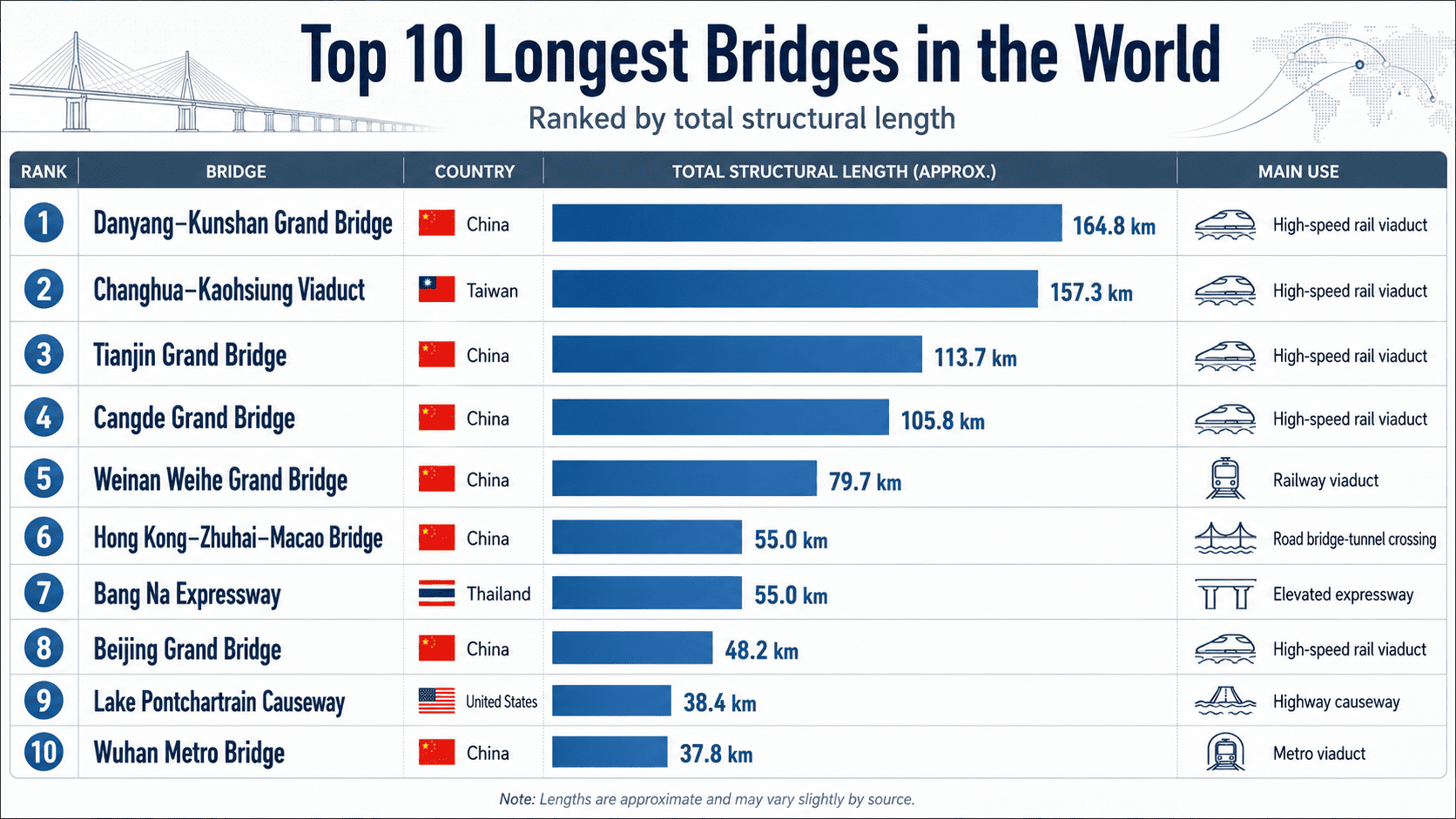
The longest bridge in the world is the Danyang-Kunshan Grand Bridge in China, with an approximate length of 102.4 miles, or 164.8 kilometers. However, the full ranking includes different types of structures, such as high-speed rail viaducts, elevated expressways, road bridges, causeways, and bridge-tunnel systems.
In this article, you will find a clear list of the longest bridges in the world by length, country, type, and main use. You will also learn why many of the longest bridges are in Asia, why rankings can vary between sources, and which U.S. bridges are especially important in global and American bridge rankings.
Completed Longest Bridges in the World
The completed longest bridges in the world are not always the kind of bridges people imagine at first. Many of them are not single dramatic crossings over one river. Instead, they are massive viaducts, elevated rail lines, sea crossings, expressways, and long causeways built to move people and goods across difficult landscapes.
This ranking focuses on completed bridges by total structural length. That means it includes bridges and viaducts that extend over land, water, wetlands, highways, railways, and other obstacles. Because of that, many of the longest bridges in the world are high-speed rail viaducts in Asia, especially in China.
| Rank | Bridge Name | Country / Region | Approximate Length | Main Use |
|---|---|---|---|---|
| 1 | Danyang-Kunshan Grand Bridge | China | 102.4 miles / 164.8 km | High-speed rail |
| 2 | Changhua–Kaohsiung Viaduct | Taiwan | 97.8 miles / 157.3 km | High-speed rail |
| 3 | Cangde Grand Bridge | China | 72.0 miles / 115.9 km | High-speed rail |
| 4 | Tianjin Grand Bridge | China | 70.6 miles / 113.7 km | High-speed rail |
| 5 | Weinan Weihe Grand Bridge | China | 49.5 miles / 79.7 km | High-speed rail |
| 6 | Hong Kong–Zhuhai–Macao Bridge | China | 34.2 miles / 55 km | Road / bridge-tunnel system |
| 7 | Bang Na Expressway | Thailand | 33.5 miles / 54 km | Elevated expressway |
| 8 | Beijing Grand Bridge | China | 29.9 miles / 48.2 km | High-speed rail |
| 9 | Lake Pontchartrain Causeway | United States | 23.9 miles / 38.4 km | Road bridge |
| 10 | Wuhan Metro Bridge | China | 23.5 miles / 37.8 km | Metro / urban rail |
| 11 | Manchac Swamp Bridge | United States | 22.8 miles / 36.7 km | Road bridge |
1. Danyang-Kunshan Grand Bridge, China
The Danyang-Kunshan Grand Bridge is widely recognized as the longest bridge in the world. It stretches about 102.4 miles, or 164.8 kilometers, across Jiangsu Province in eastern China.
This bridge is part of the Beijing-Shanghai High-Speed Railway, one of China’s most important rail corridors. Instead of carrying cars, it was built mainly for high-speed trains traveling between major cities. Its enormous length helps trains move across canals, rivers, lakes, lowlands, rice fields, and developed areas without constantly returning to ground level.
The Danyang-Kunshan Grand Bridge is a good example of why many of the longest bridges in the world are actually railway viaducts. Its purpose is not only to cross one obstacle, but to keep a long transportation route stable, elevated, and efficient across a changing landscape.
For readers searching for a List of Longest Bridges In The World, this bridge almost always appears in first place because its total structural length is greater than any other completed bridge commonly listed in global rankings.
2. Changhua–Kaohsiung Viaduct, Taiwan
The Changhua–Kaohsiung Viaduct in Taiwan is usually ranked as the second longest bridge in the world. It is about 97.8 miles, or 157.3 kilometers, long.
This structure is part of the Taiwan High Speed Rail system. It runs through western Taiwan and supports high-speed train service rather than road traffic. That detail is important because many readers expect the longest bridges to be highways or famous tourist crossings, but several of the top-ranked bridges are rail viaducts.
The viaduct helps trains travel efficiently through populated and varied terrain. It also reflects Taiwan’s need for strong transportation infrastructure along a busy north-south corridor.
Because Taiwan is located in a seismically active region, high-speed rail infrastructure must be designed with safety and stability in mind. This makes the Changhua–Kaohsiung Viaduct not only one of the longest bridges in the world, but also an important example of large-scale rail engineering.
3. Cangde Grand Bridge, China
The Cangde Grand Bridge is another major Chinese railway viaduct and is commonly ranked among the top three longest bridges in the world. It measures about 72.0 miles, or 115.9 kilometers.
Like the Danyang-Kunshan Grand Bridge, it is associated with the Beijing-Shanghai High-Speed Railway. This railway corridor required long elevated sections to support fast, stable, and direct train movement across large areas.
The Cangde Grand Bridge shows how modern bridge rankings can be different from traditional expectations. It is not famous because of a single iconic tower, arch, or suspension span. Its importance comes from its scale, function, and role in a national high-speed rail system.
Many of the longest bridges in the world are built this way: as extended viaducts that cross land, roads, waterways, farmland, and infrastructure in a continuous elevated structure.
4. Tianjin Grand Bridge, China
The Tianjin Grand Bridge is another completed bridge that appears near the top of global length rankings. It is approximately 70.6 miles, or 113.7 kilometers, long.
This bridge is also part of China’s high-speed rail infrastructure. It extends through the region between Langfang and Qingxian, supporting railway movement along the Beijing-Shanghai corridor.
Its role is mainly functional. The Tianjin Grand Bridge helps keep trains on an elevated and efficient route, reducing interruptions from roads, local terrain, and other obstacles below. This type of design is especially useful for high-speed rail, where route smoothness and stability matter.
Although it may not be as visually famous as a suspension bridge or sea bridge, the Tianjin Grand Bridge is one of the most important structures in any serious list of the longest bridges in the world.
5. Weinan Weihe Grand Bridge, China
The Weinan Weihe Grand Bridge is another major Chinese high-speed rail bridge. It is about 49.5 miles, or 79.7 kilometers, long.
This bridge is part of the Zhengzhou-Xi’an High-Speed Railway. It crosses the Wei River area and was designed to support rail travel across a complex landscape of rivers, roads, and low-lying terrain.
The Weinan Weihe Grand Bridge is historically important because it was once considered the longest bridge in the world before being surpassed by newer and longer structures. That shows how quickly bridge rankings can change when countries invest in major transportation infrastructure.
Its placement in this ranking also highlights a key point: the longest bridges are often built for mobility at a regional or national scale. Their purpose is not just to cross a single river, but to support long-distance transportation across many obstacles.
6. Hong Kong–Zhuhai–Macao Bridge, China
The Hong Kong–Zhuhai–Macao Bridge is one of the most recognizable long bridges in the world. It measures about 34.2 miles, or 55 kilometers, when the full bridge-tunnel system is considered.
This structure connects Hong Kong, Zhuhai, and Macao across the Pearl River Delta. Unlike many of the rail viaducts above it in the ranking, this project is especially notable because it combines bridges, an undersea tunnel, and artificial islands.
For readers in the United States, the Hong Kong–Zhuhai–Macao Bridge may be easier to picture than some of the longer railway viaducts because it looks more like a major sea-crossing megaproject. It was designed for road traffic and regional connectivity, helping reduce travel time between major cities in southern China.
This bridge also shows why some long bridge rankings can be complicated. It is not only a bridge in the simple sense; it is a fixed link system with multiple engineering elements. Even so, it is commonly included in rankings because of its total connected structure and its importance as one of the world’s longest sea crossings.
7. Bang Na Expressway, Thailand
The Bang Na Expressway in Thailand is often included among the longest bridges in the world because it is a massive elevated roadway. It is about 33.5 miles, or 54 kilometers, long.
Located in the Bangkok area, this structure functions as an elevated expressway rather than a traditional bridge over a river or valley. It carries road traffic above existing urban and transportation corridors.
The Bang Na Expressway is important because it expands the definition of what many rankings count as a bridge. Some sources classify it as a bridge, while others describe it more specifically as an elevated highway or viaduct.
Its inclusion makes sense when the ranking is based on total elevated structural length. It was built to improve traffic movement in a dense urban region, showing how long bridge-like structures can be used not only for water crossings, but also for city transportation.
8. Beijing Grand Bridge, China
The Beijing Grand Bridge is another long bridge associated with China’s high-speed railway network. It is approximately 29.9 miles, or 48.2 kilometers, long.
This bridge forms part of the Beijing-Shanghai High-Speed Railway system. Compared with the Danyang-Kunshan, Cangde, and Tianjin Grand Bridges, it is shorter, but it still ranks among the longest completed bridges in the world.
Its main purpose is to support high-speed rail movement across a section of northern China. Like other railway viaducts, it helps trains maintain a stable and efficient route while crossing roads, developed areas, and changing ground conditions.
The Beijing Grand Bridge reinforces one of the strongest patterns in this topic: China dominates the list because of its extensive use of long viaducts in high-speed rail construction.
9. Lake Pontchartrain Causeway, United States
The Lake Pontchartrain Causeway is one of the most famous long bridges in the United States. It is located in Louisiana and measures about 23.9 miles, or 38.4 kilometers.
This bridge crosses Lake Pontchartrain and connects the New Orleans area with communities on the lake’s north shore. For American readers, it is one of the most relevant examples in this list because it is often associated with the phrase “longest bridge in the United States.”
The Lake Pontchartrain Causeway is especially notable because of its long continuous stretch over water. Unlike many of the longer Asian viaducts that cross a mix of land and infrastructure, this bridge is strongly associated with an open-water crossing.
It consists of two parallel spans used for road traffic. The first span opened in the 1950s, and the second span opened later to improve traffic capacity. Its long, straight appearance across the lake makes it one of the most recognizable causeways in the world.
In a List of Longest Bridges In The World, the Lake Pontchartrain Causeway matters because it connects global rankings with U.S. infrastructure history and American search intent.
10. Wuhan Metro Bridge, China
The Wuhan Metro Bridge is commonly listed among the longest completed bridges in the world, with an approximate length of 23.5 miles, or 37.8 kilometers.
This structure is connected to urban rail transportation rather than high-speed intercity rail or highway traffic. That makes it different from many of the other bridges in the ranking. Its purpose is to support metro movement within a major city.
Wuhan is one of China’s largest urban centers, and large metro infrastructure is essential for moving people across dense city areas. A long metro bridge or viaduct can help trains cross rivers, roads, districts, and developed land while staying separated from surface traffic.
The Wuhan Metro Bridge is a useful reminder that long bridges are not limited to highways and high-speed rail. Urban transit systems can also require extensive elevated structures, especially in large and rapidly growing cities.
11. Manchac Swamp Bridge, United States
The Manchac Swamp Bridge is another major long bridge in the United States. It is located in Louisiana and is about 22.8 miles, or 36.7 kilometers, long.
This bridge carries road traffic across swampy terrain and wetlands. It is an important example because it shows how long bridges are sometimes built not over deep water, but over soft, difficult, or environmentally sensitive ground.
The Manchac Swamp Bridge is often mentioned among the longest bridges in the United States, along with the Lake Pontchartrain Causeway. Both are located in Louisiana, a state where water, wetlands, and low-lying terrain create major engineering challenges.
Unlike some of the high-speed rail viaducts in Asia, the Manchac Swamp Bridge serves highway transportation. Its purpose is practical: to keep road traffic moving safely over a landscape where building directly at ground level would be difficult.
Including this bridge expands the ranking beyond the usual top 10 and gives U.S. readers another familiar example of long bridge engineering. It also helps show that the world’s longest bridges are built for many different environments, from Chinese rail corridors to Taiwanese viaducts, Thai expressways, American lakes, and Louisiana swamps.
Under Construction Longest Bridges in the World
Some of the longest bridges in the world are still under construction, planned, delayed, or being built as part of larger transportation corridors. These projects are important because they may change future rankings once they are completed and opened to traffic.
This section is separate from the completed ranking because unfinished bridges should not be mixed with bridges that are already in service. A project may have an announced length, route, or completion date, but those details can change because of engineering challenges, funding, land acquisition, environmental review, or construction delays.
Major Long Bridges Currently Under Construction
One of the most important long bridge-related projects under construction is the Mumbai–Ahmedabad high-speed rail corridor in India. The full corridor is about 508 kilometers long, and a major portion of it is being built on elevated viaducts. Some rankings list the viaduct portion at about 353.1 kilometers [VERIFICAR], which would make it longer than the Danyang-Kunshan Grand Bridge if counted as one continuous bridge or viaduct system.
This project is designed for high-speed rail, not road traffic. Its purpose is to connect Mumbai and Ahmedabad with faster rail service across western India. Because so much of the corridor is elevated, it is often mentioned in discussions about future long bridges and viaducts. However, it should be treated carefully in rankings because the full rail corridor includes different structural elements, not only one traditional bridge.
Another major project is the Lion Ocean Link in China. It is commonly listed as a long expressway crossing with a projected length of about 35.1 kilometers [VERIFICAR]. The project is significant because it is designed for road traffic and includes major bridge engineering over water. Once completed, it may become one of the important long sea-crossing structures in China.
The Southeast Metro Manila Expressway, also known as Skyway Stage 4 or SEMME, is another large project often included in under-construction bridge or viaduct lists. It is planned as a long expressway in the Philippines, with an approximate length of 32.66 kilometers. Because it includes elevated highway sections, some rankings classify it as a bridge or viaduct-style structure.
This project is important for Metro Manila because it is intended to improve road connectivity and reduce congestion in one of Southeast Asia’s busiest urban regions. However, its status should be described carefully because large expressway projects may move through different phases, and not every section may be elevated in the same way.
The Bataan–Cavite Interlink Bridge in the Philippines is another major future bridge project. It is planned to span about 32.15 kilometers across Manila Bay, connecting Bataan and Cavite. Unlike some viaduct-heavy rail projects, this is more recognizable as a major sea-crossing bridge system.
The project is expected to include cable-stayed bridge sections, marine viaducts, and approach roads. Its purpose is to reduce travel time between Bataan, Cavite, and the wider Manila Bay region. If completed as planned, it would become one of the longest bridge projects in the Philippines and one of the most important long road bridges in Southeast Asia.
The Kolkata Metro Orange Line in India is also sometimes listed among long under-construction elevated structures, with a projected length of about 29.87 kilometers [VERIFICAR]. This project is connected to urban metro transportation rather than highway or high-speed intercity rail. Because metro lines often use elevated viaducts, they may appear in rankings that count long elevated transit structures as bridges.
Another major project is the Hangzhou Bay Railway Bridge in China, part of the Nantong–Suzhou–Jiaxing–Ningbo high-speed railway. The bridge is reported at about 29.2 kilometers long and is designed for high-speed rail service across Hangzhou Bay. Its role is important because it combines long-distance rail transportation with a major cross-sea engineering challenge.
These projects show that the future of the longest bridges in the world is not limited to one type of structure. Some are high-speed rail viaducts, some are expressways, some are metro lines, and others are major sea crossings. That is why future rankings must explain what kind of bridge is being counted and how the length is measured.
Why Some Future Bridges May Change the Ranking
Future bridge rankings can change because many of the world’s longest bridge projects are connected to large transportation systems. When a new high-speed rail viaduct, elevated expressway, metro bridge, or sea crossing is completed, it may enter the ranking immediately if its total structural length is long enough.
This is especially important for projects like the Mumbai–Ahmedabad high-speed rail corridor. If its elevated viaduct sections are counted as one bridge system, it could dramatically affect future lists of the longest bridges in the world. However, if rankings separate the corridor into different structures or count only specific bridge portions, its placement may be different.
Rankings can also vary because sources do not always use the same definition of a bridge. Some include viaducts, elevated highways, and metro structures. Others focus only on road bridges, water crossings, or continuous bridge decks. This is why one list may rank a high-speed rail viaduct first, while another may give more attention to a famous bridge over water.
Completion status also matters. A bridge under construction may have an announced length and planned opening date, but it should not replace a completed bridge in the main ranking until it is actually finished and opened. Large infrastructure projects can face delays because of financing, engineering problems, environmental approvals, land access, weather, or political changes.
Another reason future bridges may change the ranking is the growth of high-speed rail and expressway megaprojects in Asia. Countries such as China, India, and the Philippines are building large transportation systems that often require long elevated sections. These viaducts can be much longer than traditional bridges because they are designed to carry routes over many small obstacles instead of one single river or bay.
For readers comparing the longest bridges in the world, the most important point is this: completed rankings show what is already in service, while under-construction rankings show what may reshape the list in the future. Both are useful, but they should not be mixed without explaining the difference.
What Is the Longest Bridge in the World?
The longest bridge in the world is the Danyang-Kunshan Grand Bridge in China. It is about 102.4 miles, or 164.8 kilometers, long and forms part of the Beijing-Shanghai High-Speed Railway.
This answer is important because many people imagine the longest bridge as a dramatic sea crossing or a famous road bridge. In reality, the world’s longest bridge is a high-speed rail viaduct. It was built to carry trains across a long stretch of lowlands, waterways, canals, roads, and developed areas in eastern China.
However, the answer can change depending on what type of bridge ranking is being discussed. The longest bridge overall, the longest bridge over water, and the longest road bridge are not always the same structure.
Longest Bridge Overall
The longest bridge overall is the Danyang-Kunshan Grand Bridge in China. It stretches approximately 102.4 miles, or 164.8 kilometers.
This bridge is generally recognized as the longest bridge in the world by total structural length. It is part of the Beijing-Shanghai High-Speed Railway, one of China’s most important rail corridors.
Its purpose is not to carry cars or pedestrians. Instead, it supports high-speed train service across Jiangsu Province. The bridge passes through a landscape with rivers, canals, lakes, agricultural land, and urban areas.
The Danyang-Kunshan Grand Bridge shows why many of the longest bridges in the world are actually viaducts. A viaduct can extend for many miles because it is designed to keep a transportation route elevated across many smaller obstacles, not just one large body of water.
For a general List of Longest Bridges In The World, this bridge is usually placed at number one because its total length is greater than any other completed bridge commonly recognized in global rankings.
Longest Bridge Over Water
The longest bridge over water depends on the measurement method. One of the most famous and widely recognized examples is the Lake Pontchartrain Causeway in Louisiana, United States.
The Lake Pontchartrain Causeway is about 23.9 miles, or 38.4 kilometers, long. It crosses Lake Pontchartrain and connects the New Orleans area with communities on the north shore of the lake.
This bridge is especially important in U.S. search intent because many readers are looking for the longest bridge in the United States or the longest continuous bridge over water. Unlike the Danyang-Kunshan Grand Bridge, which is mostly a railway viaduct over mixed terrain, the Lake Pontchartrain Causeway is strongly associated with an open-water crossing.
This distinction matters because “longest bridge” can mean different things. A bridge may be the longest overall by total structure length, while another may be the longest continuous bridge over water. That is why the Danyang-Kunshan Grand Bridge and the Lake Pontchartrain Causeway often appear in different types of bridge records.
Some modern sea-crossing bridges and bridge-tunnel systems may be longer in total project length, but they may include tunnels, artificial islands, approach roads, or multiple structural sections. For that reason, rankings over water can vary depending on whether the source counts only the bridge deck, the continuous over-water section, or the full transportation link.
Longest Road Bridge
The longest road bridge is not always ranked the same way as the longest bridge overall. This is because many of the world’s longest bridges are built for rail, especially high-speed rail systems in China and Taiwan.
One major road structure often mentioned in this category is the Bang Na Expressway in Thailand. It is about 33.5 miles, or 54 kilometers, long and functions as an elevated toll road. It carries vehicle traffic above an existing highway corridor near Bangkok.
The Hong Kong–Zhuhai–Macao Bridge is another important road crossing. Its full bridge-tunnel system is about 34.2 miles, or 55 kilometers, long. However, it includes bridges, an undersea tunnel, and artificial islands, so it is not always ranked the same way as a single continuous bridge.
This is why road bridge rankings can be confusing. Some lists include elevated expressways, some focus only on bridges over water, and others include full bridge-tunnel systems. A road bridge may be longer than many famous bridges, but still shorter than the longest railway viaducts.
For readers comparing the longest bridges in the world, the clearest approach is to separate the categories. The Danyang-Kunshan Grand Bridge is the longest overall, the Lake Pontchartrain Causeway is one of the most famous continuous bridges over water, and structures such as the Bang Na Expressway and Hong Kong–Zhuhai–Macao Bridge are major examples of long road-based crossings.
Top 10 Longest Bridges in the World Ranked by Length
The top 10 longest bridges in the world are mostly high-speed rail viaducts, elevated expressways, and long causeways. This is why the ranking may look different from what many readers expect. Instead of famous tourist bridges with tall towers or dramatic suspension cables, the longest bridges are usually large transportation structures built to cross long stretches of land, water, wetlands, roads, and developed areas.
The table below ranks the longest completed bridges by approximate total structural length. It includes the bridge name, country or region, approximate length, type of structure, and main use.
Ranking Table by Length, Country, and Type
| Rank | Bridge Name | Country / Region | Approximate Length | Type | Main Use |
|---|---|---|---|---|---|
| 1 | Danyang-Kunshan Grand Bridge | China | 102.4 miles / 164.8 km | Viaduct | High-speed rail |
| 2 | Changhua–Kaohsiung Viaduct | Taiwan | 97.8 miles / 157.3 km | Viaduct | High-speed rail |
| 3 | Cangde Grand Bridge | China | 72.0 miles / 115.9 km | Viaduct | High-speed rail |
| 4 | Tianjin Grand Bridge | China | 70.6 miles / 113.7 km | Viaduct | High-speed rail |
| 5 | Weinan Weihe Grand Bridge | China | 49.5 miles / 79.7 km | Viaduct | High-speed rail |
| 6 | Hong Kong–Zhuhai–Macao Bridge | China | 34.2 miles / 55 km | Bridge-tunnel system | Road traffic |
| 7 | Bang Na Expressway | Thailand | 33.5 miles / 54 km | Elevated expressway / viaduct | Road traffic |
| 8 | Beijing Grand Bridge | China | 29.9 miles / 48.2 km | Viaduct | High-speed rail |
| 9 | Lake Pontchartrain Causeway | United States | 23.9 miles / 38.4 km | Causeway / bridge | Road traffic |
| 10 | Wuhan Metro Bridge | China | 23.5 miles / 37.8 km | Metro viaduct | Urban rail |
This quick ranking shows one of the clearest patterns in modern bridge engineering: China dominates the list because several of the world’s longest bridges were built as part of large high-speed rail systems. Taiwan, Thailand, and the United States also appear because of major viaducts, expressways, and long road crossings.
For users comparing the longest bridges in the world, the most important detail is the measurement category. A bridge ranked by total structure length may be very different from a bridge ranked by main span length or over-water length.
Why Rankings Can Vary Between Sources
Rankings of the world’s longest bridges can vary because not every source uses the same definition of a bridge. Some lists include railway viaducts, elevated highways, metro bridges, bridge-tunnel systems, and causeways. Other lists focus only on traditional bridges over water.
This matters because a high-speed rail viaduct can be much longer than a famous suspension bridge or sea crossing. For example, the Danyang-Kunshan Grand Bridge is the longest bridge overall by total structural length, but it is mainly a railway viaduct. The Lake Pontchartrain Causeway, on the other hand, is often discussed as one of the most famous long bridges over water.
Another reason rankings vary is that some sources count the full transportation link, while others count only the bridge portion. The Hong Kong–Zhuhai–Macao Bridge is a good example. Its full system includes bridges, an undersea tunnel, and artificial islands, so rankings may treat it differently depending on whether they count the entire link or only the bridge sections.
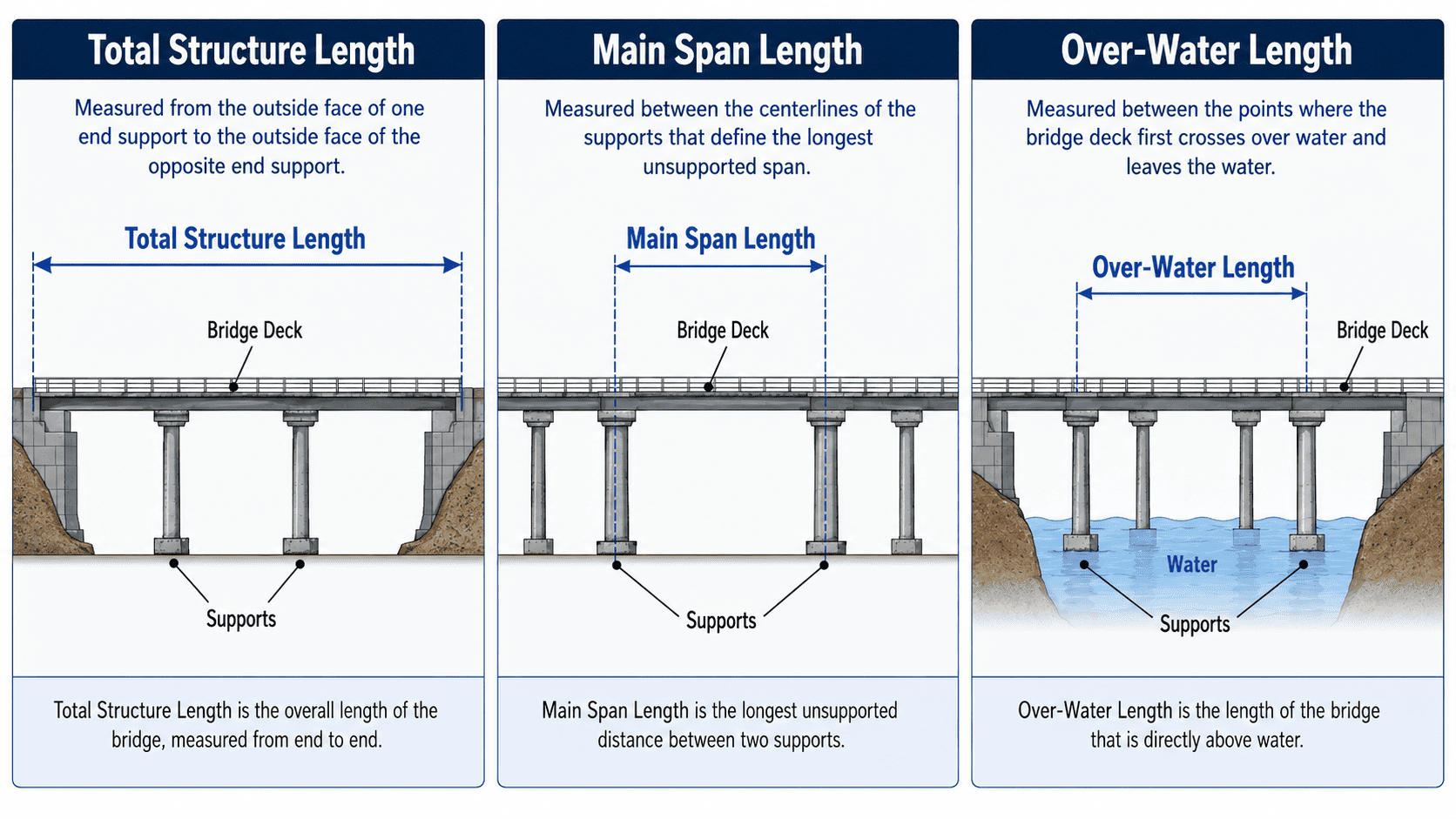
There can also be differences between total length and main span length. Total length measures the full structure from end to end, including many repeated spans. Main span length measures only the longest unsupported distance between two major supports. A bridge can have an impressive main span without being one of the longest bridges overall.
Because of these differences, the best way to read a List of Longest Bridges In The World is to check what the ranking is measuring. A clear ranking should explain whether it is counting total bridge length, over-water length, road bridge length, railway viaduct length, or a combined bridge-tunnel system.
Longest Bridges by Country
The longest bridges in the world are not spread evenly across every country. A small number of countries dominate the ranking because they have built massive rail viaducts, elevated expressways, long causeways, or major crossings over water and wetlands.
China appears more than any other country in global rankings because of its high-speed rail network. The United States also has several important long bridges, especially in Louisiana. Taiwan and Thailand are also important because of their long rail and expressway structures.
Longest Bridges in China
China has more of the world’s longest bridges than any other country. The main reason is its large high-speed rail network, which uses long viaducts to keep train routes elevated, stable, and efficient.
The Danyang-Kunshan Grand Bridge is the clearest example. It is about 102.4 miles, or 164.8 kilometers, long and is part of the Beijing-Shanghai High-Speed Railway. This makes it the longest bridge in the world by total structural length.
Other major Chinese bridges include the Cangde Grand Bridge, Tianjin Grand Bridge, Weinan Weihe Grand Bridge, Beijing Grand Bridge, and Wuhan Metro Bridge. Most of these structures are not traditional tourist bridges. They are transportation viaducts built to support trains or urban rail systems across long distances.
China’s dominance in this ranking also reflects the scale of its infrastructure development. Long viaducts are useful in places where rail lines must cross rivers, roads, canals, farmland, urban areas, and soft ground without constant changes in elevation.
For this reason, many of the longest bridges in China are better understood as parts of national transportation corridors. Their purpose is not only to cross one obstacle, but to keep major rail routes moving smoothly across many different landscapes.
Longest Bridges in the United States
The United States has several of the world’s most recognized long bridges, especially when the ranking focuses on road bridges, causeways, or bridges over water. Two of the most important examples are the Lake Pontchartrain Causeway and the Manchac Swamp Bridge, both located in Louisiana.
The Lake Pontchartrain Causeway is about 23.9 miles, or 38.4 kilometers, long. It crosses Lake Pontchartrain and connects the New Orleans area with communities on the north shore. It is one of the most famous long bridges in the United States and is strongly associated with records for long continuous bridges over water.
The Manchac Swamp Bridge is also located in Louisiana. It is about 22.8 miles, or 36.7 kilometers, long and carries road traffic across swamp and wetland terrain. Unlike a bridge crossing a deep bay or major river, this bridge shows how long structures can be necessary in soft, low-lying landscapes where building directly on the ground would be difficult.
Louisiana appears often in U.S. bridge rankings because of its geography. The state has lakes, swamps, wetlands, rivers, bayous, and low-lying terrain. These conditions create a need for long elevated road structures that can carry traffic safely over water or unstable ground.
For American readers, the longest bridges in the United States are important because they feel more familiar than many of the huge rail viaducts in Asia. They also help explain the difference between the longest bridge overall and the longest bridge in the USA. The longest bridge overall is in China, but some of the most famous long road and over-water bridges are in the United States.
Longest Bridges in Asia
Asia dominates the global ranking of the longest bridges in the world. China, Taiwan, and Thailand all have major structures that appear near the top of international lists.
China leads the ranking because of high-speed rail viaducts such as the Danyang-Kunshan Grand Bridge, Cangde Grand Bridge, Tianjin Grand Bridge, Weinan Weihe Grand Bridge, and Beijing Grand Bridge. These bridges are connected to massive rail systems rather than simple local crossings.
Taiwan is represented by the Changhua–Kaohsiung Viaduct, one of the longest railway viaducts in the world. It forms part of Taiwan’s high-speed rail system and supports passenger train service along a major transportation corridor.
Thailand appears in the ranking because of the Bang Na Expressway, a long elevated toll road near Bangkok. Unlike the high-speed rail viaducts in China and Taiwan, this structure serves road traffic. It shows that Asia’s longest bridges are not limited to rail systems; they also include elevated highways built to manage urban and regional transportation demand.
Asia has so many long bridges because many countries in the region have invested heavily in transportation infrastructure. High-speed rail, expressways, metro systems, coastal crossings, and elevated urban routes often require long bridge-like structures.
This pattern is important for anyone reading a List of Longest Bridges In The World. The ranking is not only about individual landmarks. It also reflects where large-scale infrastructure is being built and how countries solve transportation challenges across water, wetlands, cities, farmland, and difficult terrain.
What Counts as a Bridge in These Rankings?
Not every structure in a ranking of the longest bridges looks like a traditional bridge. Some are railway viaducts, some are elevated highways, some are causeways, and others are metro structures or bridge-tunnel systems.
This is why rankings of the longest bridges in the world can sometimes feel confusing. A famous suspension bridge over water may look more impressive, but a long railway viaduct or elevated expressway may be much longer when measured from end to end.
To understand a List of Longest Bridges In The World correctly, it is important to know what each ranking counts as a bridge.
Bridge vs. Viaduct
A bridge is a structure built to carry people, vehicles, trains, or other traffic over an obstacle. That obstacle may be water, a valley, a road, a railway, a canal, wetlands, or uneven land.
A viaduct is a type of bridge made up of many repeated spans. It is usually long and often crosses valleys, roads, railways, lowlands, farmland, urban areas, or mixed terrain. Instead of crossing one single obstacle, a viaduct may pass over many smaller obstacles along a route.
This is why many of the longest bridges in the world are actually viaducts. Structures such as the Danyang-Kunshan Grand Bridge, Changhua–Kaohsiung Viaduct, Cangde Grand Bridge, and Tianjin Grand Bridge are long elevated transportation structures, mostly connected to high-speed rail.
A viaduct may not look as dramatic as a suspension bridge, but it can be much longer. Its purpose is usually practical: to keep trains or vehicles elevated across long stretches of land and infrastructure.
For ranking purposes, many sources count viaducts as bridges because they are elevated structures supported by spans and piers. This is one reason high-speed rail projects dominate many lists of the world’s longest bridges.
Bridge vs. Causeway
A causeway is a route built across water, wetlands, or low-lying ground. It may include bridge sections, embankments, raised roadways, or other elevated parts.
This makes causeways different from some traditional bridges. A bridge usually spans an obstacle with open space below the structure. A causeway may include sections that are raised on supports and other sections that are built closer to the ground or water level.
The Lake Pontchartrain Causeway in Louisiana is one of the most famous examples. It is often included in lists of the longest bridges in the United States and is widely known for its long crossing over Lake Pontchartrain.
Causeways can create confusion in rankings because different sources may count them in different ways. Some rankings count the full causeway length, while others focus only on continuous bridge sections or over-water portions.
This distinction is important when comparing global bridge records. A causeway may be one of the longest road crossings over water, but it may not be ranked the same way as a high-speed rail viaduct, an elevated expressway, or a bridge-tunnel system.
Road Bridges, Railway Bridges, and Metro Bridges
The longest bridge rankings often include different types of transportation structures. Some bridges carry cars and trucks, some carry high-speed trains, and others support metro or urban rail systems.
Road bridges are built for vehicles. Examples include the Lake Pontchartrain Causeway in the United States, the Manchac Swamp Bridge in Louisiana, the Bang Na Expressway in Thailand, and the Hong Kong–Zhuhai–Macao Bridge system in China.
Railway bridges are built for trains. Many of the longest bridges in the world fall into this category because high-speed rail systems often require long elevated viaducts. The Danyang-Kunshan Grand Bridge, Changhua–Kaohsiung Viaduct, Cangde Grand Bridge, Tianjin Grand Bridge, and Weinan Weihe Grand Bridge are all connected to rail transportation.
Metro bridges are built for urban transit systems. These structures may not be as widely known as road bridges or high-speed rail viaducts, but they can still be very long when they support elevated train lines across large cities. The Wuhan Metro Bridge is an example of a long bridge or viaduct connected to urban rail.
These categories matter because a road bridge, railway bridge, and metro bridge may serve very different purposes. They may also be measured differently depending on whether a source counts the full elevated route, only the bridge deck, or only the section crossing a specific obstacle.
For readers, the best way to understand the ranking is to look beyond the bridge name. The most useful lists explain the bridge type, main use, country, and approximate length. That makes it easier to compare a railway viaduct in China, a causeway in the United States, an elevated expressway in Thailand, and a metro bridge in a major city.
Why Are Many of the Longest Bridges in China?
Many of the longest bridges in the world are in China because the country has built an enormous network of high-speed rail lines, expressways, and large transportation corridors. These projects often require long viaducts that keep trains and vehicles elevated across rivers, roads, farmland, wetlands, cities, and soft ground.
This is why China appears so often in rankings of the world’s longest bridges. Structures such as the Danyang-Kunshan Grand Bridge, Cangde Grand Bridge, Tianjin Grand Bridge, Weinan Weihe Grand Bridge, Beijing Grand Bridge, and Wuhan Metro Bridge are not isolated landmarks. They are part of a larger national transportation strategy.
Instead of building a bridge only when there is one large river to cross, China often uses long elevated structures to keep railways and roads moving efficiently across many different obstacles. That approach helps explain why several Chinese bridges are much longer than famous bridges in the United States or Europe.
High-Speed Rail Expansion
One of the main reasons China has so many of the longest bridges is the rapid expansion of its high-speed rail network. High-speed trains need routes that are stable, smooth, and as direct as possible. Long viaducts help achieve this by reducing sharp curves, steep changes in elevation, and interruptions from roads or local terrain.
A high-speed railway cannot operate efficiently if the route constantly rises, falls, bends, or crosses busy ground-level obstacles. By using elevated viaducts, engineers can create a more controlled path for trains. This is especially useful in areas with canals, rivers, farmland, towns, highways, and other transportation lines.
The Danyang-Kunshan Grand Bridge is the clearest example. It is part of the Beijing-Shanghai High-Speed Railway and was built to support train movement across a long and complex stretch of eastern China. Its length is not only about crossing water. It is about keeping a major rail route elevated and efficient across many types of terrain.
This same pattern explains other Chinese bridges in the ranking. The Cangde Grand Bridge, Tianjin Grand Bridge, Weinan Weihe Grand Bridge, and Beijing Grand Bridge are all connected to large railway systems. Their purpose is practical transportation at a national scale.
For this reason, many of the longest bridges in China are better described as high-speed rail viaducts. They may not look like iconic tourist bridges, but they are essential parts of modern rail infrastructure.
Large-Scale Infrastructure Projects
China also appears frequently in global bridge rankings because it has invested heavily in large-scale infrastructure. The country has built major railways, highways, metro systems, ports, sea crossings, and urban transit networks to connect cities, industrial zones, and regional economic corridors.
Long bridges and viaducts are a natural part of that infrastructure strategy. When a transportation corridor must connect major cities across long distances, engineers often need elevated sections to keep the route consistent and efficient.
In many cases, these projects are not designed as standalone attractions. They are built to solve transportation problems. A long bridge may reduce travel time, connect regions more directly, support high-speed rail service, or help vehicles avoid congested ground-level routes.
This is different from the way many famous bridges are known in popular culture. Bridges like the Golden Gate Bridge or Brooklyn Bridge are famous for their design, history, and visual identity. Many of China’s longest bridges are famous mainly because of their scale and function.
The Hong Kong–Zhuhai–Macao Bridge is one of the more visually recognizable examples. It connects Hong Kong, Zhuhai, and Macao through a major bridge-tunnel system. Unlike the long rail viaducts, it is more commonly viewed as a major sea-crossing megaproject. Still, it reflects the same broader pattern: China uses large bridge systems to improve regional connectivity.
Geography and Engineering Needs
China’s geography also helps explain why so many long bridges are needed. Large transportation routes may pass through rivers, deltas, lowlands, agricultural areas, cities, soft soil, wetlands, and densely developed regions.
In these conditions, building directly at ground level is not always the best option. A long viaduct can allow trains or vehicles to pass above obstacles instead of constantly crossing them one by one. This can be especially useful for high-speed rail, where route stability is very important.
Soft or uneven ground can also make elevated structures more practical. Instead of building a railway directly across unstable land, engineers may use piers and elevated spans to create a stronger and more controlled route.
Urban growth is another factor. In populated areas, long elevated bridges can pass over roads, neighborhoods, industrial zones, and other infrastructure without creating as many ground-level conflicts. This is one reason metro systems and rail corridors may include long bridge-like structures.
Rivers and water systems also play a role. Some bridges in China cross rivers or bays, while others pass through regions where water, canals, and lowlands are common. In these areas, viaducts help transportation lines stay continuous.
Overall, China has many of the longest bridges because of a combination of high-speed rail expansion, national infrastructure investment, and complex geography. These bridges are not only engineering records. They are tools for moving people, trains, and vehicles across some of the world’s busiest and most rapidly developed transportation corridors.
Longest Bridges in the World vs. Most Famous Bridges
The longest bridges in the world are not always the most famous bridges. A bridge can be extremely long and still be unfamiliar to many travelers, while a shorter bridge can become globally recognized because of its design, location, history, or cultural meaning.
This difference is important when comparing bridge rankings. A list of the longest bridges focuses on total structural length. A list of the most famous bridges usually focuses on visual identity, tourism, engineering influence, historical importance, or cultural recognition.
That is why bridges such as the Danyang-Kunshan Grand Bridge, Changhua–Kaohsiung Viaduct, and Tianjin Grand Bridge rank among the longest bridges in the world, while bridges such as the Golden Gate Bridge, Brooklyn Bridge, and Tower Bridge are more famous to the general public.
Why the Longest Bridges Are Often Viaducts
Many of the longest bridges in the world are viaducts because viaducts can extend for dozens or even hundreds of miles. They are often built as part of high-speed rail lines, expressways, metro systems, or large transportation corridors.
A viaduct does not always cross one dramatic obstacle like a bay, canyon, or major river. Instead, it may pass over farmland, roads, canals, wetlands, rail lines, urban areas, and low-lying terrain. This allows the structure to become much longer than a traditional bridge built over a single body of water.
This is why many of the longest bridges do not have iconic towers, decorative arches, or famous viewpoints. Their main purpose is function. They are designed to keep transportation routes elevated, stable, and efficient over long distances.
For example, several of the longest bridges in China are high-speed rail viaducts. They are impressive because of their scale, but they are not necessarily famous tourist landmarks. Most people do not recognize them by appearance, even though they are engineering achievements.
This creates a clear difference between length and fame. The longest bridges are often practical infrastructure. The most famous bridges are often memorable landmarks.
Famous Bridges That Are Not the Longest
Some of the world’s most famous bridges are not among the longest bridges in the world by total length. They are famous for other reasons, such as architecture, location, history, or cultural symbolism.
The Golden Gate Bridge in San Francisco is one of the best examples. It is world-famous because of its orange color, Art Deco design, dramatic towers, and setting over the entrance to San Francisco Bay. However, it is not one of the longest bridges in the world by total structural length.
The Brooklyn Bridge in New York City is another famous bridge that does not rank near the top by length. Its importance comes from its history, its connection between Manhattan and Brooklyn, and its status as one of the most recognizable bridges in the United States.
Tower Bridge in London is also globally recognized, but its fame comes from its distinctive towers, movable bascules, and historic setting near the Tower of London. It is a landmark bridge, not a record-setting bridge by total length.
Other famous bridges, such as the Sydney Harbour Bridge, Charles Bridge, Rialto Bridge, and Akashi Kaikyo Bridge, are known for different reasons. Some are admired for engineering, some for history, some for tourism, and some for their visual impact.
This distinction helps readers understand why a List of Longest Bridges In The World may look different from a list of famous bridges. The longest bridges are ranked by measurement. The most famous bridges are remembered because of what they represent.
How Bridge Length Is Measured
Bridge length can be measured in different ways, and this is one of the main reasons rankings of the longest bridges in the world do not always look the same. Some sources measure the full structure from end to end, while others focus only on the main span, the over-water portion, or the bridge section of a larger transportation system.
This matters because a long railway viaduct, a sea-crossing bridge, a causeway, and a suspension bridge may all be measured differently. A bridge can be the longest by total structure length, but not have the longest main span. Another bridge may be shorter overall, but still hold a record for its over-water length.
For readers comparing a List of Longest Bridges In The World, understanding these measurement methods makes the ranking much clearer.
Total Structure Length
Total structure length measures the full length of the bridge from one end to the other. This may include all repeated spans, elevated sections, viaduct portions, and bridge decks that form part of the continuous structure.
This is the most common measurement used in lists of the longest bridges in the world. It is also the reason why many high-speed rail viaducts appear at the top of global rankings. A viaduct can stretch for dozens or even hundreds of miles because it carries a transportation route over many types of terrain.
The Danyang-Kunshan Grand Bridge is usually ranked as the longest bridge in the world because of its total structural length. It is not the longest because it crosses one single body of water. It is the longest because the full elevated structure extends across a very long route.
Total structure length can include sections over rivers, roads, canals, lowlands, farmland, developed areas, and other obstacles. That is why this measurement often favors large infrastructure projects such as high-speed rail corridors and elevated expressways.
However, total structure length can also create confusion. Some readers expect the longest bridge to be a dramatic sea crossing, but many record-setting bridges are long, functional viaducts built for transportation efficiency.
Main Span Length
Main span length measures the longest distance between two major supports of a bridge. This is a different measurement from total length.
Main span length is especially important for suspension bridges, cable-stayed bridges, and some arch bridges. These bridge types are often admired because they can cross wide bodies of water or deep valleys with fewer supports in the middle.
A bridge with a very long main span may be an extraordinary engineering achievement, even if its total length is much shorter than a long railway viaduct. For example, a suspension bridge may have a dramatic central span, tall towers, and long cables, but still not rank among the longest bridges in the world by total structure length.
This is why “longest bridge” and “longest span” are not the same thing. The longest bridge usually refers to the full structure from end to end. The longest span refers only to the largest unsupported distance between two supports.
Understanding this difference helps readers avoid comparing two different records. A viaduct may win by total length, while a suspension bridge may be more impressive by main span.
Over-Water Length
Over-water length measures how much of a bridge extends across water. This can change the ranking because many of the longest bridges overall are not entirely over water.
The Lake Pontchartrain Causeway in Louisiana is a major example. It is famous because of its long continuous crossing over Lake Pontchartrain. While it is not longer than the Danyang-Kunshan Grand Bridge by total structure length, it is one of the most recognized bridges when the focus is on continuous over-water distance.
This distinction is important because some bridges cross a mix of water, land, artificial islands, tunnels, and approach structures. In those cases, one source may count the full transportation link, while another may count only the bridge sections over water.
The Hong Kong–Zhuhai–Macao Bridge is a good example of why this can be complicated. It is often described as a major sea-crossing system, but the full project includes bridges, an undersea tunnel, and artificial islands. Depending on the measurement method, its ranking may change.
Over-water length is useful for comparing bridges that cross lakes, bays, seas, and wide rivers. However, it should not be confused with total length. A bridge may be one of the longest over water without being the longest bridge overall.
For the most accurate comparison, bridge rankings should clearly explain whether they measure total structure length, main span length, or over-water length. Without that context, two sources may appear to disagree even when they are simply measuring different things.
Frequently Asked Questions About the Longest Bridges in the World
The longest bridges in the world can be confusing because different rankings measure different things. Some lists focus on total structure length, while others focus on bridges over water, road bridges, railway viaducts, or main span length. These frequently asked questions explain the most important differences in a simple way.
What is the longest bridge in the world?
The longest bridge in the world is the Danyang-Kunshan Grand Bridge in China. It is approximately 102.4 miles, or 164.8 kilometers, long.
This bridge is part of the Beijing-Shanghai High-Speed Railway and is mainly used for high-speed train service. It is not a road bridge or a tourist-style suspension bridge. It is a massive railway viaduct designed to carry trains across rivers, canals, lowlands, roads, farmland, and developed areas.
The Danyang-Kunshan Grand Bridge is usually ranked first because its total structural length is greater than any other completed bridge commonly listed in global rankings.
What is the longest bridge in the United States?
The Lake Pontchartrain Causeway in Louisiana is one of the most widely recognized answers for the longest bridge in the United States, especially when discussing long continuous bridges over water. It is about 23.9 miles, or 38.4 kilometers, long.
The causeway crosses Lake Pontchartrain and connects the New Orleans area with communities on the north shore. It is especially famous because of its long stretch over water.
Another major long bridge in the United States is the Manchac Swamp Bridge, also in Louisiana. It is about 22.8 miles, or 36.7 kilometers, long and crosses swamp and wetland terrain.
The answer can vary slightly depending on whether a source is measuring total bridge length, over-water length, roadway structure, or causeway length.
Which country has the most longest bridges?
China has the most bridges near the top of global longest bridge rankings. This is mainly because of its large high-speed rail network and major infrastructure projects.
Many of China’s longest bridges are not traditional road bridges. They are long railway viaducts designed to keep high-speed trains elevated across rivers, roads, canals, farmland, cities, and low-lying terrain.
Examples include the Danyang-Kunshan Grand Bridge, Cangde Grand Bridge, Tianjin Grand Bridge, Weinan Weihe Grand Bridge, Beijing Grand Bridge, and Wuhan Metro Bridge. These structures show why China dominates many lists of the longest bridges in the world.
Are viaducts counted as bridges?
Yes, viaducts are often counted as bridges in many rankings. A viaduct is a long elevated structure made of multiple spans, usually built to carry roads, trains, or metro lines across valleys, roads, railways, wetlands, lowlands, or urban areas.
Many of the world’s longest bridges are actually viaducts. They may not look like famous suspension bridges or landmark bridges, but they still function as bridge structures because they carry transportation routes over obstacles.
This is why structures such as the Danyang-Kunshan Grand Bridge and Changhua–Kaohsiung Viaduct appear in lists of the longest bridges in the world. They are long elevated transportation structures supported by spans and piers.
What is the difference between the longest bridge and the longest span?
The longest bridge refers to the total length of the full structure from one end to the other. This measurement may include many repeated spans, viaduct sections, elevated decks, and approach structures.
The longest span refers only to the longest unsupported distance between two main supports. This measurement is especially important for suspension bridges, cable-stayed bridges, and arch bridges.
A bridge can have a very long main span without being the longest bridge overall. For example, a famous suspension bridge may have an impressive central span, but its total length may be much shorter than a long railway viaduct.
This is why rankings should clearly explain what they are measuring. The longest bridge by total length and the bridge with the longest span are usually not the same structure.
Final Thoughts on the List of Longest Bridges In The World
The longest bridges in the world represent some of the most ambitious achievements in modern engineering, transportation, and infrastructure. They are not only impressive because of their length, but also because of the problems they solve. These bridges and viaducts help trains, vehicles, and people move across rivers, lakes, bays, wetlands, farmland, cities, and difficult terrain.
A List of Longest Bridges In The World can vary depending on how length is measured. Some rankings focus on total structure length, while others focus on over-water length, road bridges, railway bridges, metro bridges, or main span length. This is why a high-speed rail viaduct in China may rank above a famous bridge over water in the United States.
The Danyang-Kunshan Grand Bridge in China is generally recognized as the longest bridge in the world by total structural length. Other major bridges and viaducts in China, Taiwan, Thailand, and the United States show how different countries use long bridge structures for different transportation needs.
The biggest pattern is clear: large viaducts in Asia, especially in China, dominate the global ranking because of high-speed rail expansion and massive infrastructure development. At the same time, some U.S. bridges remain especially important for American readers, particularly the Lake Pontchartrain Causeway and the Manchac Swamp Bridge in Louisiana.
In the end, the longest bridges are not always the most famous bridges. Some are practical transportation corridors rather than tourist landmarks. Others are well-known because they cross water, connect major regions, or hold national records. Together, they show how bridge engineering continues to shape travel, trade, and regional connectivity around the world.
Related Entries: