
Beam Bridge: History, Mechanics, and Examples
A beam bridge is one of the simplest, oldest, and most widely used bridge designs in the world. At its core, it uses a horizontal beam supported at both ends to create a safe crossing over obstacles such as rivers, roads, railways, ditches, drainage channels, or small valleys.
Although the concept is simple, beam bridges play an important role in modern infrastructure. They are used in highway overpasses, short road bridges, railway crossings, pedestrian bridges, rural routes, and urban transportation systems. Their popularity comes from their direct design, practical construction process, lower cost for short spans, and reliable performance when supported by strong foundations.
In this guide, you will learn what a beam bridge is, how it works, where it came from, what parts it includes, how it is built, what materials are used, and how it compares with other bridge types. You will also see its main advantages, disadvantages, examples, best applications, and common questions explained in clear and simple language.
What Is a Beam Bridge?
A beam bridge is one of the simplest and most common types of bridges. It is made from a horizontal beam that is supported at both ends, allowing people, vehicles, or trains to cross over an obstacle such as a river, road, railway, ditch, or small valley.
In basic terms, a beam bridge works because the beam carries the weight placed on it and transfers that weight down to the supports. This simple structure is one reason why beam bridges have been used for centuries and are still common in modern roads, highways, railways, and pedestrian crossings.
Simple Beam Bridge Definition
A simple beam bridge is a bridge made from a horizontal beam supported at both ends. The beam may be made of wood, steel, reinforced concrete, or another strong material, depending on the size of the bridge and the type of traffic it needs to carry.
The easiest way to understand a beam bridge is to imagine a strong plank placed across a small stream. If both ends of the plank rest firmly on the ground, people can walk across it. That basic idea is the foundation of a beam bridge: a straight horizontal structure that spans a gap and rests on supports.
In more formal terms, a beam bridge is a bridge where the main load-carrying element is a beam or girder. The deck, which is the surface people or vehicles travel on, is supported by this beam. When weight is added to the bridge, the beam bends slightly and transfers the load to the supports at each end.
This is why the phrase “a horizontal beam supported at both ends” is one of the clearest beam bridge definitions. It explains the structure without making the concept too technical.
Why Beam Bridges Are So Common
Beam bridges are so common because they are simple, practical, and usually less expensive to build than many other bridge types. Their design is direct, which makes them easier to plan, construct, inspect, and maintain, especially for short or medium distances.
They are often used where the crossing does not require a very long span. For example, beam bridges are common on local roads, highway overpasses, pedestrian crossings, railway lines, rural routes, and small urban bridges. Many people pass over or under beam bridges every day without realizing what type of bridge they are seeing.
Another reason beam bridges are widely used is that they can be built with different materials. A small pedestrian beam bridge may use wood or steel, while a road or highway beam bridge may use reinforced concrete or steel girders. This flexibility allows engineers to adapt the same basic bridge type to many different situations.
Beam bridges are especially useful when the goal is to create a strong, reliable crossing without unnecessary complexity. For short distances, they provide a practical balance between strength, cost, construction speed, and long-term usefulness.
History of Beam Bridges
The history of beam bridges goes back to the earliest forms of human construction. Long before modern engineering, people needed simple ways to cross streams, ditches, narrow rivers, and uneven ground. The most natural solution was to place a strong horizontal object across the gap and use it as a crossing.
This basic idea made the beam bridge one of the oldest bridge forms in the world. Its early versions were not complex structures with calculated designs, but practical crossings made from materials that were already available in nature. Over time, this simple concept developed into more durable bridges used in roads, railways, cities, and modern infrastructure.
Early Beam Bridges Made From Wood and Stone
The earliest beam bridges were probably made from fallen logs, shaped timber, or flat stones placed across small gaps. A tree trunk lying across a stream could become a simple crossing, while large stone slabs could be positioned over narrow channels, drainage paths, or small ravines.
These early bridges were important because they solved an immediate problem: how to move people, animals, and goods from one side of an obstacle to the other. They did not require advanced tools or complicated construction methods. The main requirement was a material strong enough to span the gap and stable enough to support weight.
Wood was likely one of the first materials used because it was easier to find, cut, move, and place. In forested areas, logs could be used to create basic footbridges or small crossings. Stone, on the other hand, offered more durability but was harder to move and position. In places where large flat stones were available, they could be used to create stronger and longer-lasting crossings.
These primitive beam bridges show why the design became so widespread. The concept was easy to understand, adaptable to different environments, and useful for everyday travel. Even without modern engineering knowledge, early communities could build basic beam bridges using the materials around them.
Beam Bridges in Ancient and Modern Infrastructure
As societies developed, beam bridges became more organized, durable, and important for transportation. Ancient communities used timber and stone beam structures to connect paths, support trade routes, and improve access between settlements. These early bridges helped people move more safely and efficiently across natural obstacles.
Over time, the materials and construction methods improved. Instead of relying only on logs or stone slabs, builders began using shaped timber, masonry supports, and stronger structural layouts. The same basic principle remained, but the bridges became more reliable and better suited for regular use.
In modern infrastructure, beam bridges are still widely used, but they are built with stronger and more engineered materials. Reinforced concrete, steel girders, prestressed concrete, and modern composite materials allow beam bridges to support heavier loads and serve more demanding transportation systems.
Today, beam bridges can be found in highway overpasses, short road bridges, railway crossings, pedestrian bridges, rural routes, and urban infrastructure. Although modern versions are much more advanced than their earliest forms, they still follow the same essential idea: a horizontal structure spanning a gap and supported by strong foundations.
This connection between ancient simplicity and modern engineering is one reason beam bridges remain important. They show how a very old structural idea can continue to serve modern transportation needs when improved with better materials, design methods, and construction technology.
How Does a Beam Bridge Work?
A beam bridge works by carrying weight across a gap and transferring that weight to the supports at each end. When a person, car, truck, or train moves across the bridge, the beam resists the load and directs the force downward into the abutments or piers.
The basic mechanics of a beam bridge are easy to understand when you imagine a board placed between two solid supports. As weight is added near the middle, the board may bend slightly. A real beam bridge works in a similar way, but it is designed with stronger materials and carefully planned supports so it can carry traffic safely.
Compression and Tension in a Beam Bridge
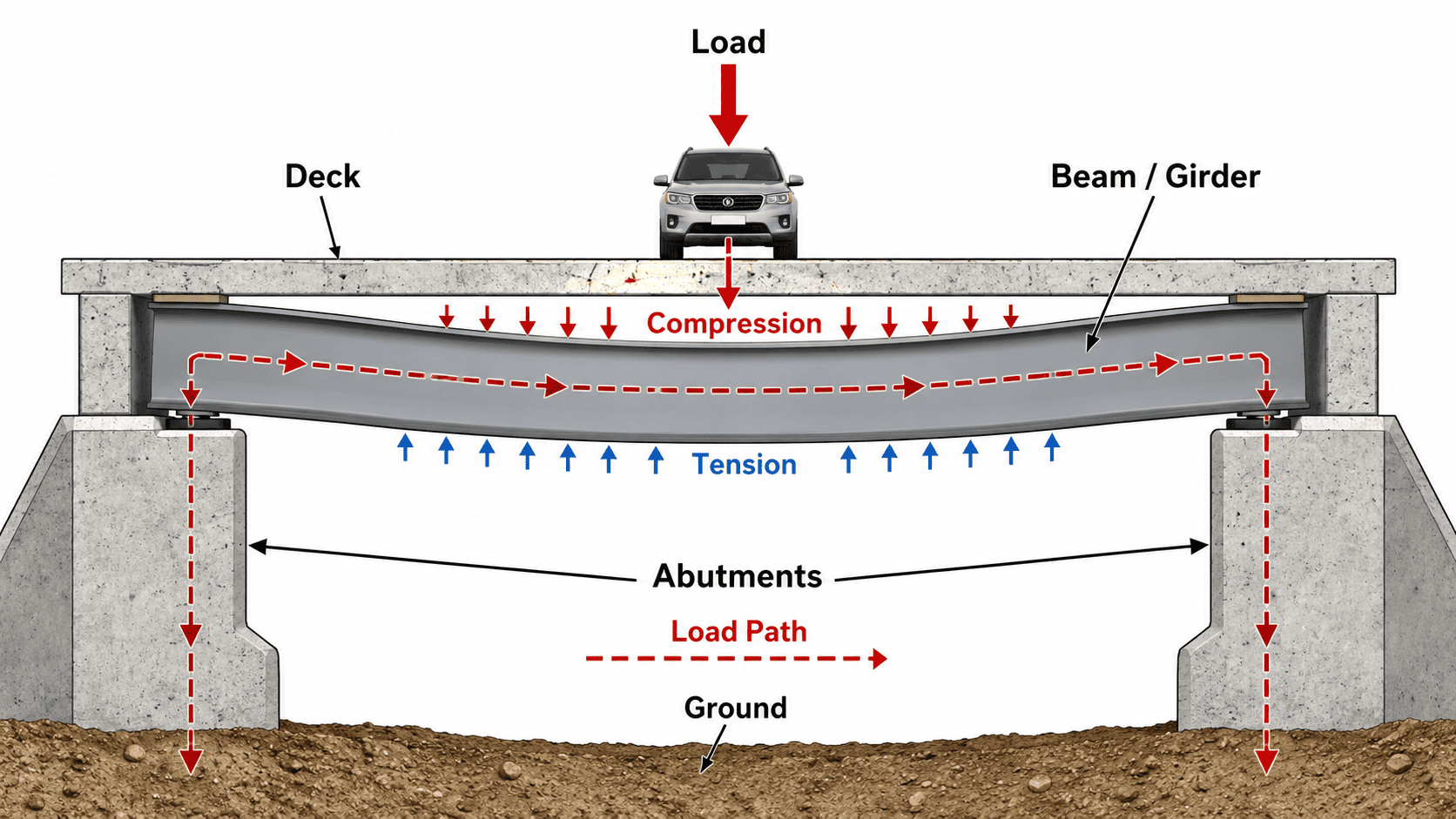
When a load passes over a beam bridge, the beam experiences two important forces: compression and tension. These forces happen because the beam bends slightly under weight.
The top part of the beam is usually pushed together. This is called compression. At the same time, the bottom part of the beam is stretched. This is called tension.
A simple way to picture this is to imagine pressing down on the middle of a ruler supported at both ends. The upper side of the ruler is squeezed, while the lower side is pulled apart. In a beam bridge, the same basic action happens, although the bridge is much stronger and designed to control this bending.
This is why the material of the beam matters. Concrete is strong in compression, while steel is strong in tension. Reinforced concrete combines both qualities by using concrete together with steel reinforcement. This helps the bridge resist both the squeezing forces at the top and the stretching forces at the bottom.
Understanding compression and tension helps explain why beam bridges must be designed carefully. Even though the structure looks simple, the beam must be strong enough to handle the forces created by its own weight and by the traffic that crosses it.
How Loads Move to the Supports
Every beam bridge must manage loads. A load is any weight or force acting on the bridge. This includes the weight of the bridge itself, the deck, vehicles, pedestrians, trains, wind, and other forces that may affect the structure.
When a load is placed on the bridge, the beam carries that load and moves it toward the supports. These supports may be abutments at the ends of the bridge or piers placed between spans. The supports then transfer the weight down into the ground.
The abutments are especially important because they hold the ends of the bridge and help keep the structure stable. In longer beam bridges, piers may be added between the ends to give the beam more support. This reduces the distance each beam section must cover and helps the bridge carry heavier loads.
This load path is one of the most important ideas in beam bridge mechanics. The weight does not simply stay in the middle of the bridge. It travels through the beam, into the supports, and finally into the foundation below.
Because of this, a beam bridge is only as reliable as its supports. Even a strong beam needs stable abutments, piers, and foundations. If the supports are weak, poorly built, or placed on unstable ground, the entire bridge can become unsafe.
Why Span Length Matters
Span length is the distance between two supports. In a beam bridge, this distance is very important because the longer the span, the more the beam tends to bend under weight.
A short beam is easier to support because the load does not have to travel far before reaching the supports. A long beam, however, must carry the load over a greater distance. This creates more bending and requires stronger materials, deeper beams, or additional supports.
This is one reason beam bridges are usually best for short or medium spans. They can be very effective when the distance is reasonable, but they become less efficient when the crossing is very long. For long rivers, wide valleys, or large bays, other bridge types may be better because they are designed to handle longer spans more efficiently.
Engineers can extend the usefulness of a beam bridge by adding piers between the ends. Instead of one long span, the bridge can be divided into several shorter spans. This makes the structure stronger and reduces the amount of bending in each beam section.
Span length also affects construction cost and design complexity. A longer beam may require more material, heavier equipment, deeper foundations, and more detailed engineering. For this reason, beam bridges are often chosen when the crossing is short enough for the design to remain simple, strong, and cost-effective.
Main Parts of a Beam Bridge
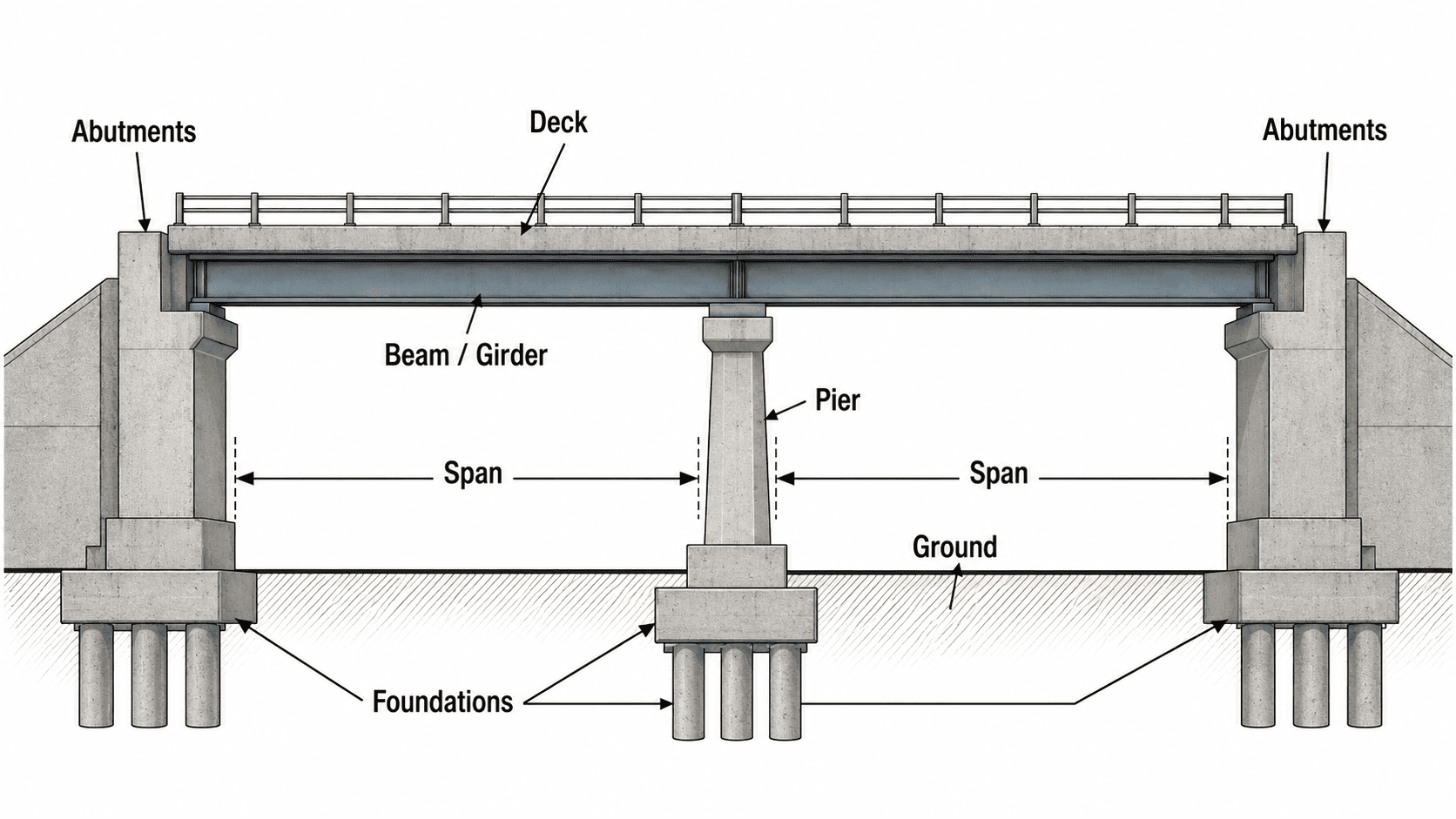
A beam bridge may look simple from the outside, but it is made of several important parts that work together to support weight and keep the crossing stable. The main parts of a beam bridge usually include the beam or girder, the deck, the abutments, and, in longer bridges, piers.
Each part has a specific function. The beam carries the main load, the deck provides the travel surface, and the supports hold the structure in place. Understanding these parts makes it easier to see why beam bridges are practical, strong, and widely used in roads, railways, pedestrian crossings, and overpasses.
Beam or Girder
The beam, also called a girder, is the main horizontal structural element of a beam bridge. It is the part that spans the gap between supports and carries the weight placed on the bridge.
In a small bridge, the beam may be a simple wooden or steel member. In a larger road or railway bridge, the beam may be a heavy steel girder, a reinforced concrete beam, or a prestressed concrete girder designed to carry much greater loads.
The beam or girder is important because it gives the bridge its basic strength. It supports the deck above it and helps transfer the weight of traffic, pedestrians, or trains toward the supports. Without a strong beam, the bridge would not be able to span the gap safely.
Some beam bridges use one large beam, while others use several beams placed side by side. In many road bridges, multiple girders are installed under the deck to distribute the load more evenly. This allows the bridge to carry wider lanes, heavier vehicles, or more frequent traffic.
The size, depth, shape, and material of the beam depend on the purpose of the bridge. A pedestrian bridge does not need the same type of girder as a highway overpass or railway bridge. Engineers choose the beam based on the expected load, span length, location, and required durability.
Deck
The deck is the surface of the bridge where movement takes place. It is the part people walk on, vehicles drive on, or trains travel across.
On a road beam bridge, the deck usually includes the roadway surface, lanes, shoulders, and sometimes sidewalks or barriers. On a pedestrian beam bridge, the deck may be made of timber planks, steel panels, concrete slabs, or composite materials. On a railway beam bridge, the deck must support tracks, ties, and the loads created by trains.
The deck does not work alone. It rests on the beam or girders beneath it, which provide the main structural support. When traffic moves across the deck, the weight is passed into the beams and then down into the supports.
A good deck must be strong, stable, and safe for the type of use it serves. For vehicles, it must provide a durable driving surface. For pedestrians, it must offer a secure walking path. For trains, it must support heavy and repeated loads without losing stability.
The deck also affects the comfort and safety of the bridge. Features such as guardrails, curbs, drainage systems, anti-slip surfaces, and protective barriers may be added depending on the bridge’s purpose and location. These details help make the bridge safer and more functional for everyday use.
Abutments and Piers
Abutments are the supports located at the ends of a beam bridge. They hold the ends of the beam and help transfer the bridge’s load into the ground. Every beam bridge needs abutments because they provide the main support at each side of the crossing.
An abutment also helps connect the bridge to the road, path, or railway approaching it. In many cases, it holds back the soil behind the bridge and creates a stable transition between the ground and the bridge deck.
Piers are intermediate supports placed between the end abutments when a beam bridge has more than one span. Instead of making one very long beam stretch across the entire distance, engineers can use piers to divide the bridge into shorter sections.
This is useful because shorter spans are easier to support and usually require less bending strength than one long span. By adding piers, a beam bridge can cross a wider obstacle while still using the same basic structural concept.
For example, a short beam bridge over a small stream may only need two abutments. A longer bridge over a road, railway, or wider waterway may need one or more piers between the ends. These piers help support the beams and keep the bridge stable under repeated use.
Abutments and piers must be strong because they receive the forces coming from the bridge. They are usually built from reinforced concrete, stone, masonry, or other durable materials. Their foundations must also be stable enough to resist movement, settlement, water flow, soil pressure, and the weight transferred from the bridge above.
Beam Bridge Construction
Beam bridge construction is usually more straightforward than the construction of many other bridge types. Since the main idea is based on placing strong horizontal beams over supports, the process can often be planned, built, and inspected with a clear sequence of steps.
Even though the design may look simple, a beam bridge still requires careful engineering. The bridge must be able to carry its own weight, support traffic safely, resist environmental conditions, and remain stable over time. For that reason, construction involves more than just placing beams across a gap. It includes planning, site preparation, support construction, beam installation, deck placement, and structural inspection.
Basic Construction Process
The construction of a beam bridge usually begins with the design stage. Engineers study the location, the distance that must be crossed, the expected loads, the soil conditions, the type of traffic, and the materials that will be used. A pedestrian bridge, for example, does not need the same design as a highway overpass or railway bridge.
After the design is completed, the site must be prepared. This may include clearing the area, measuring the span, improving access for equipment, and preparing the ground where the supports will be built. If the bridge crosses water, extra planning may be needed to protect the site and keep the foundations stable.
The next major step is the construction of the supports. These supports may include abutments at both ends of the bridge and piers in the middle if the bridge has more than one span. The supports must be strong because they receive the weight transferred from the beams and deck.
Once the supports are ready, the beams or girders are placed into position. In many modern beam bridges, these beams may be made from steel, reinforced concrete, or prestressed concrete. Some are built on-site, while others are prefabricated and transported to the location. Prefabricated beams can make construction faster because they arrive already shaped and prepared for installation.
After the beams are installed, the deck is added. The deck creates the surface used by vehicles, pedestrians, or trains. Depending on the project, the deck may include concrete slabs, pavement, rail tracks, sidewalks, barriers, drainage systems, or protective railings.
The final stage is inspection and finishing work. Engineers and construction teams check whether the bridge is aligned correctly, whether the beams and supports are secure, and whether the deck is safe for use. Additional details such as guardrails, signs, lighting, waterproofing, expansion joints, and surface treatments may also be added before the bridge opens.
This step-by-step process helps explain why beam bridges are often considered practical and efficient. Their construction can be simpler than more complex bridge types, but they still require careful design and professional execution to perform safely.
Common Uses in Roads, Railways, and Pedestrian Crossings
Beam bridges are commonly used in many types of transportation infrastructure, especially where the span is short or medium in length. In the United States, many highway overpasses, short road bridges, railway bridges, and pedestrian bridges use some form of beam bridge design.
Highway overpasses are one of the most recognizable examples. These bridges often carry roads over other roads, ramps, rail lines, or drainage channels. Beam bridge construction works well in these situations because the span is usually manageable and the design can support regular vehicle traffic.
Short road bridges also commonly use beam construction. These bridges may cross small rivers, creeks, drainage areas, canals, or low sections of land. In rural and urban areas, beam bridges provide a practical way to keep traffic moving without requiring a highly complex structure.
Railway beam bridges are another important use. Trains are heavy, so railway bridges must be strong, stable, and durable. Steel and reinforced concrete beam bridges can be useful for railway crossings because they provide direct support and can be designed for repeated heavy loads.
Pedestrian beam bridges are often used in parks, campuses, trails, neighborhoods, and public spaces. These bridges may cross small streams, roads, landscaped areas, or walking paths. Because pedestrian loads are usually lighter than vehicle or train loads, these bridges can sometimes use simpler designs and lighter materials.
Beam bridge construction remains popular because it fits many everyday infrastructure needs. When the crossing distance is not too long and the project requires a strong, reliable, and cost-effective solution, a beam bridge is often one of the most practical choices.
What Are Beam Bridges Made Of?
Beam bridges can be made from several materials, depending on their purpose, size, location, budget, and expected load. The most common materials include wood, steel, reinforced concrete, and modern composite materials such as FRP.
Each material has different strengths. Wood is simple and traditional, steel is strong and flexible, reinforced concrete is durable and widely used in modern infrastructure, and composite materials can offer advantages in special conditions where corrosion resistance or low weight is important.
Wood Beam Bridges
Wood is one of the oldest materials used in beam bridge construction. Early beam bridges often used logs or timber because wood was available, easy to shape, and simple to place across small gaps.
Today, wood beam bridges are still used in certain situations, especially for small bridges, rural crossings, park trails, private roads, and pedestrian bridges. They are useful when the bridge does not need to carry very heavy traffic and when a natural appearance is desired.
A wood beam bridge can work well for short spans because timber can support light to moderate loads when properly selected and maintained. In parks, gardens, nature reserves, and walking trails, wood is often chosen because it blends well with the environment.
However, wood also has limitations. It can be affected by moisture, insects, rot, and weathering if it is not protected. For that reason, wooden beam bridges usually need regular inspection, treatment, and maintenance to remain safe over time.
Even with these limitations, wood remains an important material in the history and practical use of beam bridges. It shows how the basic beam bridge design can be built with simple materials while still serving real transportation needs.
Steel Beam Bridges
Steel is one of the most important materials used in modern beam bridges. It is strong, durable, and capable of carrying heavy loads, which makes it useful for roads, railways, industrial areas, and highway infrastructure.
A steel beam bridge often uses steel girders as the main supporting elements. These girders can span longer distances than many simple wooden beams and can support heavier traffic. Because steel has high tensile strength, it is especially useful in structures where the lower part of the beam must resist stretching forces.
Steel beam bridges are common in transportation systems because they can be fabricated into precise shapes and installed efficiently. In many projects, steel girders are manufactured off-site and then transported to the bridge location. This can help reduce construction time and improve quality control.
Another advantage of steel is that it can be used in different beam shapes, such as I-beams and box girders. These shapes help the structure carry loads more efficiently while using material in a practical way.
The main challenge with steel is corrosion. When steel is exposed to water, salt, humidity, or harsh weather, it may rust if not properly protected. For this reason, steel beam bridges often need coatings, painting, drainage control, and regular maintenance.
Despite this, steel remains a major material for beam bridges because it provides strength, reliability, and flexibility for many modern infrastructure needs.
Reinforced Concrete Beam Bridges
Reinforced concrete is one of the most common materials used in beam bridges today. It combines concrete and steel reinforcement so the structure can resist both compression and tension more effectively.
Concrete performs well under compression, while steel reinforcement helps resist tension. This combination makes reinforced concrete very useful for road bridges, highway overpasses, urban bridges, and short to medium crossings.
Many reinforced concrete beam bridges are used in cities because they are durable and can handle regular vehicle traffic. They are also common in highway systems, where bridges must support cars, trucks, and repeated daily use.
Reinforced concrete can be poured on-site or used in precast elements. In some projects, concrete beams are made in a controlled environment and then transported to the construction site. This can help improve consistency and speed up installation.
Another reason reinforced concrete is widely used is its durability. When properly designed and maintained, it can resist weather, traffic loads, and long-term wear. It also requires less frequent painting than steel, although it still needs inspection to detect cracks, corrosion of reinforcement, drainage problems, or surface damage.
Reinforced concrete beam bridges are often chosen when the project needs a strong, practical, and long-lasting structure. They are especially common in everyday infrastructure where reliability and cost control are important.
FRP and Modern Composite Materials
Modern beam bridges may also use composite materials such as FRP, which stands for fiber-reinforced polymer. FRP is made by combining strong fibers with a polymer resin, creating a material that can be lightweight, strong, and resistant to corrosion.
FRP and other composite materials are not as historically common as wood, steel, or reinforced concrete, but they represent an important step in the evolution of bridge materials. They are often considered in projects where weight, durability, or resistance to moisture and chemicals is especially important.
One advantage of FRP is that it does not rust like steel. This can make it useful in environments exposed to water, salt, or corrosive conditions. Because it is relatively lightweight, it can also be easier to transport and install in some bridge projects.
FRP may be used for pedestrian bridges, bridge decks, strengthening systems, or special structural components. In some cases, it can help extend the life of an existing bridge by reinforcing parts of the structure without adding too much extra weight.
However, composite materials also have limitations. They may cost more than traditional materials, and engineers must carefully evaluate how they perform under long-term loads, temperature changes, impact, and fire exposure.
Even so, FRP and modern composites show how beam bridge design continues to evolve. The basic idea of a beam bridge remains simple, but the materials used to build it keep improving as engineering technology advances.
Types of Beam Bridges
Beam bridges can be grouped into different types based on how they are supported, how many spans they have, and what purpose they serve. Although all beam bridges follow the same basic structural idea, not every beam bridge is built the same way.
Some beam bridges are very simple and cover only a short distance. Others use several supports to cross longer gaps. Some are designed for cars and trucks, while others are built only for pedestrians. Understanding these types makes it easier to see how flexible the beam bridge design can be.
Simple Beam Bridge
A simple beam bridge is the most basic type of beam bridge. It uses one horizontal beam or girder supported at two ends. The supports may be abutments, walls, or other stable structures that hold the beam in place.
This type of bridge is often used for short spans because the beam has to carry the load from one support to the other without any intermediate support. If the span becomes too long, the beam may bend too much or require a much stronger and heavier design.
A simple beam bridge can be found in small road crossings, rural paths, short pedestrian bridges, drainage crossings, and basic overpasses. Its main advantage is that the design is easy to understand and relatively direct to build.
Because of its simplicity, this type of bridge is often used in educational examples. When students learn about bridge design, a simple beam bridge is usually one of the first structures they study because it clearly shows how a horizontal member carries weight between two supports.
Even though the design is basic, a simple beam bridge must still be properly planned. The beam must be strong enough for the expected load, and the supports must be stable enough to hold the structure safely.
Continuous Beam Bridge
A continuous beam bridge is a beam bridge that extends over more than two supports. Instead of having one beam section supported only at both ends, the structure continues across several supports or piers.
This type of design allows the bridge to cover longer distances by dividing the crossing into multiple spans. Each span is shorter than the full length of the bridge, which helps reduce bending and makes the structure more efficient.
Continuous beam bridges are often used in roads, highways, railways, and urban infrastructure where a single short span is not enough. For example, a bridge that crosses several lanes of traffic, a wide drainage channel, or a broad low area may use piers to create several connected spans.
One important advantage of a continuous beam bridge is that the load can be shared across multiple supports. This can improve strength and stability when compared with a single simple span. It also allows engineers to design longer bridges while still using the beam bridge concept.
However, continuous beam bridges are more complex than simple beam bridges. The design must account for how the beam behaves over each support, how the loads are distributed, and how the structure responds to movement, temperature changes, and repeated traffic.
Even with this added complexity, continuous beam bridges remain a practical choice when a project needs a strong and efficient crossing over a medium distance.
Pedestrian Beam Bridge
A pedestrian beam bridge is a beam bridge designed mainly for people walking, cycling, or using light personal mobility devices. These bridges are common in parks, campuses, neighborhoods, trails, gardens, public spaces, and recreational areas.
Because pedestrian bridges usually carry lighter loads than road or railway bridges, they can often use simpler and lighter designs. A pedestrian beam bridge may be made from wood, steel, reinforced concrete, aluminum, or composite materials, depending on the location and the desired appearance.
The design of a pedestrian beam bridge must focus not only on strength, but also on safety and comfort. The deck should provide a stable walking surface, and the bridge usually needs railings, guardrails, or barriers to protect users.
In public spaces, appearance may also matter. A pedestrian beam bridge may be designed to blend with a natural setting, match nearby architecture, or create an attractive connection between two areas. This is why wood and composite materials are sometimes used in parks or trails, while steel and concrete may be chosen for urban locations.
Pedestrian beam bridges are useful because they provide simple crossings without requiring large or complex structures. They can help people cross streams, roads, landscaped areas, railway lines, or uneven ground safely and directly.
Although they may be smaller than road or railway beam bridges, pedestrian beam bridges still follow the same important principle: a horizontal structure spans a gap and transfers the load to stable supports.
Advantages of Beam Bridges
Beam bridges have several advantages that make them one of the most practical bridge types for many everyday crossings. Their main strengths are simplicity, lower cost, faster construction, and reliable performance over short or medium spans.
These advantages explain why beam bridges are still widely used in roads, highways, pedestrian crossings, railway routes, and small infrastructure projects.
Simple Design
One of the biggest advantages of a beam bridge is its simple design. The structure is easy to understand because it is based on a horizontal beam supported by strong foundations.
This simplicity makes beam bridges easier to design, build, inspect, and maintain compared with more complex bridge types. Engineers can adapt the basic concept to different locations, materials, and traffic needs without changing the main structural idea.
A simple design is especially useful for projects where the crossing does not require a long span or a highly complex structure. For small rivers, drainage channels, local roads, pedestrian paths, and overpasses, a beam bridge can provide a direct and effective solution.
Because the design is straightforward, beam bridges are also easier for students and general readers to understand. This is one reason they are often used as a basic example when explaining how bridges work.
Lower Construction Cost
Beam bridges are often more affordable than many other bridge types, especially when the span is short. Their simple structure usually requires fewer complex components, less specialized construction, and a more direct building process.
The cost advantage is especially clear when the bridge can be built with standard materials such as reinforced concrete, steel girders, or timber. In many cases, the materials are readily available, and the construction methods are familiar to engineers and contractors.
A beam bridge may also reduce costs because it does not usually need towers, cables, large arches, or complicated support systems. This makes it a practical choice for smaller crossings where a more expensive bridge type would not be necessary.
However, the cost benefit depends on the project. A beam bridge is usually most economical when the distance is short or moderate. If the crossing is very long, the need for larger beams or multiple supports can increase the cost.
Fast Installation
Another advantage of beam bridges is that they can often be installed quickly. This is especially true when prefabricated beams or girders are used.
Prefabricated beams are made before they arrive at the construction site. Once the supports are ready, the beams can be transported, lifted into place, and connected to the rest of the structure. This can shorten the construction schedule and reduce disruption to traffic or nearby communities.
Fast installation is useful for highway overpasses, road repairs, rural crossings, pedestrian bridges, and projects where time is important. In some cases, using ready-made components can help reopen a road or restore access more quickly.
A faster construction process does not mean the bridge is less important or less carefully built. The structure still needs proper design, safe installation, and final inspection. The advantage is that the basic beam bridge system can often be assembled more efficiently than more complicated bridge designs.
Reliable for Short Spans
Beam bridges are especially reliable for short spans. When the distance between supports is not too long, the beam can carry the load effectively without excessive bending.
This makes beam bridges a good choice for small rivers, creeks, road crossings, drainage channels, pedestrian paths, and many highway overpasses. In these situations, the bridge does not need to cover a very large distance, so the beam design can perform well.
For short and medium spans, beam bridges can offer a strong balance of safety, cost, simplicity, and durability. They can support vehicles, pedestrians, or trains when they are properly designed for the expected load.
The key requirement is having strong and stable supports. A beam bridge depends on its abutments, piers, and foundations to hold the structure safely. When those supports are properly built, beam bridges can provide long-lasting service in many common infrastructure settings.
Disadvantages of Beam Bridges
Beam bridges are practical and widely used, but they also have important limitations. Their simple structure works very well in many situations, but it is not always the best option for every crossing.
The main disadvantages of beam bridges are their limited span length, lower efficiency for very long crossings, and strong dependence on solid supports. These limits are important because they help explain when another bridge type may be more suitable.
Limited Span Length
One of the main disadvantages of a beam bridge is its limited span length. A beam can only stretch so far between supports before it begins to bend too much under weight.
As the span becomes longer, the beam must carry the load over a greater distance. This increases bending and makes the structure more difficult to design efficiently. To solve this problem, engineers may need to use deeper beams, stronger materials, or additional supports.
This is why beam bridges are usually better for short or medium spans. They can be very effective for small rivers, roads, drainage channels, pedestrian crossings, and highway overpasses. However, when the distance becomes too long, a simple beam design may no longer be the most practical choice.
Adding piers can help extend the total length of a beam bridge by dividing the crossing into several shorter spans. Even so, this does not remove the basic limitation. Each span still needs proper support, and the bridge may become more expensive or complicated if many intermediate supports are required.
Less Efficient for Very Long Crossings
Beam bridges are generally less efficient for very long crossings such as wide rivers, deep valleys, large bays, or major waterways. In these situations, other bridge types may provide better performance because they are designed to cover longer distances with fewer supports.
For example, suspension bridges and cable-stayed bridges can span much longer distances because their cables and towers distribute loads in a different way. Arch bridges and truss bridges may also be more efficient in certain settings because they use different structural systems to manage forces.
A beam bridge can still be used across a longer area if several spans and piers are added. However, this may not always be ideal. Building many piers can increase cost, require more foundation work, affect water flow, or create obstacles below the bridge.
This is especially important in places where supports cannot easily be built in the middle of the crossing. A deep river, busy shipping channel, unstable soil, or protected environmental area may make intermediate piers difficult or undesirable.
For that reason, beam bridges are usually not the first choice for very long or complex crossings. They are most useful when the project needs a direct, strong, and economical solution over a manageable distance.
Requires Strong Supports
Another disadvantage of a beam bridge is that it depends heavily on strong supports. The abutments and piers must be able to receive the loads from the beam and transfer them safely into the ground.
If the supports are weak, poorly built, or placed on unstable soil, the entire bridge can be affected. Even a strong beam cannot perform safely if the foundation beneath it is not reliable.
This is why the condition of the ground matters. Before building a beam bridge, engineers must consider the soil, water conditions, slope, erosion risk, and the weight the bridge will carry. The supports must remain stable not only when the bridge is new, but also after years of traffic, weather, and environmental exposure.
Strong supports are especially important when the bridge carries heavy vehicles, trains, or repeated daily traffic. The more weight the bridge must handle, the more important the abutments, piers, and foundations become.
In some locations, building these supports can be challenging. Soft soil, moving water, flood risk, or limited construction space can make the project more difficult. In those cases, the support system may increase the cost and complexity of the bridge.
This dependence on strong supports is not a weakness in every situation, but it is an important design requirement. A beam bridge can be simple and reliable, but only when the supports beneath it are properly planned, built, and maintained.
Beam Bridge Examples
Beam bridge examples can be found in many everyday places. Although people may not always recognize them by name, beam bridges are commonly used in highway overpasses, railway crossings, pedestrian bridges, local road bridges, and short infrastructure crossings.
In many cases, a beam bridge is chosen because the crossing is practical, direct, and not too long. This makes the design useful for transportation systems where strength, simplicity, and cost control are important.
Highway Overpasses
Highway overpasses are among the most common examples of beam bridges, especially in the United States. Many overpasses that carry one road over another use beams or girders supported by abutments and piers.
Drivers often pass under or over these bridges without realizing they are seeing a beam bridge design. The structure may look simple from the road, but it performs an important job by allowing traffic to move safely at different levels.
A highway overpass may use steel girders, reinforced concrete beams, or prestressed concrete girders. These beams support the deck where vehicles travel and transfer the load to the supports below.
Beam bridges work well for many overpasses because the span is usually short or medium in length. The bridge only needs to cross a road, ramp, railway line, drainage channel, or small obstacle. In these cases, a beam bridge can provide a strong and efficient solution without requiring towers, cables, or arches.
This is why beam bridge design is so common in highway systems. It supports regular traffic, can be built with familiar materials, and fits many standard road-crossing situations.
Railway Beam Bridges
Railway beam bridges are another important example. Railways need bridges that can support heavy loads, repeated movement, and strong vibrations from passing trains.
A beam bridge can be useful in railway infrastructure because the design is direct and strong. Steel and reinforced concrete beam bridges are often used where train tracks must cross roads, small rivers, drainage areas, or uneven ground.
Railway beam bridges must be designed with special care because trains are much heavier than ordinary pedestrian or road traffic. The bridge must support not only the weight of the train, but also the repeated forces created as trains pass over the structure.
In many railway settings, beam bridges are chosen because they provide stable support over manageable spans. Their simple structural form makes them practical for crossings where strength and durability are more important than decorative appearance.
These bridges may not always look dramatic, but they play an essential role in transportation. They help trains move across obstacles safely while keeping the rail route continuous and reliable.
Pedestrian Beam Bridges
Pedestrian beam bridges are common in parks, campuses, trails, neighborhoods, public gardens, and recreational areas. They are used to help people cross small streams, roads, landscaped areas, drainage channels, or uneven ground.
These bridges are usually smaller than road or railway beam bridges because they carry lighter loads. However, they still need to be safe, stable, and comfortable for users.
A pedestrian beam bridge may be made from wood, steel, reinforced concrete, aluminum, or composite materials. In natural areas, wood may be chosen because it blends with the landscape. In urban settings, steel or concrete may be used for durability and a cleaner modern appearance.
Pedestrian beam bridges often include railings, walking surfaces, anti-slip materials, and sometimes lighting. These features help make the bridge safer for daily use, especially in public spaces.
One reason pedestrian beam bridges are so common is that they provide a simple way to connect two areas. A small bridge in a park, a campus walkway over a drainage channel, or a trail bridge over a stream can all use the same basic beam bridge concept.
Even though pedestrian beam bridges may be modest in size, they are useful examples of how the beam bridge design can serve everyday movement in a simple and effective way.
Beam Bridge vs. Other Bridge Types
A beam bridge is only one of several major bridge types. To understand its strengths and limits, it helps to compare it with arch bridges, truss bridges, and suspension bridges.
The main difference is how each bridge carries and distributes loads. A beam bridge depends on horizontal beams and strong supports, while other bridge types use arches, triangular frameworks, cables, or towers to manage forces in different ways.
Beam Bridge vs. Arch Bridge
A beam bridge uses a horizontal beam or girder to carry weight across a gap. The load moves through the beam and down into the supports at the ends or into piers between spans.
An arch bridge works differently. Instead of relying mainly on a straight horizontal beam, it uses a curved arch to distribute forces. The arch pushes loads outward and downward toward the supports, which are often called abutments.
This makes arch bridges useful in situations where the curved shape can help carry weight efficiently. Stone arch bridges, for example, were historically important because stone performs well under compression. The arch shape allowed builders to create durable bridges long before modern steel and reinforced concrete became common.
Beam bridges are usually simpler in appearance and construction. They are often practical for short or medium spans where a direct horizontal structure is enough. Arch bridges, on the other hand, may be more visually distinctive and can be very strong when the site and materials are suitable.
In simple terms, a beam bridge carries loads mainly through a straight beam, while an arch bridge carries loads through a curved structure that redirects forces into its supports.
Beam Bridge vs. Truss Bridge
A truss bridge uses a framework of connected triangles to support and distribute loads. These triangular patterns help the bridge spread forces more efficiently across the structure.
A beam bridge is more direct. It uses beams or girders to span the gap, with the load moving into the supports below. It does not need the visible triangular framework that defines a truss bridge.
The main advantage of a truss bridge is that the triangular design can provide strength while using material efficiently. This can make truss bridges useful for longer spans or heavier loads than a basic beam bridge might handle on its own.
Truss bridges are often seen in older railway bridges, road bridges, and industrial crossings. Their geometric structure makes them easy to recognize because the sides or overhead sections often show repeated triangle shapes.
Beam bridges are usually simpler and may be easier to build for shorter crossings. Truss bridges are more complex, but they can distribute loads across many connected members, making them useful where additional structural efficiency is needed.
The key difference is that a beam bridge relies mainly on horizontal beams, while a truss bridge uses a network of triangles to strengthen the structure and spread the load.
Beam Bridge vs. Suspension Bridge
A suspension bridge is designed for much longer spans than most beam bridges. Instead of using only beams supported from below, a suspension bridge uses large cables, towers, and anchorages to hold the deck.
In a suspension bridge, the deck hangs from vertical suspenders connected to main cables. These main cables pass over tall towers and are anchored at both ends. This system allows suspension bridges to cross wide rivers, bays, and deep valleys where placing many supports below would be difficult or impossible.
A beam bridge is usually much simpler. It depends on beams, girders, abutments, and sometimes piers. This makes it practical for shorter crossings, overpasses, local roads, railway crossings, and pedestrian bridges.
Suspension bridges can cover impressive distances, but they are also more complex and expensive to design, build, and maintain. They require towers, massive cables, strong anchorages, aerodynamic planning, and careful engineering to handle wind, traffic, and movement.
Beam bridges do not offer the same long-span capability, but they are often more economical and practical when the crossing is short or medium in length. For this reason, a beam bridge may be the better choice for everyday infrastructure, while a suspension bridge is better suited for major long-distance crossings.
The basic comparison is clear: beam bridges are simpler and cost-effective for shorter spans, while suspension bridges are better for very long crossings but require much more complex engineering.
When Is a Beam Bridge the Best Choice?
A beam bridge is often the best choice when the crossing is short, direct, and does not require a highly complex structure. It works especially well when the project needs a practical bridge that can be built with familiar materials, supported by stable foundations, and maintained without excessive difficulty.
This makes beam bridges useful in many everyday infrastructure projects. They are not always the right option for very long or difficult crossings, but they are highly effective when the distance is manageable and the site conditions are suitable.
Best Applications for Beam Bridges
Beam bridges are best suited for short and medium spans. They are commonly used where the distance between supports is not too great and where the bridge can safely transfer loads into strong abutments or piers.
One of the best applications is a short road bridge. These bridges may cross small rivers, creeks, drainage channels, canals, or uneven ground. In these situations, a beam bridge can provide a strong and direct solution without needing a more complex bridge system.
Beam bridges are also a good choice for pedestrian crossings. A pedestrian beam bridge can connect walking paths, parks, campuses, trails, neighborhoods, and public spaces. Because these bridges usually carry lighter loads than highway or railway bridges, the design can often remain simple while still being safe and durable.
Rural roads are another common setting. In rural areas, bridges often need to cross small waterways, ditches, or low sections of land. A beam bridge can be practical because it is usually straightforward to construct and can be adapted to local conditions.
Small urban bridges can also use beam bridge design. These may appear in city streets, service roads, drainage crossings, industrial areas, or local transportation networks. When the span is not too long, a beam bridge can fit well into a compact urban environment.
Highway overpasses are also strong examples of where beam bridges are often a good choice. Many overpasses only need to cross another road, ramp, railway line, or drainage area. In these cases, beams or girders can support the deck efficiently while keeping the design practical and reliable.
Overall, a beam bridge is a good option when the project needs simplicity, strength, reasonable cost, and dependable performance over a limited distance.
When Another Bridge Type May Be Better
Another bridge type may be better when the crossing is very long, very deep, or difficult to support from below. Beam bridges depend heavily on supports, so they are not always the most efficient choice when placing piers or abutments is difficult.
For large rivers, wide bays, deep valleys, or major waterways, a suspension bridge, cable-stayed bridge, arch bridge, or truss bridge may be more suitable. These bridge types can often handle longer spans more efficiently than a basic beam bridge.
A suspension bridge, for example, may be better for a very long crossing because its cables and towers allow the deck to span great distances without many supports in the middle. A cable-stayed bridge can also be useful for long spans where a strong tower-and-cable system is more efficient than multiple beam spans.
An arch bridge may be a better choice when the site allows forces to be directed into strong supports at each end. A truss bridge may be useful when a stronger framework is needed to distribute loads across a longer or heavier crossing.
Another bridge type may also be better when the site has unstable soil, deep water, strong currents, heavy ship traffic, or environmental restrictions that make intermediate piers difficult to build. In those cases, relying on several beam supports may increase cost, complexity, or risk.
This does not mean beam bridges are weak or outdated. It simply means they are best used in the right setting. For short and medium crossings, they remain one of the most practical bridge types. For long, complex, or highly demanding crossings, other bridge designs may offer better performance.
Frequently Asked Questions About Beam Bridges
Beam bridges are simple in design, but many readers still have common questions about how they are used, why they are popular, and what limits they have. These frequently asked questions summarize the most important points in a clear and direct way.
What is the main purpose of a beam bridge?
The main purpose of a beam bridge is to allow people, vehicles, or trains to cross over an obstacle. That obstacle may be a river, road, railway, ditch, drainage channel, small valley, or uneven ground.
A beam bridge does this by using a horizontal structure supported at its ends. The beam carries the crossing surface and transfers the weight down into the supports. This makes it a practical solution when a safe and direct crossing is needed over a short or medium distance.
What is the strongest material for a beam bridge?
The strongest material for a beam bridge depends on the purpose of the bridge, the expected load, the span length, and the environment where it will be built. For many modern beam bridges, steel and reinforced concrete are among the most common strong materials.
Steel is valued because it has high strength and performs well under tension. This makes it useful for road bridges, railway bridges, and structures that need strong girders. Reinforced concrete is also widely used because it combines concrete, which is strong in compression, with steel reinforcement, which helps resist tension.
In many highway overpasses, urban bridges, and short road bridges, reinforced concrete is a practical and durable choice. In heavier or more demanding projects, steel girders may be preferred. The best material is not always the same for every bridge, because each project has different structural and environmental needs.
Are beam bridges still used today?
Yes, beam bridges are still used today. They remain one of the most common bridge types in modern infrastructure because they are simple, practical, and effective for many everyday crossings.
Beam bridges are used in roads, highway overpasses, railways, pedestrian bridges, rural routes, parks, campuses, and urban transportation systems. Many people cross beam bridges regularly without realizing what type of bridge they are using.
Modern beam bridges may use reinforced concrete, steel, prestressed concrete, or composite materials. Although the basic concept is very old, the materials and construction methods have improved over time. This allows beam bridges to continue serving modern transportation needs.
Why are beam bridges good for short distances?
Beam bridges are good for short distances because the beam can support the load without bending too much. When the span is short, the weight placed on the bridge can move more efficiently toward the supports.
As the span becomes longer, the beam has to carry the load over a greater distance. This increases bending and may require deeper beams, stronger materials, or additional supports. For this reason, beam bridges are most efficient when the crossing is short or moderate in length.
This is why beam bridges are commonly used for small rivers, drainage channels, pedestrian crossings, road overpasses, and local infrastructure. In these situations, they provide a strong and cost-effective solution without requiring a more complex bridge design.
What is the main weakness of a beam bridge?
The main weakness of a beam bridge is its limited span length. A beam bridge is not usually the best choice for very long crossings unless it includes intermediate supports or multiple spans.
If the distance between supports is too long, the beam may bend too much or require a much heavier and more expensive design. This can make the structure less efficient compared with other bridge types.
For wide rivers, deep valleys, large bays, or major long-distance crossings, suspension bridges, cable-stayed bridges, arch bridges, or truss bridges may be more suitable. Beam bridges are still very useful, but they work best when the span length matches the strengths of the design.
Final Thoughts on Beam Bridges
Beam bridges are one of the oldest, simplest, and most practical forms of bridge engineering. From early crossings made with wood and stone to modern structures built with steel, reinforced concrete, and composite materials, the basic idea has remained useful for centuries.
Their value comes from their simplicity. A beam bridge does not need towers, cables, arches, or complex structural systems to work well in the right setting. It uses a direct design that can be adapted to roads, railways, pedestrian crossings, rural routes, highway overpasses, and small urban bridges.
Beam bridges are also important because they often provide a cost-effective solution for short and medium spans. They can be easier to design, faster to install, and simpler to maintain than many more complex bridge types. This makes them a practical choice for many everyday infrastructure needs.
However, beam bridges also have limits. Their main weakness is span length. When a crossing becomes very long, such as a wide river, deep valley, or large bay, other bridge types may be more efficient. In those cases, suspension bridges, cable-stayed bridges, arch bridges, or truss bridges may offer better performance.
Even with this limitation, beam bridges remain highly relevant today. They show how a simple engineering concept can continue to serve modern transportation when supported by strong materials, careful design, and reliable foundations. For short and medium crossings, the beam bridge continues to be one of the most useful and dependable bridge types.
Related Entries: