
Viaducts: Definition, Uses, Types, Examples, and History
Viaducts are long elevated structures that carry roads, railways, walkways, or transit lines over land, water, valleys, roads, rail lines, and urban areas. They are usually built with a series of spans, piers, arches, beams, columns, or girders that keep transportation routes raised, stable, and continuous across difficult or complex terrain.
Unlike a short bridge that may cross one specific obstacle, a viaduct often extends across a broader area or multiple obstacles. Viaducts can pass over valleys, wetlands, city streets, floodplains, rail corridors, highways, or coastal zones while allowing movement, drainage, land use, or public space to continue below.
This article explains what viaducts are, how they are used, how they differ from bridges, what materials they are made of, and why they remain important in modern infrastructure. You will also learn about viaducts over land and water, common types of viaducts, famous examples around the world, their advantages and disadvantages, and their role in transportation history and future urban design.
What Is a Viaduct?
A viaduct is a long elevated structure that carries a road, railway, walkway, or transit line across land, water, valleys, roads, rail lines, or urban areas. It is usually made of a series of spans supported by piers, columns, arches, or beams. Instead of crossing only one small obstacle, viaducts often extend across longer distances or multiple obstacles while keeping transportation routes level, continuous, and efficient.
Viaducts are commonly used when building directly on the ground would be difficult, unsafe, disruptive, or inefficient. They can carry trains over uneven terrain, highways above city streets, pedestrian paths across busy corridors, or roadways over wetlands and flood-prone areas. Their main purpose is to keep movement flowing while allowing the space below to remain open for traffic, water, land use, or natural features.
Basic Definition of a Viaduct
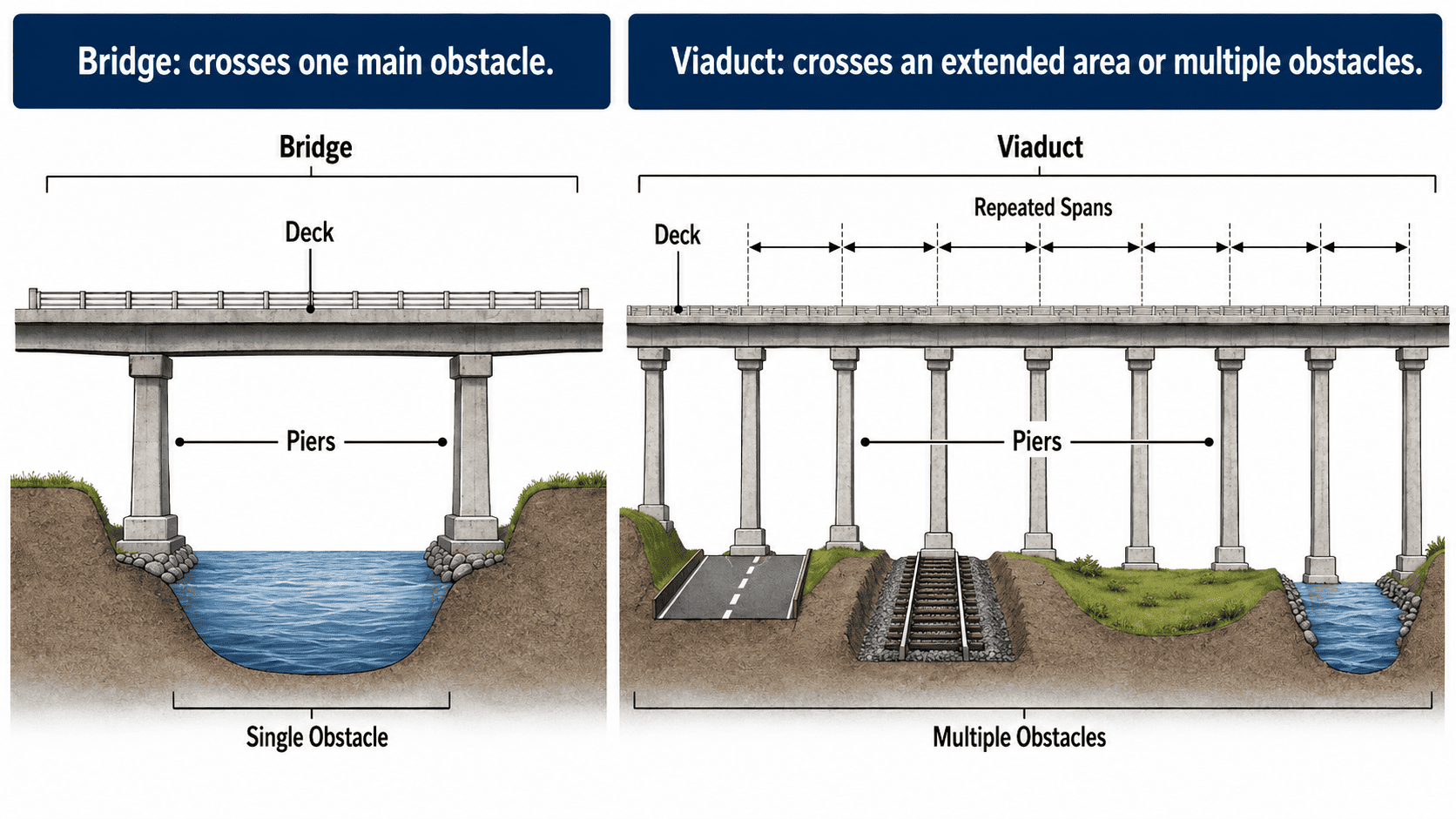
In simple terms, a viaduct is a type of bridge-like structure made to carry transportation over an extended area. A regular bridge often crosses a single obstacle, such as a river or road. A viaduct, by contrast, is typically longer and supported by repeated spans or a series of structural supports.
This is why viaducts are often seen in railways, elevated highways, metro systems, and large infrastructure projects. They are designed not just to cross something, but to maintain a raised route across a broader landscape or urban corridor.
Main Parts of a Viaduct
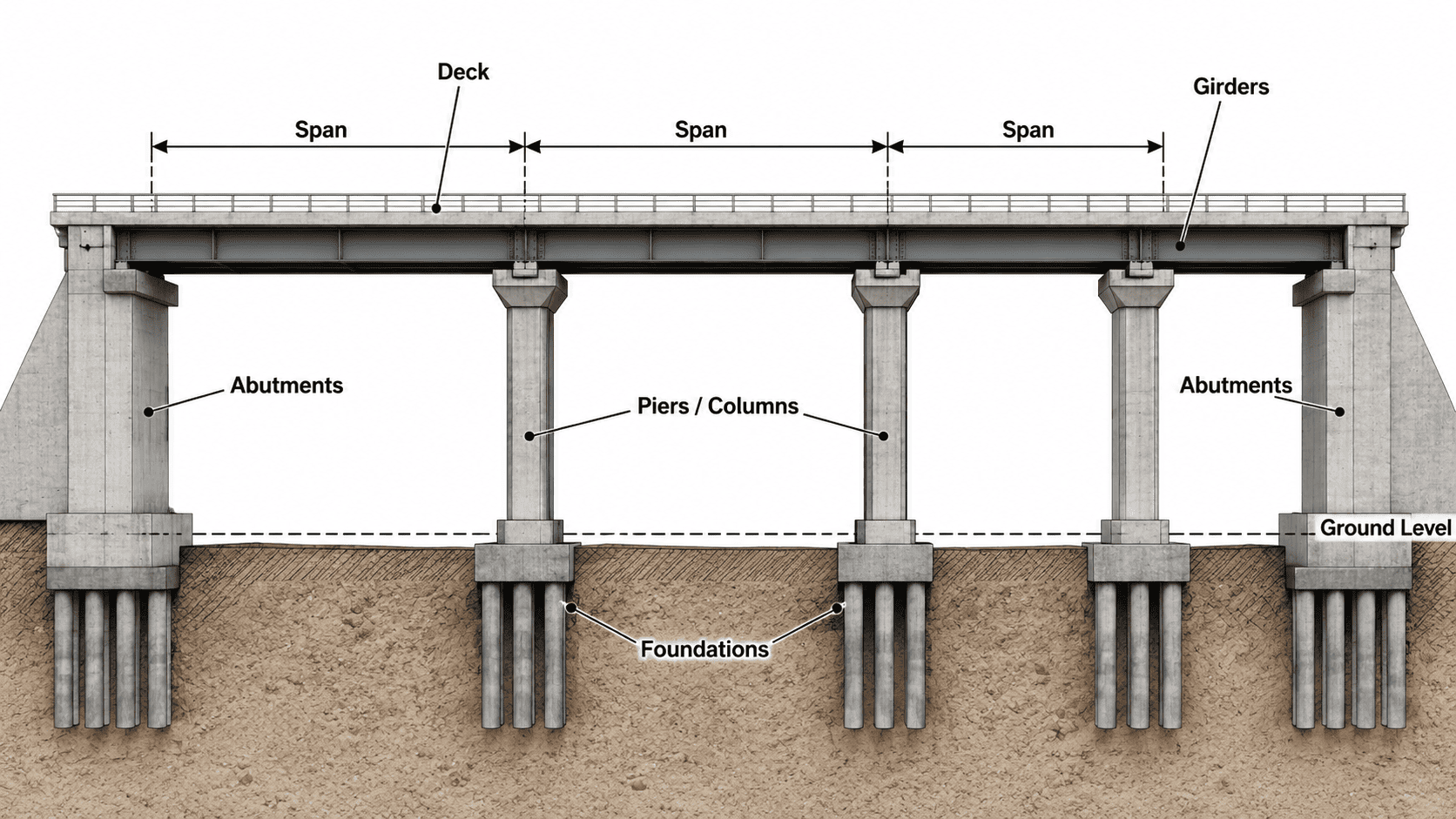
The main parts of a viaduct include the deck, spans, piers, foundations, and end supports. The deck is the surface that carries vehicles, trains, pedestrians, or transit systems. The spans are the sections between supports, and each span helps distribute the load across the structure.
Piers or columns support the viaduct from below and transfer loads into the foundations. The foundations anchor the structure into the ground and must be strong enough to handle weight, vibration, soil conditions, and environmental forces. Some viaducts also use arches, beams, girders, or box girders depending on the design.
Abutments are usually located at the ends of the viaduct, where the elevated structure connects back to the ground or to another section of roadway or railway. Together, these components allow a viaduct to carry transportation safely across long, complex, or obstructed areas.
Viaducts Over Land
Viaducts over land are built to carry roads, railways, walkways, or transit lines across terrain that would be difficult to cross at ground level. Instead of forcing a route to follow every rise, dip, road, rail line, or urban obstacle, a viaduct creates an elevated path that stays more direct and continuous.
This type of viaduct is common in valleys, hilly landscapes, dense cities, transportation corridors, and industrial areas. By lifting the route above the ground, engineers can reduce sharp changes in elevation, avoid conflicts with existing infrastructure, and keep movement flowing both on and below the structure.
Viaducts Across Valleys and Uneven Terrain
One of the most common uses of a viaduct is to cross valleys, ravines, or uneven land. In these settings, building a road or railway directly on the ground could require deep cuts, large embankments, steep grades, or major earthwork. A viaduct allows the route to pass over the terrain instead of reshaping the entire landscape.
This is especially important for railways, highways, and transit systems that need a smooth and stable alignment. A viaduct can maintain a more gradual grade while crossing low areas, small streams, service roads, or natural depressions. It can also reduce the amount of land disturbance compared with filling an entire valley or cutting heavily into hillsides.
Urban Viaducts and Elevated Roads
In cities, viaducts are often used to carry highways, rail lines, metro systems, or pedestrian routes above streets and developed areas. An urban viaduct can separate fast-moving traffic from local roads, reduce conflicts at intersections, and allow transportation lines to pass through crowded corridors where ground-level space is limited.
Elevated roads and transit viaducts can be practical in dense urban environments, but they also require careful planning. They may create shade, noise, visual barriers, and unused spaces below the structure. For this reason, modern urban design often considers not only the viaduct itself, but also how the area beneath and around it can function safely and usefully.
Railway Viaducts Over Land
Railway viaducts are especially important because trains need smoother grades and wider curves than ordinary roads. A steep or uneven route can reduce train efficiency, limit speed, and increase operating difficulty. By using a viaduct, railway engineers can carry tracks across valleys, roads, or uneven terrain while keeping the rail line more level and continuous.
Historically, many famous viaducts were built for railways because expanding rail networks had to cross difficult landscapes without interrupting the route. Modern rail systems still use viaducts for commuter rail, freight rail, metro lines, and high-speed rail. In each case, the viaduct helps maintain alignment, improve reliability, and separate rail movement from obstacles below.
Viaducts Over Water
Viaducts over water are built to carry roads, railways, transit lines, or pedestrian routes across rivers, wetlands, lakes, bays, coastal areas, and flood-prone landscapes. In many cases, they are long elevated structures made of repeated spans supported by piers or columns. This repeated design allows the route to continue across broad water or low-lying areas without relying on one single large span.
Not every viaduct over water is simply described as an ordinary bridge. A typical bridge may cross one clear obstacle, such as a river channel. A viaduct often extends across a wider or more complex area, such as a wetland, tidal flat, bay approach, or floodplain. Its purpose is not only to cross water, but also to keep a transportation route elevated and continuous across changing ground or water conditions.
River and Wetland Viaducts
River and wetland viaducts are useful where the crossing area is too wide, soft, or environmentally sensitive for a simple ground-level route. Instead of filling wetlands or building long embankments, a viaduct can raise the roadway or railway above the landscape. This can help preserve water movement, reduce disruption to natural drainage, and limit the amount of land that must be covered.
In wetland areas, the spacing and design of piers are important. Engineers must consider soil strength, water flow, erosion, wildlife movement, and long-term settlement. A poorly designed viaduct can still damage the environment, but a carefully planned structure can reduce direct disturbance compared with building a solid causeway or embankment.
Coastal and Bay Viaducts
Coastal and bay viaducts are often used where transportation routes must cross shallow water, tidal areas, harbor approaches, or long stretches near the shoreline. These structures may serve highways, rail systems, airport access routes, or port infrastructure. Their repeated spans allow them to cover long distances while leaving openings for water movement, small navigation channels, drainage, or service access.
In coastal areas, viaducts must be designed for harsh conditions. Saltwater exposure, wind, waves, storm surge, corrosion, and foundation scour can all affect long-term performance. Materials, coatings, drainage details, and inspection access become especially important in these environments.
Why Viaducts Are Useful in Flood-Prone Areas
Viaducts are valuable in flood-prone areas because they elevate transportation above land that may be temporarily covered by water. This can help keep roads or rail lines usable during seasonal flooding, heavy storms, or rising water events. By lifting the route above the floodplain, a viaduct can reduce the risk of closures and damage compared with a low embankment or at-grade road.
However, a viaduct in a flood-prone area must be designed carefully. The structure should allow water to pass without creating dangerous flow restrictions, erosion, or increased flooding nearby. Engineers must evaluate flood levels, debris impact, foundation depth, scour protection, and the effect of repeated high-water events. When properly designed, a viaduct can provide a safer and more resilient crossing over water and unstable low-lying ground.
Land Use Below Viaducts
The space below viaducts can be more than leftover land. In cities, transportation corridors, and industrial areas, the ground beneath a viaduct may be used for roads, parking, pedestrian routes, public spaces, storage, service access, or commercial activity. Because a viaduct raises a road, railway, or transit line above the ground, it creates an area below that can either support urban life or become neglected, depending on how it is designed and managed.
This makes land use below viaducts an important planning issue. A well-designed viaduct can keep transportation moving above while allowing useful activity below. A poorly planned one can create dark, noisy, disconnected, or unsafe spaces that divide neighborhoods and reduce the quality of the surrounding area.
Transportation and Parking Uses
One of the most common uses below viaducts is transportation. Local roads, service lanes, bus routes, bike paths, sidewalks, and pedestrian crossings may pass under an elevated structure. This allows traffic above and below the viaduct to operate at different levels, reducing conflicts between major routes and local movement.
Parking is also common below viaducts, especially in dense urban areas where land is limited. The covered space can be used for cars, maintenance vehicles, transit equipment, or municipal services. However, these uses require good lighting, clear access, drainage, security, and maintenance. Without proper planning, areas below viaducts can become confusing, unsafe, or poorly used.
Public Spaces, Parks, and Commercial Areas
Some cities have begun to rethink the space below viaducts as an opportunity for public use. Instead of treating it as empty infrastructure space, planners may transform it into parks, walking paths, bike lanes, sports courts, markets, event spaces, art areas, or small commercial zones.
These projects can help reconnect neighborhoods that were once divided by elevated roads or rail lines. They can also turn unused land into active public space. In some cases, the shade from the viaduct can be useful for outdoor activity, especially in hot climates. Good design is essential, including lighting, seating, landscaping, visibility, noise control, and safe pedestrian access.
Challenges Under Viaducts
The space below viaducts can also create serious challenges. Noise from traffic or trains above may make the area uncomfortable. Shade can limit natural light, making the space feel dark or unwelcoming. Poor lighting, hidden corners, and limited visibility can create safety concerns.
Pollution is another issue, especially below highway viaducts where vehicle emissions, dust, runoff, and road debris may affect the area beneath. Maintenance access must also be considered, because the structure above needs inspection, repair, drainage control, and protection from damage.
Viaducts can also contribute to urban fragmentation. Large elevated structures may separate neighborhoods, reduce walkability, and create physical or visual barriers. For this reason, modern viaduct planning increasingly looks beyond the structure itself. Engineers, architects, and city planners must consider how the viaduct affects the people, streets, businesses, and public spaces around it.
Past and Future of Viaducts
The history of viaducts shows how elevated infrastructure has helped people move across difficult landscapes for centuries. Long before modern highways and rail systems, builders used arches, stone supports, and elevated channels to cross valleys, uneven ground, and waterways. Over time, viaducts evolved from masonry structures into major transportation systems made with steel, reinforced concrete, prestressed concrete, and modern prefabricated components.
The future of viaducts is also important. As cities grow, transportation networks expand, and climate risks increase, viaducts continue to serve a practical role. They can carry roads, railways, metro lines, and pedestrian routes above obstacles while reducing conflicts at ground level. However, modern viaduct design must also consider sustainability, urban impact, long-term maintenance, and the quality of the spaces below.
Early Viaducts and Ancient Engineering
Early forms of viaducts were closely related to aqueducts and arched stone structures. Ancient engineers used elevated masonry systems to carry water, roads, or pathways across uneven terrain. These structures often relied on repeated arches, heavy piers, and durable stone construction.
The key idea was simple: instead of forcing a route to follow the natural ground, builders created an elevated line that could remain more stable and continuous. This approach was especially useful where valleys, low areas, or water channels interrupted the route. Many early viaduct-like structures demonstrated the same principle still used today: repeated supports can carry a long elevated path across complex terrain.
Railway Viaducts and the Industrial Age
Viaducts became especially important during the Industrial Age, when railways expanded rapidly across Europe and North America. Trains require smoother grades than most roads, so railway engineers needed elevated structures to cross valleys, rivers, roads, and uneven ground without creating steep slopes.
Many historic railway viaducts were built with stone arches, brick arches, iron, or steel. These structures allowed rail lines to remain efficient, direct, and reliable across difficult landscapes. In some areas, railway viaducts became landmarks because of their length, height, repeated arches, and dramatic settings.
The rise of railway viaducts also showed how infrastructure could reshape regions. By making transportation faster and more dependable, viaducts helped connect cities, industrial centers, ports, rural areas, and trade routes.
Modern Highway and Transit Viaducts
Today, viaducts are widely used in highways, elevated roads, metro systems, light rail, commuter rail, and high-speed rail. In cities, they can separate major transportation routes from local streets. In rural or mountainous areas, they can carry roads and railways across valleys, wetlands, floodplains, and other obstacles.
Modern viaducts often use reinforced concrete, prestressed concrete, steel, or box girder systems. These materials allow longer spans, faster construction, and more efficient load distribution. Prefabricated segments are also common in some projects, helping reduce construction time and disruption to traffic or nearby communities.
The Future of Viaduct Design
Future viaduct design will likely focus on resilience, sustainability, and better urban integration. Engineers must design structures that can handle heavier traffic, extreme weather, flooding, seismic forces, corrosion, and long-term wear.
Sustainability may influence material selection, construction methods, and maintenance planning. Designers may use high-performance concrete, weathering steel, recycled materials, improved drainage, and structural health monitoring systems to extend service life and reduce environmental impact.
Urban design will also matter more. Instead of treating viaducts only as transportation structures, cities are increasingly looking at how they affect neighborhoods, public space, noise, shade, walkability, and land use below. The best future viaducts will not only move traffic efficiently; they will also fit more carefully into the communities and landscapes around them.
The Difference Between a Bridge and a Viaduct
The difference between a bridge and a viaduct is mainly based on length, structure, purpose, and the type of area being crossed. A bridge is a broad term for a structure that carries a road, railway, walkway, or other route over an obstacle. A viaduct is generally a specific type of bridge-like structure that is long, elevated, and supported by a series of spans, piers, arches, or columns.
In everyday language, people may use the word bridge for almost any elevated crossing. In engineering and infrastructure planning, however, viaducts are usually associated with longer elevated routes that cross valleys, roads, rail lines, wetlands, urban areas, or multiple obstacles instead of just one clear gap.
Is a Viaduct a Type of Bridge?
Yes, a viaduct can generally be considered a type of bridge. The two terms are closely related because both describe structures that carry transportation over something else. The difference is that a viaduct is usually longer and more repetitive in form than a typical bridge.
A small bridge may cross a creek, road, or narrow river with one main span. A viaduct often extends across a much broader area, using many repeated spans supported by piers or columns. This makes viaducts especially common in railways, elevated highways, urban transit systems, and long infrastructure corridors.
Viaduct vs. Bridge: Main Differences
The main difference is that a bridge often crosses a single obstacle, while a viaduct may cross a series of obstacles or an extended area. For example, a bridge might cross one river channel. A viaduct might cross a valley, several roads, railway tracks, low-lying land, and a floodplain as part of one continuous elevated structure.
Length is another difference. Viaducts are usually longer than ordinary bridges, although there is no single universal length that separates the two terms. Structure also matters. Viaducts often use repeated spans, arches, beams, or box girders supported by many piers. A bridge may also use these elements, but it may have fewer spans or a more focused crossing purpose.
Location is also important. Bridges are often associated with rivers, highways, and individual crossings. Viaducts are commonly associated with elevated routes over land, cities, rail corridors, wetlands, valleys, or complex transportation areas.
When Engineers Use the Term Viaduct
Engineers often use the term viaduct when the structure is part of a longer elevated route rather than a single isolated crossing. The term is common in railway, highway, metro, and transit projects where the goal is to keep a route level and continuous over changing ground or existing infrastructure.
A viaduct may be selected when building at ground level would require excessive earthwork, create steep grades, interrupt traffic below, damage sensitive land, or reduce transportation efficiency. In this sense, a viaduct is not just a bridge over an obstacle. It is an elevated infrastructure solution designed to carry movement across a larger and more complex setting.
Types of Viaducts
Viaducts can be designed in several structural forms depending on the site, the span length, the type of traffic, the available materials, and the construction method. Some viaducts are made of repeated arches, while others use beams, girders, columns, or prefabricated segments. The type of viaduct chosen affects cost, appearance, durability, maintenance needs, and how the structure interacts with the land or water below.
Understanding the main types of viaducts helps explain why these structures appear in so many different settings. A historic stone railway viaduct, a modern elevated freeway, and a high-speed rail viaduct may all serve the same basic purpose, but they can be built in very different ways.
Arch Viaducts
Arch viaducts are made from a series of arches that support the deck above. This type is strongly associated with historic masonry construction, especially railway viaducts built from stone or brick. The repeated arches allow the structure to cross valleys, roads, rivers, or uneven land while distributing loads into piers and foundations.
Arch viaducts are visually distinctive because their repeated openings create a rhythmic architectural pattern. Many historic viaducts became landmarks because of this appearance. In traditional stone and brick versions, the arch form was also practical because masonry materials perform well under compression.
Modern arch viaducts may use reinforced concrete or other materials, but the basic concept remains similar: the arch shape carries loads efficiently across repeated spans.
Beam Viaducts
Beam viaducts use horizontal beams or girders supported by piers, columns, or bents. This is one of the most common forms for elevated roads, railways, and transit lines. Each span carries the deck load and transfers it down into the supports below.
Beam viaducts are practical because they can be designed with repeated, standardized sections. This can make construction faster and more economical, especially for long elevated corridors. They are commonly used for highways, overpasses, metro lines, and railway approaches where the structure needs to cover a long distance with multiple supports.
The main advantage of a beam viaduct is simplicity. However, longer spans may require deeper beams, stronger materials, or more advanced girder systems to control bending and deflection.
Box Girder Viaducts
Box girder viaducts are common in modern infrastructure because they offer strong stiffness and efficient load distribution. A box girder is a hollow structural section shaped like a rectangular or trapezoidal box. This form can resist bending and twisting better than many simple beam systems.
Box girder viaducts are often used for elevated highways, metro systems, and high-speed rail lines. They are especially useful where the viaduct must carry heavy loads, handle curves, or maintain a clean and streamlined appearance. Many box girder sections can also be built with prestressed concrete, which improves strength and helps control cracking.
Another advantage is constructability. Some box girder viaducts are built using precast segments that are manufactured off-site and assembled in place. This can reduce disruption in busy urban corridors or active transportation areas.
Cable-Stayed or Segmental Viaducts
Some modern viaducts use cable-stayed, segmental, or hybrid systems when ordinary beams or arches are not the best solution. A cable-stayed viaduct may use towers and cables to support longer spans, especially where fewer piers are desired below. This can be useful over wide roads, rail yards, waterways, or sensitive areas where placing many supports would be difficult.
Segmental viaducts are built from smaller sections, often made of precast concrete, that are assembled piece by piece. This method is common in large transportation projects because it can speed up construction and reduce the need for extensive falsework below the structure.
These modern systems show how viaduct design continues to evolve. While older viaducts often relied on stone arches or simple repeated spans, today’s viaducts can use advanced materials, modular construction, and specialized structural systems to meet the demands of highways, railways, and urban transit networks.
What Are Viaducts Made Of?
Viaducts can be made from stone, brick, masonry, steel, concrete, reinforced concrete, prestressed concrete, or a combination of materials. The material used depends on the age of the structure, the required span, the type of traffic, the site conditions, and the construction method. Historic viaducts often used stone or brick arches, while modern viaducts commonly use steel, reinforced concrete, prestressed concrete, or precast concrete segments.
The choice of material affects how the viaduct carries loads, how long it may last, how much maintenance it needs, and how easily it can be built. A railway viaduct carrying heavy trains, for example, may require a very different material system from a pedestrian viaduct or an elevated urban roadway.
Stone and Masonry Viaducts
Stone and masonry viaducts are strongly associated with historic engineering. Many early viaducts used repeated arches made of stone, brick, or other masonry units. These materials were practical because they were widely available and performed well under compression, especially when arranged in arch forms.
A well-built stone or masonry viaduct can be extremely durable. Many historic examples have survived for generations because their arches, piers, and foundations were designed to carry loads in a stable way. However, masonry viaducts also require maintenance. Mortar joints, drainage, vegetation, freeze-thaw damage, settlement, and water infiltration can affect long-term performance.
Steel Viaducts
Steel viaducts became important as railways, industry, and modern transportation networks expanded. Steel allows engineers to create strong structural members with less weight than massive masonry or plain concrete. This makes it useful for longer spans, elevated rail lines, industrial crossings, and structures where a lighter framework is beneficial.
A steel viaduct may use beams, girders, trusses, bracing, or other fabricated components. Steel performs well in both tension and compression, which gives designers flexibility. However, steel must be protected from corrosion, especially in wet, coastal, industrial, or deicing-salt environments. Regular inspection, painting, coatings, and drainage details are important for its service life.
Concrete and Reinforced Concrete Viaducts
Concrete is one of the most common materials in modern viaduct construction. It is strong in compression, durable when properly designed, and adaptable to many structural forms. Reinforced concrete uses steel bars inside the concrete to help resist tension and cracking, making it more suitable for roads, railways, and transit systems.
Prestressed concrete is also widely used in modern viaducts. In this system, steel tendons are tensioned to place the concrete under controlled compression. This improves structural performance, helps reduce cracking, and allows longer or more efficient spans.
Many contemporary viaducts use precast concrete segments. These pieces can be manufactured off-site and assembled on location, which can speed up construction and reduce disruption in busy corridors. For highways, metros, light rail, and high-speed rail, reinforced and prestressed concrete viaducts offer a strong balance of durability, efficiency, and constructability.
What Are the Most Impressive Viaducts in the World?
The most impressive viaducts in the world are not always the longest or tallest. Some are famous because of their historic importance, while others stand out for their engineering difficulty, dramatic setting, cultural value, or modern design. A viaduct can become impressive because it solves a difficult transportation problem in a beautiful, efficient, or memorable way.
Many famous viaducts were built for railways, highways, canals, or major transportation corridors. Some cross deep valleys, while others pass through cities, over wetlands, or across wide landscapes. Together, they show how viaducts can combine function, engineering, and visual impact.
Historic Viaducts
Historic viaducts are often admired for their masonry arches, long service life, and connection to early railway or canal engineering. The Glenfinnan Viaduct in Scotland is one of the best-known examples. Opened in 1901, it is a curved concrete railway viaduct with 21 arches. It became especially famous because of its scenic setting and its appearance in the Harry Potter films, but its engineering value comes from its early use of mass concrete on a large railway structure.
The Ribblehead Viaduct in North Yorkshire, England, is another important historic example. It carries the Settle–Carlisle railway across difficult moorland terrain and is known for its 24 large stone arches. The viaduct reflects the scale and ambition of nineteenth-century railway construction, when engineers needed durable elevated structures to maintain reliable routes across challenging landscapes.
The Pontcysyllte Aqueduct in Wales is also worth mentioning, although it is technically an aqueduct rather than an ordinary road or railway viaduct. It carries a canal across the River Dee valley and is recognized as a major work of civil engineering. Its use of metal arches supported by slender masonry piers makes it an important example of how elevated structures could combine utility, innovation, and architectural presence.
Modern Viaducts
Modern viaducts often use steel, reinforced concrete, prestressed concrete, or cable-stayed systems to achieve longer spans, greater height, and faster construction. One of the most famous examples is the Millau Viaduct in southern France. Opened to traffic in 2004, it carries the A75 motorway across the Tarn valley and is known for its very tall pylons, long elevated deck, and elegant cable-stayed design.
High-speed rail systems in many countries also rely heavily on modern viaducts. These structures help maintain smooth track alignment, reduce steep grades, and separate trains from roads, rivers, floodplains, and urban obstacles. In this context, a viaduct is not only a crossing but part of a larger transportation system designed for speed, reliability, and safety.
Modern highway viaducts can also be impressive when they cross mountainous terrain, coastal areas, or dense urban corridors. Their engineering challenge often lies in balancing structural efficiency with traffic needs, environmental impact, seismic design, and long-term maintenance.
Famous Viaducts in the United States
The United States has several notable viaducts connected to railway history, industrial development, and modern infrastructure. The Canton Viaduct in Massachusetts, built in 1834–1835 for the Boston and Providence Railroad, is one of the oldest significant railroad viaducts in the country. It remains notable because of its long service life and continued connection to rail transportation.
The Tunkhannock Creek Viaduct, also known as the Nicholson Bridge, in Pennsylvania is another major American example. Opened in 1915, it is a large concrete deck arch railroad viaduct that became famous for its scale and engineering ambition. Its repeated concrete arches show how early twentieth-century engineers used reinforced concrete for heavy rail infrastructure.
The Kinzua Viaduct in Pennsylvania is historically important even though much of the original structure collapsed during a tornado in 2003. Built in 1882 and later rebuilt in steel, it was once recognized for its great height and dramatic setting. Today, its remaining structure and state park setting continue to tell the story of American railway engineering and the challenges of maintaining large elevated structures over time.
Advantages and Disadvantages of Viaducts
Viaducts are valuable infrastructure because they allow roads, railways, transit lines, and walkways to pass over obstacles without stopping the movement below. They can solve complex transportation problems in valleys, cities, wetlands, rail corridors, highways, and flood-prone areas. However, viaducts also come with costs and challenges. Their size, height, visual presence, and structural complexity can affect nearby communities, maintenance budgets, and long-term planning.
Understanding the advantages and disadvantages of viaducts helps explain why engineers may choose this type of elevated structure in some locations and avoid it in others.
Advantages of Viaducts
One of the main advantages of viaducts is transportation continuity. A viaduct can carry a road, railway, or transit line across multiple obstacles while keeping the route smooth and direct. This is especially useful for trains, highways, and metro systems that need consistent alignment and fewer interruptions.
Viaducts are also effective for crossing difficult terrain. They can pass over valleys, uneven ground, floodplains, roads, rail lines, rivers, wetlands, and urban corridors without requiring the entire route to be built at ground level. This can reduce the need for steep grades, large cuts, heavy embankments, or major changes to the landscape.
Another advantage is that viaducts can preserve movement below the structure. Roads, bike paths, pedestrian routes, water channels, service areas, or public spaces may continue underneath. In urban areas, this separation can reduce conflicts between different types of traffic and allow limited land to serve more than one function.
Viaducts can also improve reliability in flood-prone areas by elevating transportation above low-lying land. When properly designed, they can help keep important routes open during high-water events and reduce damage compared with ground-level infrastructure.
Disadvantages of Viaducts
The main disadvantage of viaducts is cost. Because they are long elevated structures with many spans, piers, foundations, joints, bearings, drainage systems, and safety details, they can be expensive to design, build, inspect, and maintain.
Viaducts can also have a strong visual impact. In cities or scenic areas, a large elevated structure may block views, cast shadows, and change the character of the surrounding space. If the design is not carefully planned, it can make an area feel darker, louder, or less welcoming.
Noise is another common concern, especially below highway or railway viaducts. Traffic, trains, vibration, braking, and expansion joints can affect nearby homes, businesses, and public spaces. Air pollution and runoff may also be issues below road viaducts.
Maintenance can be complex because viaducts include many structural components spread across a long distance. Engineers must monitor concrete cracking, steel corrosion, drainage problems, foundation settlement, seismic performance, and damage from vehicles or weather.
Viaducts may also contribute to urban division. Large elevated structures can separate neighborhoods, reduce walkability, and create underused spaces below. For this reason, modern viaduct planning must balance transportation efficiency with community impact, design quality, and long-term land use.
Fun Facts About Viaducts
Viaducts are practical engineering structures, but they are also connected to history, travel, architecture, and urban design. Some are admired for their size, others for their repeated arches, dramatic locations, or role in famous transportation routes. These facts help show why viaducts are more than elevated roads or railways.
Viaducts Are Often Longer Than Ordinary Bridges
Many viaducts are longer than ordinary bridges because they are designed to cross extended areas rather than one single obstacle. A short bridge may cross a narrow river, creek, or road. A viaduct may cross a valley, several streets, rail lines, wetlands, floodplains, or uneven terrain in one continuous elevated structure.
This is why viaducts often use repeated spans. Instead of one large opening, the structure may have many similar sections supported by piers, arches, or columns. This repeated layout makes viaducts useful for railways, highways, metro systems, and long transportation corridors where a smooth route is more important than a single dramatic span.
Some Viaducts Become Cultural Landmarks
Some viaducts become famous far beyond their original transportation purpose. Their height, length, arches, or setting can make them popular with photographers, travelers, filmmakers, and local communities. A viaduct crossing a valley or curving through a scenic landscape can become part of a region’s identity.
Historic railway viaducts are especially likely to become landmarks because they often combine engineering with visual rhythm. Repeated arches, stone construction, and dramatic terrain can make these structures memorable. In some cases, viaducts are also associated with films, tourism, heritage railways, or major engineering achievements.
Many Modern Cities Are Rethinking Viaduct Spaces
In the past, the space below viaducts was often treated as leftover land. Today, many cities are rethinking these areas as opportunities for better urban design. Instead of leaving them dark or unused, planners may turn them into bike paths, pedestrian routes, markets, parks, sports courts, public art areas, or small commercial spaces.
This shift shows how viaducts can affect more than transportation. A well-designed viaduct can support movement above while improving public life below. The challenge is to manage noise, lighting, safety, pollution, and maintenance so the space feels useful rather than neglected.
Frequently Asked Questions About Viaducts
What is a viaduct in simple terms?
A viaduct is a long elevated structure that carries a road, railway, walkway, or transit line over land, water, valleys, roads, rail lines, or urban areas. In simple terms, it is like a long bridge made of repeated spans and supports.
Viaducts are used when a route needs to stay raised and continuous across an extended area. They are common in railways, highways, metro systems, and large transportation projects where building directly on the ground would be difficult or inefficient.
What is the difference between a viaduct and a bridge?
A bridge is a general structure that carries a route over an obstacle, such as a river, road, or railway. A viaduct is usually a longer bridge-like structure made of many spans, piers, arches, beams, or columns.
The main difference is that a bridge often crosses one specific obstacle, while a viaduct may cross a larger area or several obstacles at once. Viaducts are often used over valleys, city streets, rail corridors, wetlands, floodplains, or uneven terrain.
Are viaducts used for trains or cars?
Yes, viaducts are used for both trains and cars. Railway viaducts carry freight trains, commuter trains, metro lines, light rail, or high-speed rail over obstacles and uneven ground. Road viaducts carry highways, elevated roads, ramps, and urban expressways.
Some viaducts are also used for pedestrians, cyclists, airport access roads, industrial routes, or transit systems. The design depends on the type of traffic, load requirements, span length, and site conditions.
Can a viaduct go over water?
Yes, a viaduct can go over water. Viaducts may cross rivers, wetlands, lakes, bays, floodplains, tidal areas, or coastal zones. They are especially useful when the crossing is long or when the route must stay elevated over a broad low-lying area.
A viaduct over water may look similar to a bridge, but it often has repeated spans and many supports that allow it to cover a longer or more complex crossing.
Why are viaducts built so high?
Viaducts are built high when they need to clear obstacles below, such as roads, railways, valleys, rivers, floodwaters, buildings, or uneven terrain. Height also helps maintain a smoother route for trains, highways, or transit systems.
In flood-prone areas, elevation can help keep transportation routes above high water. In cities, height can separate major transportation lines from local streets and reduce direct conflicts at ground level.
Are viaducts still built today?
Yes, viaducts are still built today. Modern viaducts are used in highways, railways, metro systems, light rail, high-speed rail, airport connections, and urban transportation projects.
Today’s viaducts often use reinforced concrete, prestressed concrete, steel, box girders, or precast segments. Modern design also considers safety, durability, seismic performance, climate resilience, maintenance, and how the structure affects the community below.
Final Thoughts on Viaducts
Viaducts are an important part of modern and historic infrastructure because they help transportation routes cross land, water, valleys, roads, railways, and urban areas without losing continuity. Their long elevated form allows roads, trains, transit lines, and walkways to move above obstacles while keeping space below available for movement, drainage, public use, or natural systems.
From ancient elevated structures and railway viaducts to modern highway and transit systems, viaducts show how engineering adapts to different landscapes and transportation needs. They can be built with arches, beams, girders, steel, concrete, masonry, or modern prefabricated systems, depending on the site and purpose.
A well-designed viaduct is more than a raised structure. It can improve mobility, reduce conflicts at ground level, support urban planning, and become a recognizable part of a city or landscape. As transportation networks continue to evolve, viaducts will remain relevant because they combine engineering efficiency, practical movement, historical value, and modern urban function.
Related Entries: