
Arch Bridge: Definition, History, Types, Mechanics, and Examples
An arch bridge is one of the oldest and most enduring bridge designs in the world. Its strength comes from a simple but highly effective structural idea: a curved arch transfers weight outward and downward into strong supports, allowing the bridge to carry heavy loads across rivers, valleys, roads, railways, and other obstacles.
For thousands of years, arch bridges have been built with stone, brick, masonry, steel, and concrete. Ancient civilizations used them for roads and aqueducts, while modern engineers continue to use the arch form for highways, railways, pedestrian crossings, and landmark infrastructure. This long history shows why the arch bridge remains important in both traditional construction and modern bridge engineering.
This article explains what an arch bridge is, how it works, where it came from, and why it is still used today. You will learn about the main types of arch bridges, their structural mechanics, common materials, advantages and disadvantages, famous examples, record-setting bridges, and how arch bridges compare with other major bridge types.
What Is an Arch Bridge?
An arch bridge is a type of bridge that uses a curved structural form to carry loads across an opening, such as a river, valley, road, or railway. Instead of relying only on straight horizontal beams, an arch bridge transfers weight through its curved arch and directs that force toward the supports at each end, known as abutments. This design allows the bridge to handle heavy loads efficiently because the arch works mainly in compression, a type of force that pushes materials together rather than pulling them apart.
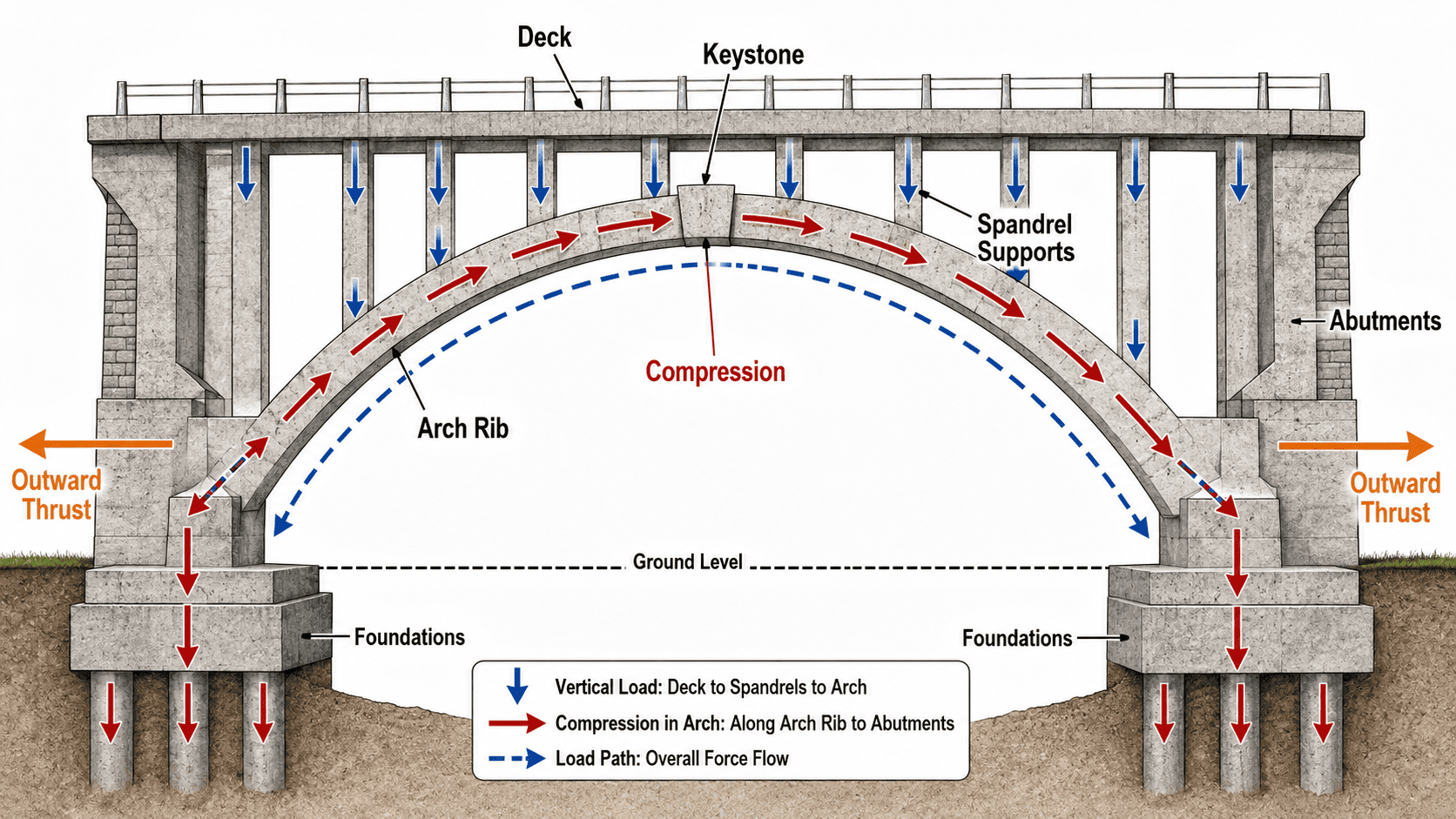
The basic idea behind an arch bridge is simple but powerful. When weight from traffic, pedestrians, or the bridge itself presses downward, the curved arch redirects that load outward and downward. The abutments then resist those forces and keep the arch stable. This is why arch bridges can be extremely strong when they are built on solid foundations and designed with the right proportions.
Arch bridges have been used for thousands of years because the shape is naturally efficient. Stone, brick, and concrete are especially well suited for arch construction because these materials perform well under compression. Modern arch bridges may also use steel, reinforced concrete, or composite systems, but the central principle remains the same: the arch carries the load by channeling forces along a curved path toward stable supports.
Basic Definition of an Arch Bridge
In simple terms, an arch bridge is a bridge with one or more curved arches that support the bridge deck and transfer loads to the ends of the structure. The deck may sit above the arch, pass through the arch, or be suspended from it, depending on the type of arch bridge. Regardless of the exact design, the defining feature is the arch itself.
The strength of an arch bridge comes from the way its shape manages force. A flat beam tends to bend under weight, but an arch changes much of that bending force into compression. This makes the bridge more efficient, especially when the materials used are strong in compression. For this reason, many ancient stone arch bridges survived for centuries, while simpler flat stone crossings were more limited in span and durability.
An arch bridge is not just an old design. It remains important in modern bridge engineering because it combines structural efficiency, durability, and visual appeal. Engineers still use arch forms when the site conditions, span requirements, foundation strength, and architectural goals make this type of bridge appropriate.
Main Parts of an Arch Bridge
The main parts of an arch bridge work together to support and distribute weight. The most recognizable part is the arch rib, which is the curved structural member that carries the load. In stone or masonry arch bridges, the arch is often made from wedge-shaped blocks called voussoirs. The central stone at the top of the arch is known as the keystone, and it helps lock the arch shape into place.
The deck is the surface that carries vehicles, trains, cyclists, or pedestrians. In a deck arch bridge, the deck sits above the arch. In a through arch bridge, the deck passes between or through the arches. In some designs, vertical hangers or supports connect the deck to the arch.
The abutments are the supports at each end of the arch. They are essential because they resist the outward thrust created by the arch. Without strong abutments and foundations, the arch could spread outward and lose stability. The foundations transfer the bridge loads into the ground, while spandrels or spandrel walls may fill or support the area between the arch and the deck in certain traditional designs.
Together, these elements allow an arch bridge to distribute loads in a stable and efficient way. The result is a bridge type that has remained useful from ancient stone crossings to modern steel and concrete structures.
History of Arch Bridges
The history of arch bridges is closely connected to the history of engineering itself. Long before modern steel, reinforced concrete, and computer-aided design, builders discovered that a curved form could cross wider openings and support heavier loads than many simple flat structures. The arch bridge became important because it used geometry to solve a practical problem: how to carry weight across a gap while keeping the structure stable.
Over time, arch bridges appeared in different parts of the world, often shaped by local materials, construction traditions, transportation needs, and available engineering knowledge. Stone, brick, and masonry were especially important in early arch bridge construction because these materials could resist compression effectively. As societies developed larger road networks, urban centers, aqueduct systems, and trade routes, the arch bridge became one of the most reliable ways to build durable crossings.
Early Arch Bridges and Ancient Civilizations
The earliest arch bridges grew out of a broader understanding of arched construction. Ancient builders used arches in drains, gateways, vaults, and water channels before the form became widely associated with bridges. Compared with a simple stone slab or timber beam, an arch could span a greater distance because it did not depend only on the bending strength of a single horizontal member.
This was a major engineering advantage. A flat stone beam can crack if the span is too long or the load is too heavy. An arch, by contrast, distributes weight along a curved path toward its supports. That made it possible for early builders to create stronger and more permanent crossings using stone or masonry units.
Early arch bridges were often modest in size, but they introduced a structural idea that would influence bridge design for centuries. Once builders understood how to shape stones, support the arch during construction, and lock the structure into place, the arch became a practical solution for rivers, roads, canals, and defensive works.
Roman Stone Arch Bridges
Roman engineers are among the most important figures in the history of arch bridges. They refined stone arch construction and applied it at a large scale across roads, aqueducts, and urban infrastructure. The Roman Empire depended on movement: soldiers, merchants, officials, and supplies needed reliable routes across difficult terrain. Stone arch bridges helped make that possible.
Roman stone arch bridges were often built with carefully cut voussoirs, strong piers, and durable masonry. The Romans understood that a well-built arch could carry heavy loads for a long time if the foundations and supports were strong. They also used multiple arches when crossing wider rivers or valleys, allowing the total bridge length to increase while each individual arch remained structurally manageable.
Aqueducts show another major Roman use of arch construction. Although aqueducts were not always bridges in the road-traffic sense, many used repeated arches to carry water channels across valleys or uneven ground. This demonstrated the same principle that made arch bridges successful: a series of arches could carry loads efficiently while using stone in compression.
The Roman legacy matters because many later builders inherited, copied, or adapted Roman arch techniques. Some Roman arch bridges and aqueduct structures still stand today, showing the long-term durability of well-designed stone arch engineering.
Chinese Stone Arch Bridges
Arch bridge history was not limited to the Mediterranean world. China developed its own strong tradition of stone arch bridges, including designs that reflected local engineering priorities and architectural styles. Chinese builders used stone arches for transportation, city access, garden landscapes, and river crossings.
One important contribution associated with Chinese bridge engineering is the development and use of segmental arch forms. A segmental arch is shallower than a full semicircular arch, which can reduce the height of the bridge and make the roadway more practical in certain locations. This type of form required careful understanding of thrust, support, and masonry behavior.
Chinese stone arch bridges also often combined structural function with visual elegance. Many were designed not only as crossings but also as important features within urban or scenic landscapes. This makes them valuable in the history of arch bridges because they show that the arch was both an engineering solution and an architectural form.
Including Chinese stone arch bridges gives a more complete view of global arch bridge development. It shows that different civilizations solved similar structural challenges in ways that reflected their own materials, terrain, and design traditions.
Medieval Arch Bridges
During the medieval period, arch bridges continued to play an important role in towns, trade routes, pilgrimage roads, and fortified settlements. Many medieval bridges were made of stone and used rounded or slightly pointed arches, depending on the region and architectural tradition.
These bridges were not only transportation structures. In many European towns, bridges became part of daily commercial and civic life. Some carried shops, gates, chapels, or defensive towers. A bridge could control access to a city, support trade, and serve as a strategic point during conflict.
Medieval arch bridges often had multiple spans supported by piers placed in the river. Because river currents could be strong, builders had to think about pier shape, foundation stability, flood resistance, and the durability of masonry. Some bridges were rebuilt or modified many times because floods, wars, and changing traffic needs damaged the original structures.
This period helped preserve and adapt the arch bridge tradition after the Roman era. Even when mathematical engineering theory was limited, practical knowledge passed from masons, builders, and local craftsmen allowed stone arch bridges to remain a dominant bridge type.
Renaissance and Post-Renaissance Developments
The Renaissance and post-Renaissance periods brought more systematic thinking to architecture and engineering. Builders studied proportion, geometry, materials, and structural behavior with increasing precision. Arch bridges benefited from this broader interest in design and technical improvement.
Bridge builders began to refine arch shapes, reduce unnecessary mass, improve pier design, and create more elegant structures for growing cities. As road networks, commerce, and urban populations expanded, bridges needed to be not only strong but also better suited to heavier and more frequent traffic.
During this period, stone arch bridges became more sophisticated in both appearance and performance. Engineers and architects paid greater attention to span proportions, roadway alignment, and the relationship between the bridge and the surrounding city. The arch bridge became part of civic identity, not just infrastructure.
Post-Renaissance developments also helped prepare the way for modern bridge engineering. As scientific knowledge improved, designers could better understand forces, materials, and construction methods. This shift gradually moved arch bridge design from inherited craft tradition toward calculated engineering practice.
The Rise of Metal and Concrete Arch Bridges
The Industrial Revolution changed the history of arch bridges by introducing new materials and construction possibilities. Iron, steel, and later reinforced concrete allowed engineers to design arch bridges with longer spans, thinner profiles, and greater load capacity than many traditional masonry bridges.
Metal arch bridges made it possible to create lighter structures that could still carry heavy railway, road, and industrial traffic. Steel was especially important because it offered high strength and could be fabricated into ribs, trusses, and other structural forms. This allowed arch bridges to cross wider rivers, deep valleys, and difficult terrain where massive stone construction would have been less practical.
Concrete also transformed arch bridge design. Reinforced concrete combined the compressive strength of concrete with the tensile strength of steel reinforcement. This made it possible to build durable arch bridges with more flexible shapes and improved resistance to modern traffic demands. Prestressed concrete later added even more possibilities for efficient structural performance.
The rise of metal and concrete did not replace the basic idea of the arch. Instead, it expanded what an arch bridge could do. The same ancient principle of carrying loads through a curved form remained relevant, but modern materials allowed engineers to build larger, stronger, and more visually ambitious arch bridges for highways, railways, and landmark infrastructure.
Simple Compression Arch Bridges
Simple compression arch bridges represent one of the clearest examples of how shape can create strength. Their basic principle is not complicated: when a load presses down on the bridge, the curved arch redirects that force along the arch and into the supports at both ends. Instead of depending mainly on bending resistance, a simple arch bridge is designed so that most of the load travels through compression.
This is why traditional arch bridges were often built from stone, brick, or masonry. These materials are not especially strong when pulled apart, but they can be very strong when pressed together. A well-designed arch takes advantage of that property by keeping the main structural elements under compressive force. For early builders, this made the arch bridge one of the most durable and efficient ways to cross rivers, roads, canals, and valleys.
How Compression Works in an Arch Bridge
Compression is a force that pushes material together. In an arch bridge, the weight of the deck, the bridge structure, and any traffic above it creates downward loads. The arch does not simply hold those loads in a straight vertical line. Instead, the curved shape guides the force outward and downward toward the ends of the arch.
This curved path is what gives the arch bridge its strength. Each part of the arch presses against the next part, creating a chain of compressive forces. In a traditional stone arch, the wedge-shaped stones push against one another. As long as the forces remain properly directed through the arch and into the supports, the structure can remain stable under heavy loads.
A simple way to understand this is to compare an arch with a flat beam. A flat beam tends to bend when weight is placed on it. The top of the beam may be compressed, while the bottom may be pulled in tension. Stone and brick do not perform well under tension, so a long flat stone beam can crack. An arch reduces that weakness by transforming much of the load into compression, which suits masonry materials far better.
This does not mean an arch bridge has no complex forces at all. Real bridges must also deal with uneven loads, settlement, temperature changes, water pressure, wind, and traffic movement. However, the central idea remains the same: the arch shape is efficient because it carries loads mainly through compression.
Why Abutments Are Important
Abutments are essential in a simple compression arch bridge because they resist the outward thrust created by the arch. When the arch carries weight, it pushes down and outward at its ends. If the supports are weak, unstable, or poorly founded, the arch can spread apart and lose its shape. Once that happens, the bridge may crack, deform, or fail.
This is why arch bridges require strong end supports. The abutments must be heavy enough, stable enough, and well connected to the ground so they can hold the arch in place. In many traditional bridges, the abutments were built from large masses of stone or masonry. Their purpose was not only to hold the bridge vertically, but also to resist the horizontal thrust that naturally develops in an arch.
The foundations below the abutments are just as important. Even a well-shaped arch can become unsafe if the ground under one support settles more than the other. Uneven settlement changes the way forces move through the arch, which can create cracks or distortions. For this reason, builders had to pay close attention to soil, rock, riverbanks, and water movement before constructing an arch bridge.
In short, the arch and the abutments work as a system. The arch redirects the load, but the abutments provide the resistance that allows the arch to remain stable. Without strong abutments, the compression principle cannot work properly.
Advantages of Simple Materials
One reason arch bridges became so important historically is that they could be built with simple, locally available materials. Stone, brick, and masonry were common in many regions, and they were well suited to arch construction because they perform strongly under compression.
Stone was especially valuable because it was durable, fire-resistant, weather-resistant, and capable of lasting for centuries when properly cut and placed. Brick also worked well in many areas where quality stone was not easily available. Masonry construction allowed builders to create strong arches from many smaller units rather than relying on one large piece of material.
This was a major advantage in ancient and medieval construction. Large single beams of stone were difficult to quarry, transport, and place. They also had limited span capacity because they could crack under bending. By contrast, an arch could be assembled from many smaller blocks or bricks, each contributing to the overall compressive system.
Simple materials also made arch bridges adaptable. Builders could adjust the size, shape, and number of arches depending on the width of the crossing and the strength of the available materials. A narrow stream might require one arch, while a wider river could be crossed with a series of arches supported by intermediate piers.
Construction Sequence
The traditional construction of a simple compression arch bridge required careful sequencing. Builders could not simply place the stones in the air and expect the arch to hold itself immediately. The arch needed temporary support during construction until the full curved form was complete.
The first step was usually preparing the foundations and abutments. These supports had to be strong enough to carry the final loads and resist the outward thrust of the arch. If the bridge crossed water, builders also had to manage river flow, erosion, and foundation stability.
Next, a temporary wooden framework called falsework or centering was built in the shape of the arch. This framework supported the stones or masonry units while they were being placed. Without centering, the unfinished arch would collapse before the forces could lock into a stable compressive pattern.
The wedge-shaped stones, known as voussoirs, were then placed along the curve of the arch. Builders usually worked from both sides toward the top. The final central stone, called the keystone, was placed at the crown of the arch. Once the keystone was set, the arch became structurally continuous, and the stones began to press against one another as a complete system.
After the mortar had set and the structure was stable, the temporary centering could be carefully removed. This was a critical moment because the load transferred from the wooden support into the arch itself. If the geometry, materials, and supports were correct, the arch would stand under compression and become a durable load-bearing structure.
This construction process shows why simple compression arch bridges required both practical skill and structural understanding. The materials may have been simple, but the engineering idea behind the arch was highly effective.
Form and Mechanics of Arch Bridges
The form of an arch bridge is not only an architectural choice. It directly affects how the bridge carries weight, how forces move through the structure, and how stable the bridge remains over time. The curved shape of the arch is the main reason this bridge type can be both strong and efficient, but the performance of an arch bridge depends on more than the curve alone. Span, rise, material, foundation strength, deck position, and load distribution all influence how the structure behaves.
In engineering terms, an arch bridge works best when its shape allows loads to follow a stable path through the arch and into the supports. If the arch shape, proportions, or foundations are poorly matched to the site, the bridge may experience excessive thrust, cracking, settlement, or deformation. This is why arch bridges require careful attention to both geometry and ground conditions.
Load Transfer and Structural Behavior
Load transfer is one of the most important mechanical principles in an arch bridge. The bridge must carry dead loads, such as the weight of the arch, deck, pavement, railings, and structural components. It must also carry live loads, such as vehicles, trains, pedestrians, bicycles, or maintenance equipment. In addition, the bridge may need to resist wind, temperature movement, water flow, seismic forces, and changes in soil conditions.
When these loads act on the bridge, they are transferred from the deck into the arch system. In a deck arch bridge, the roadway or walkway rests above the arch, and loads move downward through spandrel columns, walls, or other supporting elements until they reach the arch. In a through arch bridge, the deck may be suspended from the arch by vertical hangers or connected through other structural members. In both cases, the arch becomes the primary load-carrying form.
The arch then directs these forces toward the supports at each end. Ideally, the forces remain close to the centerline of the arch. When this happens, the bridge works efficiently because the arch carries most of the load through compression. If loads are uneven, poorly distributed, or too far from the ideal force path, bending forces can increase. That does not automatically mean failure, but it does mean the bridge must be designed to resist more complex stresses.
Modern arch bridge engineering often studies the line of thrust, which represents the path of compressive forces through the arch. A stable arch keeps this force path within the structural depth of the arch. If the thrust line moves too far outside the arch section, tension, cracking, or instability can occur, especially in masonry bridges.
Span, Rise, and Arch Shape
The span of an arch bridge is the horizontal distance between its supports. The rise is the vertical distance from the springing line, where the arch begins at the supports, to the crown, which is the highest point of the arch. These two measurements strongly influence the bridge’s appearance and mechanical behavior.
A high-rise arch can be structurally efficient because the curve provides a favorable path for compressive forces. However, it may require a taller structure, steeper approaches, or more vertical clearance. A low-rise arch, also called a shallow arch, can be useful where the roadway needs to remain flatter, but it usually creates greater horizontal thrust at the supports. That means the abutments and foundations must be especially strong.
Different arch shapes also affect performance. A semicircular arch has a half-circle shape and was common in many historic stone bridges. It is visually simple and structurally effective, but it can require more height than some sites allow. A segmental arch uses only part of a circle, creating a flatter profile. This can be practical for roadways and urban crossings, but it increases outward thrust.
A parabolic arch is often associated with efficient modern bridge design because its shape can closely match the natural path of forces under certain load conditions. When the arch shape follows the expected load path, the structure can reduce bending and use material more efficiently. This is one reason modern steel and concrete arch bridges often use refined curved profiles rather than relying only on traditional semicircular forms.
The best arch shape depends on the site, the required span, the height available, the type of traffic, the materials, and the strength of the supports. There is no single perfect arch form for every bridge. A successful arch bridge balances structural efficiency, constructability, cost, clearance, durability, and visual design.
Strengths and Limitations of Arch Bridges
Arch bridges have several important strengths. Their most obvious advantage is their ability to carry heavy loads efficiently when the structure is properly designed. Because the arch form naturally directs forces into compression, it works especially well with materials such as stone, concrete, and masonry. With modern materials such as steel and reinforced concrete, arch bridges can achieve long spans while maintaining an elegant and recognizable form.
Durability is another major strength. Many historic arch bridges have lasted for centuries because their structural form and materials were well matched. The arch shape can also be visually powerful, which is why arch bridges often become landmarks in cities, parks, highways, and scenic landscapes.
However, arch bridges also have limitations. They need strong supports because the arch creates horizontal thrust. If the abutments or foundations are weak, the bridge may not perform safely. This makes site conditions especially important. Rocky ground, stable riverbanks, or carefully engineered foundations are often necessary for larger arch bridges.
Construction can also be more complex than simpler bridge types. Traditional masonry arches required temporary centering, skilled labor, and careful placement of stones. Modern arch bridges may require advanced erection methods, temporary supports, cable systems, or precise sequencing to control forces during construction.
Arch bridges may also be less suitable where foundation conditions are poor, where the required span is extremely long, or where construction access is limited. In some cases, a beam, truss, cable-stayed, or suspension bridge may be more practical. Even so, when the site conditions and design goals are appropriate, an arch bridge remains one of the most efficient and enduring bridge forms in engineering.
Types of Arch Bridge
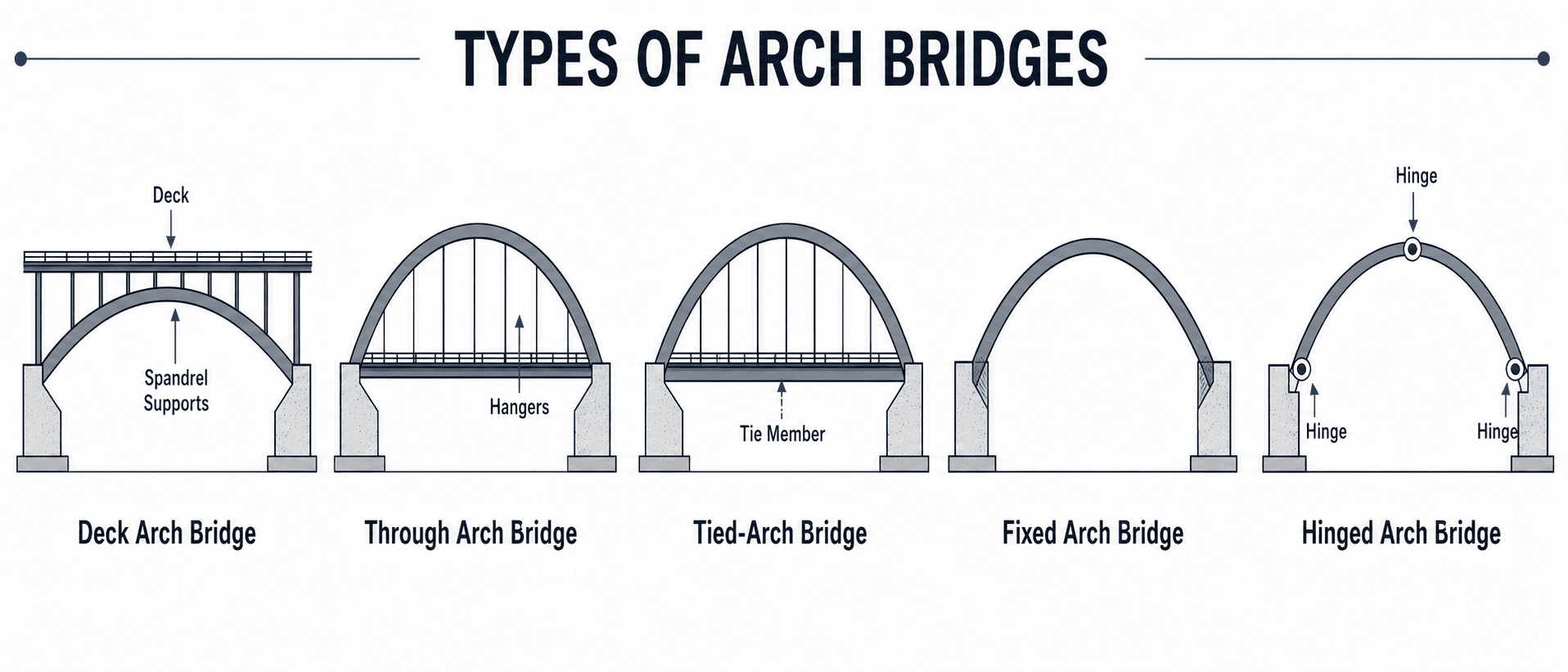
Arch bridges can be classified in several ways, but one of the most useful approaches is to look at how the arch is formed, where the deck is placed, and how the structure handles horizontal thrust. Although every arch bridge uses a curved form as part of its structural identity, not all arch bridges behave in exactly the same way. Some carry the deck above the arch, some allow the deck to pass through the arch, and others use a tie member to control outward forces.
Understanding the main types of arch bridge helps explain why this bridge form has remained useful for so many different sites and purposes. A small masonry bridge over a stream, a Roman aqueduct, a steel through arch bridge, and a modern tied-arch bridge may look very different, but each one uses the arch principle in a distinct way.
Corbel Arch Bridge
A corbel arch bridge is often discussed alongside arch bridges, although it is not a true arch in the strict structural sense. A true arch uses wedge-shaped units or a continuous curved member to transfer loads through compression along a curved path. A corbel arch, by contrast, is formed by stacking stones, bricks, or blocks so that each layer projects slightly farther inward than the layer below it until the two sides meet near the top.
This method creates an opening that resembles an arch, but the force behavior is different. Instead of relying on a continuous curved compression path, a corbel arch depends more on the weight, overlap, and stability of the stacked units. For this reason, it is usually considered a primitive or early arch-like form rather than a fully developed arch structure.
Corbel construction was useful in ancient building because it allowed builders to create openings with simple materials and limited tools. It could be used where true arch construction was not yet common or where builders did not have the technical knowledge needed to create a more precise curved arch. In the history of arch bridge development, the corbel arch is important because it shows an early attempt to solve the same basic problem: how to span an opening using small masonry units instead of one large horizontal beam.
Aqueducts
Aqueducts are closely connected to the history of arch bridge construction, especially in Roman engineering. An aqueduct is a structure designed to transport water from one place to another. When an aqueduct needed to cross a valley, low area, or uneven terrain, builders often used a series of arches to support the water channel above the ground.
Although aqueducts were built to carry water rather than road traffic, many of them function structurally like arch bridges. The repeated arches support the load of the water channel and transfer that weight into piers and foundations. This made the arch form especially useful for long elevated structures, because each arch could carry a manageable span while the full aqueduct extended across a much greater distance.
Roman aqueducts are among the most famous examples, but the concept is broader than Rome alone. The main engineering advantage was that arches allowed builders to maintain a controlled slope for water flow while crossing irregular landscapes. A straight embankment or solid wall would have required far more material. A series of arches reduced the amount of masonry while still creating a strong and durable structure.
In an article about arch bridges, aqueducts are important because they show how the arch was used beyond ordinary transportation bridges. They demonstrate that the arch was not only a bridge form, but also a broader engineering solution for carrying loads across open space.
Deck Arch Bridge
A deck arch bridge is a type of arch bridge where the deck is located above the arch. The deck is the surface that carries traffic, pedestrians, or trains. In this design, the arch usually sits below the roadway or walkway, and the load is transferred from the deck down to the arch through vertical supports, spandrel columns, walls, or other structural elements.
Deck arch bridges are common in locations where the bridge crosses a valley, canyon, river gorge, or deep opening. Because the arch is below the deck, the structure can take advantage of the space beneath the roadway. This makes the deck arch form useful when the supports can be placed on strong ground at both sides of the crossing.
One advantage of a deck arch bridge is that it can create a clean and elegant profile. The arch can rise from the sides of a canyon or riverbank while the roadway remains above it. This often produces a strong visual effect, especially in scenic or mountainous areas.
Deck arch bridges can be built from stone, concrete, steel, or a combination of materials. Traditional masonry deck arch bridges often used solid spandrel walls between the arch and the deck. Modern versions may use open spandrels, steel ribs, reinforced concrete ribs, or other lighter systems to reduce weight while maintaining strength.
Through Arch Bridge
A through arch bridge is a type of arch bridge where the deck passes through the arch. In this design, the lower parts of the arch are usually below the deck level, while the upper part of the arch rises above the deck. The bridge user may pass between the arch ribs, making the arch a visible part of the crossing experience.
In many through arch bridges, the deck is supported by vertical hangers or other connecting members attached to the arch. These hangers transfer the weight of the deck and traffic upward into the arch, which then carries the forces toward the supports. This arrangement allows the arch to remain the dominant structural element while the deck stays at a practical elevation.
Through arch bridges are often used when clearance below the bridge, roadway alignment, or site conditions make a deck arch less practical. They can also be visually striking because the arch rises above the traffic level. This makes the structure recognizable from both the bridge deck and the surrounding landscape.
A through arch bridge may use steel, concrete, or other modern materials. Steel is especially common in many large through arch designs because it can form strong ribs and hangers while keeping the structure relatively light compared with massive masonry construction.
Tied-Arch Bridge
A tied-arch bridge, also called a bowstring arch bridge, is a type of arch bridge that uses a horizontal tie to resist the outward thrust of the arch. In a traditional arch bridge, the abutments must resist the horizontal force created by the arch. In a tied-arch bridge, much of that outward force is carried by the tie member instead.
This makes the tied-arch bridge especially useful where the ground or foundations are not ideal for resisting large horizontal thrust. The arch still works mainly in compression, while the tie works mainly in tension. The deck is often connected to the arch by vertical hangers, and the tie may be integrated with the deck system.
The shape of a tied-arch bridge often resembles a bow, which is why the term bowstring arch is used. The arch acts like the curved bow, while the tie acts like the string that holds the ends together. This structural relationship allows the bridge to span an opening without pushing as strongly outward against the abutments.
Tied-arch bridges are common for road, rail, and pedestrian crossings. They are also useful in urban or constrained sites where large abutments would be difficult, expensive, or visually intrusive. Because the arch rises above the deck, the tied-arch form can also create a landmark appearance.
Hinged Arch Bridge
A hinged arch bridge includes hinges, or pinned connections, that allow controlled rotation at certain points in the arch. These hinges help the structure respond to movement, temperature changes, settlement, and other forces without creating excessive internal stress.
There are several common hinged arch forms. A one-hinged arch has a hinge at one key location, although this type is less common in basic explanations. A two-hinged arch has hinges at both supports. This allows the arch to rotate slightly at the springing points while still resisting loads through the curved structure. A three-hinged arch has hinges at both supports and a third hinge at the crown of the arch.
The three-hinged arch is especially important in structural engineering because it is statically determinate. In simple terms, that means its internal forces can be calculated more directly using the equations of static equilibrium. It can also tolerate some foundation movement better than a fixed arch because the hinges allow rotation.
Hinged arch bridges can be built from steel, reinforced concrete, or other engineered materials. They are useful when designers want to control how the bridge responds to movement. However, hinges must be carefully designed and maintained because they are important structural details.
Fixed Arch Bridge
A fixed arch bridge is an arch bridge where the ends of the arch are fixed into the supports without hinges. This means the arch cannot freely rotate at the springing points. As a result, the structure can be very stiff and efficient, but it also becomes more sensitive to foundation movement, temperature effects, and support settlement.
Fixed arches can carry loads effectively because the rigid connections help distribute forces throughout the arch. They are often used when the foundations are strong and stable enough to resist the required forces. In the right conditions, a fixed arch can be an efficient and durable structural system.
The main limitation is that fixed arches require careful design. If one support settles or moves, the arch can develop additional stresses because it has less freedom to adjust. This is especially important in large bridges, where small movements can create significant structural effects.
Fixed arch bridges are commonly associated with modern concrete and steel construction, although the basic idea can also be related to traditional masonry arches that rely on stable, continuous support. Compared with hinged arches, fixed arches can provide greater stiffness, but they place higher demands on foundations, materials, and engineering accuracy.
Together, these different types of arch bridge show how flexible the arch concept can be. The same basic curved form can be adapted for historic masonry crossings, water-carrying aqueducts, scenic deck bridges, through arch landmarks, tied-arch urban crossings, and engineered hinged or fixed structural systems.
Arch Bridge Classification
Arch bridge classification helps organize the many variations of this bridge type into clear technical categories. While the previous section described common types of arch bridges by form and function, classification looks at the bridge from an engineering perspective: what it is made of, where the deck is located, and how the arch system behaves structurally.
This is useful because two arch bridges may look similar but perform differently. For example, a steel through arch bridge and a reinforced concrete through arch bridge may have the same general deck position, but their material behavior, construction methods, maintenance needs, and design limits can be very different. Likewise, two bridges made from the same material may behave differently if one is fixed and the other is hinged.
Classification by Construction Materials
One of the most common ways to classify an arch bridge is by construction material. The material strongly affects the bridge’s span capacity, weight, durability, maintenance requirements, and construction method.
Stone arch bridges are among the oldest and most durable examples. They work well because stone performs strongly under compression. In a traditional stone arch bridge, individual stones or voussoirs are shaped and arranged so that the load is carried through compressive contact. These bridges can last for centuries when the foundations, drainage, and masonry remain stable.
Brick arch bridges follow a similar principle but use manufactured brick units instead of large stone blocks. Brick was especially useful in regions where good building stone was limited or where brickmaking was already part of local construction practice. Brick arches are often found in smaller bridges, culverts, rail infrastructure, and historic urban works.
Masonry arch bridges include both stone and brick systems, as well as mixed masonry construction. In general, masonry arch bridges are strong in compression but vulnerable to tension, foundation settlement, poor drainage, and deterioration of mortar joints.
Steel arch bridges represent a major shift from traditional masonry construction. Steel allows longer spans, lighter structural members, and more open forms. A steel arch may use ribs, trusses, box sections, or other fabricated components. Because steel performs well in both tension and compression, it gives engineers more flexibility than stone or brick.
Reinforced concrete arch bridges combine concrete with steel reinforcement. Concrete provides compressive strength, while embedded steel helps resist tension and cracking. This combination makes reinforced concrete useful for modern highway, railway, and urban arch bridges.
Prestressed concrete arch bridges add another level of performance. In these structures, internal steel tendons are tensioned to place the concrete under controlled compression. This can help reduce cracking, improve span capability, and create more efficient structural forms.
Composite arch bridges use more than one primary material, often combining steel and concrete. For example, a bridge may use steel arch ribs with a concrete deck, or concrete-filled steel tubes. Composite systems can take advantage of the strengths of different materials while reducing some of their weaknesses.
Classification by Deck Location
Arch bridges can also be classified by the position of the deck in relation to the arch. This classification is especially helpful because deck location affects appearance, clearance, load transfer, and construction method.
A deck arch bridge has the deck above the arch. The arch supports the roadway or walkway from below, often through spandrel columns, spandrel walls, or vertical supports. This arrangement is common where the bridge crosses a deep valley, canyon, gorge, or river with enough space below the deck for the arch to rise.
A through arch bridge has the deck passing through the arch. In this design, the arch rises above the deck, and the deck is often supported by hangers or connecting members. Through arch bridges are visually distinctive because users may travel between the arch ribs. They are common where the bridge deck must remain relatively low while the arch still provides the main structural support.
A half-through arch bridge, sometimes called a pony arch bridge, places the deck between the springing line and the crown of the arch. In this arrangement, part of the arch rises above the deck, but the bridge may not have overhead cross-bracing between arch ribs. This type can be useful where vertical clearance, aesthetics, or roadway alignment make a full through arch less practical.
The choice of deck location depends on the site. A deep gorge may favor a deck arch, while a flat river crossing may favor a through or tied-arch form. Engineers must consider clearance below the bridge, approach grades, foundation conditions, visual impact, and traffic requirements.
Classification by Structural System
Another important way to classify arch bridges is by structural system. This category focuses on how the arch is connected to its supports and how it responds to loads, movement, and internal forces.
A fixed arch bridge has arch ends that are restrained against rotation. This creates a stiff and efficient structure, but it also makes the bridge more sensitive to foundation settlement and temperature movement. Fixed arches work best where the supports and foundations are very stable.
A two-hinged arch bridge has hinges at both springing points, where the arch meets the supports. These hinges allow rotation at the ends of the arch, which helps reduce some internal stresses caused by movement. However, the bridge still produces horizontal thrust that must be resisted by the supports.
A three-hinged arch bridge has hinges at both springing points and another hinge at the crown. This system is more flexible and can better accommodate some support movement. It is also easier to analyze structurally because the hinge arrangement makes the system statically determinate.
A tied arch bridge uses a tie member to connect the ends of the arch and resist horizontal thrust. Instead of pushing strongly outward into massive abutments, the arch thrust is largely carried by the tie, which works in tension. This makes tied arch bridges useful where foundation conditions or site constraints make large thrust-resisting abutments difficult.
Classifying arch bridges by structural system helps explain why similar-looking bridges can behave differently. The presence or absence of hinges, ties, and fixed connections affects stiffness, movement, foundation demands, construction methods, and long-term performance.
Gallery of Famous Arch Bridges
Famous arch bridges show how flexible and enduring this bridge type can be. Some are ancient stone crossings that reveal the skill of early builders, while others are modern steel or concrete structures designed for highways, railroads, and major urban routes. A gallery of arch bridges is useful because it connects the technical ideas of arch bridge design with real structures that people can recognize, visit, and study.
Arch bridges are often remembered not only for their engineering, but also for their setting. Many cross deep gorges, wide rivers, historic city centers, or important transportation corridors. Their curved form gives them a strong visual identity, which is one reason many arch bridges become landmarks as well as infrastructure.
Ancient and Historic Arch Bridges
Ancient and historic arch bridges demonstrate the durability of stone and masonry construction. Roman bridges are among the most important examples because they show how early engineers used the arch to support roads, aqueducts, and public infrastructure across the empire. Many Roman arch structures were built with carefully shaped stones, strong piers, and repeated arches that allowed them to cross rivers and valleys with remarkable stability.
Historic stone arch bridges also appear across Europe, Asia, and the Middle East. These bridges were often built for trade routes, city access, religious travel, or military movement. Their value was practical, but many also became part of the cultural identity of the places where they were built.
One reason these older bridges remain important is that they reveal the strength of the arch principle without relying on modern materials. A well-built stone arch bridge could survive centuries of weather, traffic changes, flooding, and repair. Even when individual stones or mortar joints deteriorated, the basic compression system often remained strong if the foundations and abutments stayed stable.
Medieval arch bridges are another important group. Many were built in towns and along trade routes, sometimes with defensive gates, towers, shops, or chapels. These structures show that arch bridges were not only engineering works but also social and economic spaces. They connected communities, supported commerce, and often became central features of historic urban landscapes.
Modern Arch Bridges
Modern arch bridges expanded the possibilities of the arch form by using steel, reinforced concrete, prestressed concrete, and composite systems. These materials allowed engineers to create longer spans, lighter profiles, and more dramatic shapes than traditional masonry could usually provide.
Steel arch bridges are especially important in modern bridge history. Steel can be shaped into ribs, trusses, box sections, and braced systems that carry large loads while reducing unnecessary mass. This makes steel arch bridges useful for deep valleys, major river crossings, and rail or highway routes that require strength without the bulk of heavy masonry.
Concrete arch bridges also became prominent in modern infrastructure. Reinforced concrete allows the bridge to handle both compression and tension more effectively than plain masonry. It can also be formed into smooth, continuous shapes that work well with the natural curve of the arch. In many scenic or mountainous locations, concrete arch bridges provide a balance of strength, durability, and visual simplicity.
Modern arch bridges are often designed as landmark structures. Their form can be both efficient and symbolic. A large arch can frame a river, valley, roadway, or skyline, giving the bridge an identity that goes beyond basic transportation. This is why arch bridges continue to appear in major infrastructure projects even when other bridge types are available.
Arch Bridges in the United States
The United States has several well-known arch bridges that show the range of this bridge type in modern engineering. These examples are especially useful for readers in the U.S. because they connect the general concept of an arch bridge with familiar American infrastructure.
The New River Gorge Bridge in West Virginia is one of the most recognized steel arch bridges in the country. It crosses a deep gorge and is known for its large steel arch, dramatic setting, and importance as a highway crossing. Its design shows how an arch bridge can be especially effective where strong supports are available on opposite sides of a canyon or valley.
The Bayonne Bridge, connecting New Jersey and Staten Island, New York, is another major American arch bridge. It is known for its large steel arch and its role as an important transportation link in the New York Harbor region. The bridge also demonstrates how arch bridges can serve dense urban and industrial areas, not only scenic landscapes.
The Hell Gate Bridge in New York City is a famous railroad arch bridge. Its massive steel arch and heavy-duty design reflect the demands of rail transportation, where bridges must support very large loads and repeated use. It remains one of the most recognizable arch bridges in the United States because of its scale, location, and engineering character.
Other American arch bridges include concrete and steel examples used for highways, parkways, railroads, and pedestrian crossings. Some are famous for their size, while others are valued for their beauty or historic setting. Together, these bridges show that the arch bridge is not just an ancient form. It remains part of American transportation, engineering, and architectural identity.
Use of Modern Materials in Arch Bridges
Modern materials changed what an arch bridge could be. Early arch bridges depended mainly on stone, brick, and masonry, which performed well under compression but had clear limits in span, weight, construction speed, and flexibility. With the development of steel, reinforced concrete, prestressed concrete, and composite systems, engineers gained new ways to build longer, lighter, stronger, and more adaptable arch bridges.
The basic principle of the arch did not disappear. Modern materials still use the curved form to transfer loads efficiently toward the supports. What changed was the scale and precision of the design. Instead of relying only on massive masonry and heavy abutments, engineers could design slender arch ribs, open spandrels, suspended decks, tied systems, and hybrid structures that respond better to modern traffic, site conditions, and architectural goals.
Steel Arch Bridges
Steel is one of the most important materials in modern arch bridge construction because it combines high strength with relatively low weight. Compared with stone or plain concrete, steel can carry large forces through thinner structural members. This allows engineers to design long-span arch bridges with open, lightweight forms rather than massive solid structures.
A steel arch bridge may use solid ribs, trussed ribs, box sections, or tubular members. These elements can be fabricated with precision and assembled on-site using cranes, temporary supports, cantilever methods, or cable-assisted construction. Because steel performs well in both compression and tension, it gives designers more flexibility than traditional masonry.
Steel is especially useful for through arch bridges, tied-arch bridges, and large deck arch bridges. In a through arch bridge, the arch can rise above the deck while hangers transfer the deck loads into the arch. In a tied-arch bridge, steel is useful because the arch can resist compression while the tie and hangers handle tension forces.
Another advantage of steel is that it can create dramatic landmark structures. Large steel arches often appear lighter and more open than masonry arches, which makes them suitable for highways, railroads, urban crossings, and scenic locations. However, steel also requires protection against corrosion. Paint systems, coatings, drainage details, inspections, and maintenance are important for long-term performance.
Concrete Arch Bridges
Concrete arch bridges became important because concrete is strong in compression and can be shaped into smooth, continuous curved forms. This makes it naturally compatible with the arch concept. When concrete is reinforced with steel bars, it becomes more useful for modern bridge construction because the reinforcement helps resist tension, cracking, and localized stress.
Reinforced concrete arch bridges are common in road, rail, and pedestrian infrastructure. They can be built as solid arches, ribbed arches, open-spandrel arches, or more complex structural systems. Concrete also allows designers to create forms that blend with the landscape, which is one reason concrete arch bridges are often used in valleys, mountainous areas, parks, and scenic routes.
Prestressed concrete improves this performance further. In prestressed concrete, steel tendons are tensioned to place the concrete under controlled compression. This helps reduce cracking and allows the structure to carry loads more efficiently. For arch bridges, prestressing can improve durability, stiffness, and span capability, especially where the bridge must handle heavy traffic or difficult environmental conditions.
Concrete does have limitations. It is heavier than steel, and poor detailing can lead to cracking, water infiltration, reinforcement corrosion, or long-term durability problems. For that reason, modern concrete arch bridge design must consider drainage, reinforcement protection, material quality, shrinkage, creep, temperature movement, and inspection access.
Composite and Hybrid Arch Bridges
Composite and hybrid arch bridges combine materials to take advantage of their different strengths. A common approach is to use steel for the main arch ribs and concrete for the deck. The steel arch can provide a strong, lightweight curved structure, while the concrete deck offers stiffness, durability, and a practical riding surface.
Another example is the use of concrete-filled steel tubes. In this system, steel tubes form part of the arch, and concrete inside the tubes improves compressive strength and stiffness. The steel can provide confinement and tensile resistance, while the concrete contributes mass and compression capacity. This type of system can be useful for long-span bridges where both strength and efficient construction are important.
Hybrid designs may also combine reinforced concrete foundations, steel arch ribs, prestressed concrete decks, composite hangers, or specialized connection systems. These combinations allow engineers to respond to specific site demands. A bridge in a seismic region, coastal environment, deep valley, or dense urban corridor may require a different material strategy than a bridge in a rural or low-traffic setting.
Composite construction is not only about strength. It can also improve constructability. Prefabricated steel elements may reduce on-site work, while concrete components may improve durability and reduce vibration. The best combination depends on cost, maintenance, span length, environmental exposure, construction access, and design life.
3D Printing and Future Arch Structures
The future of arch bridges may include new construction methods as well as new materials. One area of interest is 3D-printed concrete, which allows builders and researchers to create curved structural forms with less formwork and potentially less material waste. Since arches naturally depend on geometry, they are a strong candidate for experiments in digitally guided construction.
3D-printed arch structures may allow more customized shapes, faster production of certain components, and better integration between design software and physical construction. However, this technology still faces important challenges for major bridge applications. Engineers must evaluate material strength, reinforcement methods, durability, quality control, code approval, and long-term structural behavior.
Future arch bridges may also use advanced composites, high-performance concrete, weathering steel, improved corrosion protection, structural health monitoring, and more precise digital modeling. These innovations do not replace the ancient logic of the arch. Instead, they extend it. The arch bridge remains relevant because its basic structural idea is efficient, adaptable, and compatible with both traditional craftsmanship and modern engineering technology.
Record Sizes and Notable Arch Bridge Achievements
Arch bridge records can be measured in more than one way. Some rankings focus on the longest main arch span, while others focus on total bridge length, deck height above the ground, structural height, material type, or engineering difficulty. This distinction matters because the “longest arch bridge” is not always the bridge with the longest total roadway. In bridge engineering, the main span is often the more important measure because it reflects how far the primary arch structure reaches between its supports.
Record-setting arch bridges show how far the ancient arch principle has evolved. What began as a practical way to build durable stone crossings has become a major structural form for highways, railways, deep valleys, wide rivers, and difficult mountainous terrain. Modern records are not only about size; they also reflect advances in materials, construction methods, foundation design, wind analysis, seismic resistance, and long-span structural behavior.
Longest Arch Bridges in the World
When discussing the longest arch bridges in the world, the most useful measurement is usually the main arch span. The main span is the distance between the primary supports of the arch. This is different from total bridge length, which may include approach viaducts, ramps, side spans, or elevated roadway sections that are not part of the main arch itself.
For example, a bridge may have a total length of more than a mile, but its main arch span may be much shorter. Another bridge may have a shorter total length but a longer central arch span. From an engineering perspective, the longer main arch span usually represents the greater structural challenge because the arch must carry loads across a wider unsupported opening.
As of 2026, the Tian’e Longtan Bridge in Guangxi, China, is widely identified as one of the world’s largest arch bridges by main span, with a reported arch span of about 600 meters. This record reflects the increasing importance of large concrete and composite arch bridges in China, where mountainous terrain and major river crossings have encouraged rapid development of long-span bridge engineering.
Other major long-span arch bridges include the Pingnan Third Bridge in China, with a reported main span of about 575 meters, and the Chaotianmen Bridge in Chongqing, which has a main span of about 552 meters. The Chaotianmen Bridge is also notable because it carries both road and rail traffic, showing how a large arch bridge can serve multiple transportation systems within a dense urban region.
Long-span arch bridges are important because they test the limits of geometry, material performance, construction sequencing, and foundation capacity. The longer the span, the more carefully engineers must control forces during both construction and long-term operation.
Tallest and Highest Arch Bridges
The terms “tallest” and “highest” are often confused, but they do not mean exactly the same thing. A tall bridge is usually measured by structural height, such as the distance from the lowest exposed foundation or support point to the highest part of the structure. A high bridge is usually measured by deck height, meaning how far the roadway or railway deck stands above the ground, river, or valley below.
This distinction is especially important for arch bridges built across deep gorges. A bridge may not have the tallest structural components in the world, but if its deck crosses far above a riverbed, it may still be considered one of the highest bridges of its type.
The Chenab Rail Bridge in India is one of the most notable examples in this category. It is widely described as the world’s highest railway arch bridge, with the deck standing about 359 meters above the Chenab River. Its location in mountainous terrain made construction especially challenging, requiring careful planning for wind, seismic forces, access limitations, and railway loading.
Highest-bridge records are not only about visual drama. They also reveal the engineering challenges of building in extreme landscapes. A high arch bridge may require temporary cable systems, staged erection, specialized cranes, difficult foundation work, and constant monitoring during construction. The higher the deck and the more remote the site, the more complex the project becomes.
Engineering Milestones
Some arch bridges are remembered not because they hold a current size record, but because they marked an important step in bridge engineering. A milestone can be based on material, span, construction method, location, or structural innovation.
Historic stone arch bridges were milestones because they proved that masonry could create durable crossings without modern steel or concrete. Roman arch bridges and aqueduct structures showed how repeated arches could support roads and water channels across long distances. Medieval and Renaissance arch bridges later refined the use of stone in urban and civic settings.
Steel arch bridges became major milestones during the industrial and modern periods. They allowed longer spans, lighter structural forms, and greater flexibility than traditional masonry. Large steel arch bridges also showed that the arch could serve railroads and highways carrying heavy, repeated loads.
Concrete arch bridges created another major step forward. Reinforced concrete and prestressed concrete allowed engineers to build strong curved forms with improved durability and more efficient material use. In many mountainous or scenic locations, concrete arch bridges became a practical solution because they could combine strength, stiffness, and visual simplicity.
Modern composite arch bridges represent a more recent milestone. By combining materials such as steel and concrete, engineers can design structures that take advantage of the strengths of each material. These bridges may use steel for lightweight arch ribs, concrete for deck stiffness, and specialized connections to improve overall performance.
The most important achievement of the arch bridge is not a single record. It is the fact that the same basic structural idea has remained useful across thousands of years. From small stone crossings to record-setting steel and concrete spans, the arch bridge continues to adapt to new materials, larger loads, and more demanding sites.
Advantages and Disadvantages of Arch Bridges
Arch bridges have remained important for thousands of years because they offer a strong combination of structural efficiency, durability, and visual appeal. Their curved form allows loads to move through the bridge in a stable way, which makes them suitable for many road, rail, pedestrian, and scenic crossings. However, an arch bridge is not the best solution for every location. Its performance depends heavily on site conditions, foundation strength, construction method, and the type of loads it must carry.
Understanding the advantages and disadvantages of arch bridges helps explain why engineers may choose this bridge type in some situations and avoid it in others. The arch form can be highly effective, but it must be matched with the right terrain, materials, span requirements, and support conditions.
Advantages of Arch Bridges
One of the main advantages of an arch bridge is its strength in compression. The curved shape allows the bridge to transfer loads toward the supports instead of relying mainly on bending resistance. This makes the design especially efficient for materials such as stone, brick, masonry, and concrete, which perform well when compressed.
Durability is another major advantage. Many historic arch bridges have lasted for centuries because their form and materials were well suited to long-term structural performance. When the foundations are stable, the drainage is effective, and the materials are properly maintained, an arch bridge can have a very long service life.
Arch bridges also distribute loads efficiently. The weight of the bridge, traffic, and other forces can be carried through the arch and into the abutments or tie system, depending on the design. This efficient load path can reduce the need for excessive material in some cases, especially when compared with less optimized structural forms.
Another advantage is visual appeal. Arch bridges often have a graceful and recognizable shape. Whether built from stone, concrete, or steel, the arch can create a strong architectural identity. This is why many arch bridges become landmarks in cities, parks, valleys, and historic districts.
Arch bridges can also be well suited for certain difficult sites. A deck arch bridge, for example, can be effective across a deep gorge where strong rock exists on both sides. A tied-arch bridge can be useful in flatter areas where engineers want the visual and structural benefits of an arch without placing as much horizontal thrust on the foundations.
Finally, arch bridges offer design flexibility. They can be built as deck arches, through arches, tied arches, fixed arches, or hinged arches. They can use traditional masonry or modern steel, reinforced concrete, prestressed concrete, and composite systems. This flexibility allows the arch concept to remain relevant in both historic preservation and modern infrastructure.
Disadvantages of Arch Bridges
The main disadvantage of an arch bridge is the need for strong supports. A traditional arch produces horizontal thrust, which must be resisted by abutments, foundations, or a tie system. If the ground is weak, unstable, or prone to settlement, an arch bridge may become difficult or expensive to build safely.
Construction can also be more complex than with simpler bridge types. Traditional masonry arches often require temporary centering or falsework until the arch is complete. Modern steel or concrete arches may require staged erection, temporary towers, cables, cranes, or precise construction sequencing. These requirements can increase cost, time, and technical difficulty.
Site limitations are another important disadvantage. Arch bridges are often most efficient when there are strong natural supports on both sides of the crossing. Deep valleys, rocky riverbanks, or stable canyon walls can be favorable. Flat, soft, or very wide sites may be less suitable unless the bridge is designed as a tied arch or supported by more complex foundations.
Arch bridges may also be less practical for extremely long spans compared with suspension or cable-stayed bridges. While modern arch bridges can reach impressive spans, the arch form still requires the forces to be carried through the curved structure and into its supports. For very large crossings over wide bodies of water, other bridge types may offer better efficiency.
Maintenance can be another concern, depending on the material. Steel arch bridges need corrosion protection, inspections, and repainting or coating systems. Concrete arch bridges may require monitoring for cracking, reinforcement corrosion, water infiltration, or joint deterioration. Masonry arch bridges need attention to mortar joints, drainage, vegetation growth, and foundation movement.
In some construction methods, temporary support can be a major challenge. Building an arch over deep water, a busy road, an active railway, or a steep canyon may require special methods to support the structure before it becomes self-sustaining. This can make an arch bridge more difficult to construct than a bridge type that can be built more directly from piers or prefabricated beams.
Arch Bridge vs. Other Bridge Types
An arch bridge is only one of several major bridge types used in engineering. Beam bridges, suspension bridges, truss bridges, cable-stayed bridges, and arch bridges all solve the same basic problem: carrying people, vehicles, or trains across an obstacle. The difference is how each bridge type manages forces.
An arch bridge is defined by its curved load-carrying form. It transfers much of the load into compression and directs that force toward the supports. Other bridge types rely on different structural principles, such as bending, tension, cables, or triangular frameworks. Comparing an arch bridge with other common bridge types helps explain when the arch form is useful and when another design may be more practical.
Arch Bridge vs. Beam Bridge
A beam bridge is one of the simplest bridge types. It uses horizontal beams supported at the ends or at intermediate piers. When weight is placed on the beam, the structure bends. The top of the beam is compressed, while the bottom is pulled in tension. Because of this bending behavior, beam bridges are often practical for short and medium spans, especially when they can be supported by multiple piers.
An arch bridge works differently. Instead of depending mainly on bending resistance, it uses a curved form to redirect loads toward the supports. This makes the arch more efficient for materials that perform well in compression, such as stone, masonry, and concrete.
Beam bridges are usually simpler and faster to build, especially for ordinary highway overpasses, small river crossings, and modular construction. Arch bridges can be more visually distinctive and structurally efficient in certain settings, but they usually require stronger abutments or a system that can resist horizontal thrust.
In simple terms, a beam bridge carries loads by bending, while an arch bridge carries loads mainly by compression through a curved shape.
Arch Bridge vs. Suspension Bridge
A suspension bridge uses large cables to carry the bridge deck. The main cables are supported by towers and anchored at both ends. The deck hangs from vertical suspenders attached to the main cables. This system allows suspension bridges to span very long distances, which is why they are often used for major crossings over wide bays, straits, or large rivers.
An arch bridge does not hang from cables in the same way. Its primary support comes from the arch itself, which transfers loads toward the abutments, foundations, or tie system. For moderate to long spans, an arch bridge can be very strong and visually impressive, especially where the site provides stable supports on both sides of the crossing.
Suspension bridges are generally better suited for extremely long spans. However, they require massive anchorages, tall towers, cable systems, aerodynamic design, and ongoing cable maintenance. Arch bridges may be more efficient where the span is shorter than a major suspension crossing and where strong foundations are available.
Visually, both bridge types can become landmarks. A suspension bridge often creates a dramatic skyline with towers and sweeping cables. An arch bridge creates a bold curved profile that can frame a river, valley, or cityscape.
Arch Bridge vs. Truss Bridge
A truss bridge uses a framework of connected triangles to distribute loads. The triangular arrangement is efficient because triangles are stable shapes that can carry forces through tension and compression in individual members. Truss bridges are often made of steel, although timber and other materials have also been used historically.
An arch bridge uses a curved structural form rather than a triangular framework as its main identity. The arch directs loads along the curve and into the supports. A truss bridge distributes loads through many smaller members arranged in a geometric pattern.
Truss bridges can be efficient for railroads, highways, and industrial crossings because they use material strategically. They are also relatively adaptable and can be built in different configurations, such as through trusses, deck trusses, and pony trusses. However, their many connected members can require detailed inspection and maintenance.
Arch bridges tend to have a cleaner and more continuous visual form, although some steel arch bridges may also include truss-like bracing. The choice between an arch bridge and a truss bridge depends on span length, load requirements, available materials, construction access, foundation conditions, maintenance expectations, and visual goals.
Overall, an arch bridge is often chosen when a strong curved form, compression-based load transfer, and architectural presence are desirable. Beam bridges are usually simpler, suspension bridges are better for the longest spans, and truss bridges are useful when a lightweight geometric framework is the most practical solution.
Frequently Asked Questions About Arch Bridges
What is an arch bridge used for?
An arch bridge is used to carry roads, railways, pedestrian paths, aqueducts, and other transportation or utility routes across obstacles such as rivers, valleys, canyons, highways, and rail lines. The arch form is especially useful where the bridge can transfer loads into strong supports at both ends of the span.
Historically, arch bridges were used for stone road crossings, city entrances, trade routes, and water-carrying aqueducts. Today, they are still used for highways, railroads, pedestrian bridges, scenic crossings, and landmark infrastructure. Their combination of strength, durability, and visual appeal makes them suitable for both practical and architectural purposes.
Why are arch bridges so strong?
Arch bridges are strong because their curved shape transfers loads mainly through compression. When weight from the deck, traffic, or the bridge structure presses downward, the arch redirects that force along the curve and toward the supports. This reduces the amount of bending compared with a simple flat beam.
This compression-based behavior is especially effective for materials such as stone, brick, masonry, and concrete. These materials are strong when pressed together, even if they are weaker when pulled apart. Modern steel and reinforced concrete arch bridges expand this strength by adding materials that can also handle tension, movement, and heavier modern loads.
What materials are used to build arch bridges?
Arch bridges can be built from stone, brick, masonry, steel, reinforced concrete, prestressed concrete, and composite materials. Traditional arch bridges often used stone or brick because these materials perform well under compression and were widely available in many regions.
Modern arch bridges often use steel and concrete. Steel allows long spans, lighter structural members, and flexible forms such as through arches and tied arches. Reinforced concrete combines the compressive strength of concrete with the tensile strength of steel reinforcement. Prestressed concrete and composite systems can improve performance even further, especially for larger or more demanding bridge projects.
What is the difference between a deck arch and a through arch bridge?
The main difference is the position of the deck in relation to the arch. In a deck arch bridge, the deck is located above the arch. The arch supports the roadway or walkway from below, making this design common for valleys, gorges, and crossings where the arch can sit beneath the traffic level.
In a through arch bridge, the deck passes through the arch. The arch rises above the deck, and the deck may be supported by vertical hangers or other connecting members. This type is often visually distinctive because drivers, train passengers, cyclists, or pedestrians may pass between the arch ribs.
Are arch bridges still built today?
Yes, arch bridges are still built today. Although the arch is one of the oldest bridge forms, it remains useful in modern engineering. Current arch bridges may use steel, reinforced concrete, prestressed concrete, or composite materials to meet modern traffic, safety, and durability requirements.
Engineers still choose arch bridges when the site conditions and design goals make the arch form efficient. They can be especially effective for deep valleys, scenic routes, urban landmarks, railway crossings, and locations where a strong curved profile is both structurally and visually appropriate.
What is the most famous arch bridge in the United States?
There is no single official answer, because “most famous” can depend on whether the focus is size, history, location, engineering importance, or public recognition. However, the New River Gorge Bridge in West Virginia is one of the most widely recognized arch bridges in the United States. It is known for its large steel arch, dramatic setting, and importance as a major highway crossing.
Other well-known American arch bridges include the Bayonne Bridge between New Jersey and Staten Island, the Hell Gate Bridge in New York City, and several historic concrete or steel arch bridges across the country. Each one shows a different side of arch bridge design, from railroad engineering to urban infrastructure and scenic highway construction.
Final Thoughts on Arch Bridges
Arch bridges remain one of the most important bridge forms in engineering because they combine structural logic, historical significance, and architectural beauty. From ancient stone crossings to modern steel and concrete spans, the arch bridge has continued to prove its value across different materials, cultures, landscapes, and transportation needs.
The strength of an arch bridge comes from a simple but powerful idea: a curved form can transfer loads efficiently toward stable supports. That principle made early masonry bridges possible and still guides the design of modern highway, railway, pedestrian, and landmark bridges today.
Arch bridges are also visually memorable. Their curved profiles can frame rivers, valleys, city skylines, and scenic landscapes in a way that makes them more than ordinary infrastructure. They often become symbols of place, progress, and engineering skill.
Although not every site is ideal for an arch bridge, the design remains relevant because it is adaptable, durable, and efficient when used in the right conditions. The arch bridge continues to connect history with modern engineering, showing how one timeless structural form can serve both practical and aesthetic purposes.
Related Entries: