
Suspension Bridge: Definition, History, and Examples
A suspension bridge is one of the most recognizable and important bridge types in modern engineering. Known for its tall towers, curved main cables, and ability to span great distances, this design is used to cross wide rivers, bays, straits, and other challenging obstacles where traditional bridge types may be less practical.
In this guide, you'll learn what a suspension bridge is, how it works, its history, main structural components, advantages and disadvantages, construction process, and the forces that act on it. You'll also discover famous examples from around the world, including the Golden Gate Bridge, Akashi Kaikyō Bridge, and the record-setting 1915 Çanakkale Bridge, along with answers to common questions about suspension bridge design and engineering.
What Is a Suspension Bridge?
A suspension bridge is a bridge whose deck hangs from vertical suspenders attached to large main cables. These main cables pass over tall towers and are anchored firmly at both ends of the bridge.
This design allows a suspension bridge to cross long distances with fewer supports in the middle. Because of that, suspension bridges are often used over wide rivers, bays, straits, deep valleys, and other places where building many piers would be difficult, expensive, or impossible.
Simple Suspension Bridge Definition
A suspension bridge is a bridge where the roadway or walkway is suspended from cables. The deck is held up by smaller vertical cables, called suspenders, which hang from the main cables above.
The easiest way to understand a suspension bridge is to imagine a strong cable stretched between two tall towers. From that cable, smaller cables hang down and support the bridge deck below. The deck is the part where cars, trains, cyclists, or pedestrians travel.
The main cables are the most important visual feature of this type of bridge. They usually form a long curved shape between the towers. The towers hold the cables high above the crossing, while the anchorages at each end help resist the pulling forces created by the cables.
In simple terms, a suspension bridge uses cables, towers, and anchorages to support a deck across a long span. This makes it one of the most effective bridge types for crossing large distances.
What Makes Suspension Bridges Different?
Suspension bridges are different from other bridge types because the deck hangs from cables instead of resting mainly on beams, arches, or triangular trusses. This cable-supported system allows the bridge to cover much longer spans than many simpler designs.
A beam bridge is usually supported by horizontal beams resting on piers or abutments. It works well for short and medium spans, but it becomes less efficient when the distance becomes very long.
An arch bridge uses a curved arch to carry loads toward its supports. Arch bridges can be strong and beautiful, but they need suitable ground conditions because the arch pushes forces outward into the abutments.
A cable-stayed bridge may look similar to a suspension bridge, but it works differently. In a cable-stayed bridge, the cables run directly from the towers to the deck. In a suspension bridge, the deck hangs from vertical suspenders connected to main cables that pass over the towers.
The biggest advantage of a suspension bridge is its ability to span long distances with fewer supports in the water or below the deck. This is why many of the world’s most famous long-span bridges, such as major bay crossings and strait crossings, use suspension bridge design.
History of Suspension Bridges
The history of suspension bridges goes back long before modern steel, concrete, and large-scale engineering. Early communities needed ways to cross rivers, ravines, mountain passes, and deep valleys, especially in places where building heavy stone or timber bridges was difficult.
The earliest suspension bridges were simple, flexible crossings made from natural materials. Over time, these designs evolved into chain bridges, and later into modern wire-cable suspension bridges capable of spanning enormous distances.
This evolution shows how the same basic idea became more advanced through better materials, stronger towers, improved anchorages, and deeper understanding of structural forces.
Early Precursors and Rope Bridges
The earliest precursors of suspension bridges were probably rope bridges made from vines, plant fibers, leather, or woven natural materials. These bridges were usually built in mountainous or remote areas where a lightweight crossing was more practical than a heavy structure.
A simple rope bridge could be made by stretching strong ropes across a gap and adding a walkway made from wood, woven fibers, or other local materials. These bridges were flexible and often moved when people crossed them, but they solved an important transportation problem: they allowed communities to cross dangerous or difficult terrain.
Rope suspension bridges were especially useful in regions with steep valleys, fast-moving rivers, or deep gorges. In these places, building piers from the ground up was often impossible. A suspended crossing allowed people to use the strength of cables or ropes instead of relying on many supports below.
These early bridges were not as stable or durable as modern suspension bridges, but they introduced the core idea of the design: a deck or walkway supported by tension elements stretched between two sides of a crossing.
Chain Bridges
Before modern wire-cable suspension bridges became common, some builders used chains or iron bars as the main supporting elements. These chain bridges represented an important step between simple rope bridges and modern suspension bridge engineering.
Chains were stronger and more durable than natural ropes. They allowed bridges to carry heavier loads and last longer, especially as metalworking improved. Instead of relying on plant fibers or flexible ropes, chain bridges used linked metal elements to support the deck.
This development made suspension bridges more useful for formal transportation routes. Chain bridges could serve pedestrians, animals, carts, and eventually heavier traffic, depending on their size and construction.
However, chain bridges also had limitations. Metal chains were heavy, and their strength depended on the quality of each link. If one important component failed, the whole structure could be affected. This made design, fabrication, and inspection very important.
Even with these limitations, chain bridges were a major part of suspension bridge history. They helped prove that suspended structures could be more than temporary or primitive crossings. They could become serious engineering solutions for larger and more demanding sites.
Wire-Cable Suspension Bridges
The development of wire-cable suspension bridges was one of the most important advances in bridge engineering. Instead of using simple ropes or heavy chains, modern suspension bridges use main cables made from many strands of high-strength steel wire.
This change made it possible to build longer, stronger, and more reliable suspension bridges. Steel wire cables can carry enormous tension forces, which is essential for supporting long bridge decks over wide rivers, bays, straits, and deep valleys.
Wire-cable technology also allowed engineers to distribute loads more efficiently. Thousands of individual wires can work together as one main cable, creating a strong but flexible support system. This made suspension bridges more suitable for large-scale road and transportation projects.
As wire-cable designs improved, suspension bridges became some of the most ambitious and recognizable structures in the world. They could span distances that would be difficult for beam bridges, arch bridges, or many other traditional bridge types.
Modern suspension bridges continue to use this basic cable-supported principle, but with far better materials, design methods, wind analysis, construction equipment, and safety standards. The result is a bridge type that connects ancient suspended crossings with some of the most advanced long-span structures in modern engineering.
Structure of a Suspension Bridge
The structure of a suspension bridge is based on a system of cables, towers, suspenders, anchorages, and a deck. These parts work together to carry traffic across long distances while transferring forces safely into the ground.
A suspension bridge may look elegant and simple from a distance, but its structure is carefully organized. The deck carries vehicles or pedestrians, the suspenders hold the deck, the main cables support the suspenders, the towers lift the cables high above the crossing, and the anchorages hold the cable forces at both ends.
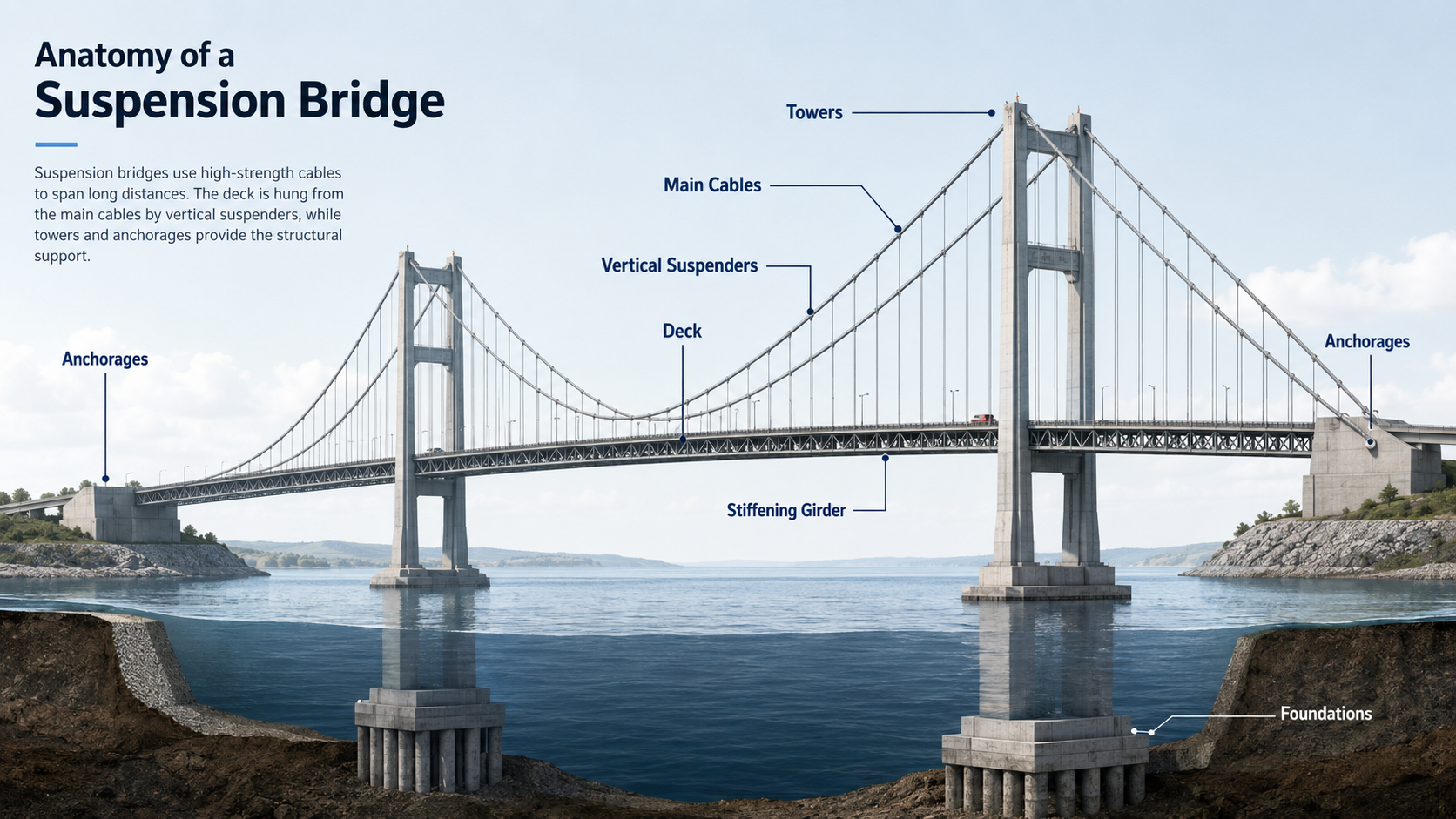
This structural system is what allows suspension bridges to cross wide rivers, bays, straits, and deep valleys with fewer supports in the middle.
Main Components of a Suspension Bridge
The main components of a suspension bridge are the towers, main cables, suspenders, deck, anchorages, and stiffening system. Each part has a specific role in keeping the bridge stable and usable.
The towers are the tall vertical structures that support the main cables. They lift the cables high enough to create the curved shape that defines a suspension bridge. The towers also help transfer forces downward into the foundations below.
The main cables are the large cables that pass over the towers and stretch from one end of the bridge to the other. These cables carry much of the load from the deck through the suspenders.
The suspenders are the smaller vertical cables that hang from the main cables and connect to the deck. They support the deck along the span and help distribute the load across the main cable system.
The deck is the surface used by cars, trucks, bicycles, pedestrians, or trains, depending on the bridge. It must be strong enough to carry traffic and stable enough to resist movement from wind, vibration, and changing loads.
The anchorages are massive structures at both ends of the bridge. They hold the main cables in place and resist the strong pulling forces created by the suspended system.
Many suspension bridges also include a stiffening truss or stiffening girder. This part helps control movement in the deck and makes the bridge more stable under traffic and wind.
Main Cables and Suspenders
The main cables and suspenders are two different parts of a suspension bridge, but they work closely together. The main cables are the large curved cables that pass over the towers, while the suspenders are the vertical cables that hang down from them.
The main cables carry the major tension forces in the bridge. They receive the load from the suspenders and transfer that load toward the towers and anchorages. Because they carry so much force, main cables are usually made from thousands of steel wires bundled together.
The suspenders have a different job. They connect the deck to the main cables. When traffic moves across the deck, the weight is transferred into the suspenders. The suspenders then pass that load upward into the main cables.
This cable arrangement allows the deck to hang below the main cables rather than needing many supports from below. That is one of the main reasons suspension bridges can cross long distances over water, valleys, or difficult terrain.
A simple way to understand the difference is this: the suspenders hold the deck, and the main cables hold the suspenders. Together, they create the suspended support system that gives this bridge type its name.
Towers and Anchorages
Towers and anchorages are essential because they give the cable system its strength and stability. Without strong towers and anchorages, the main cables would not be able to support the deck safely.
The towers support the main cables at high points above the bridge. They receive large downward forces from the cables and transfer those forces into the foundations. Because of this, the towers must be strong, stable, and carefully designed for the site.
The anchorages are located at the ends of the bridge. Their job is to hold the main cables and resist the powerful pulling forces created by the suspended structure. In many large suspension bridges, the anchorages are massive concrete blocks or structures built into strong ground or rock.
This combination of towers and anchorages allows the bridge to carry long spans. The towers lift the cables, and the anchorages secure them. The cables can then support the deck across a wide opening with fewer intermediate supports.
Anchorages are especially important in traditional suspension bridges. If the anchorages are weak or poorly placed, the cable system cannot perform properly. This is why site conditions, foundation strength, and ground stability are critical when designing a suspension bridge.
Deck and Stiffening System
The deck is the part of a suspension bridge where movement takes place. It may carry road traffic, pedestrians, bicycles, maintenance vehicles, or, in some cases, rail traffic.
Because the deck hangs from the suspenders, it must be designed for both strength and stability. It needs to carry live loads such as cars, trucks, and people, but it also needs to resist movement caused by wind, vibration, and changing traffic patterns.
A suspension bridge deck can be more flexible than the deck of some other bridge types. That flexibility is useful for long spans, but too much movement can become uncomfortable or unsafe. For this reason, many suspension bridges use a stiffening system.
The stiffening system may include a truss, girder, box girder, or other structural element that helps the deck resist bending, twisting, and excessive vibration. This is especially important for long bridges exposed to strong winds.
Modern suspension bridges are designed with careful attention to deck shape and aerodynamics. A well-designed deck helps wind pass around the bridge more safely and reduces unwanted movement.
The deck and stiffening system are important because they affect how the bridge feels and performs in real conditions. A suspension bridge must not only be strong enough to stand; it must also remain stable, comfortable, and safe for everyday use.
How Does a Suspension Bridge Work?
A suspension bridge works by transferring the weight of the deck and traffic through a system of suspenders, main cables, towers, anchorages, and foundations. Instead of placing many supports below the deck, the bridge uses cables above the deck to carry and distribute the load.
This is why suspension bridges are so effective for long crossings. The deck hangs from strong cables, the cables pass over tall towers, and the forces are carried into anchorages and foundations at each end of the bridge.
How Loads Move Through the Bridge
The load path in a suspension bridge follows a clear sequence. First, the weight of vehicles, pedestrians, trains, or the bridge deck itself acts on the deck. This weight is then transferred from the deck into the vertical suspenders.
The suspenders carry the load upward into the main cables. The main cables then move the load toward the towers and anchorages. The towers transfer much of the vertical force down into their foundations, while the anchorages resist the strong pulling forces at both ends of the bridge.
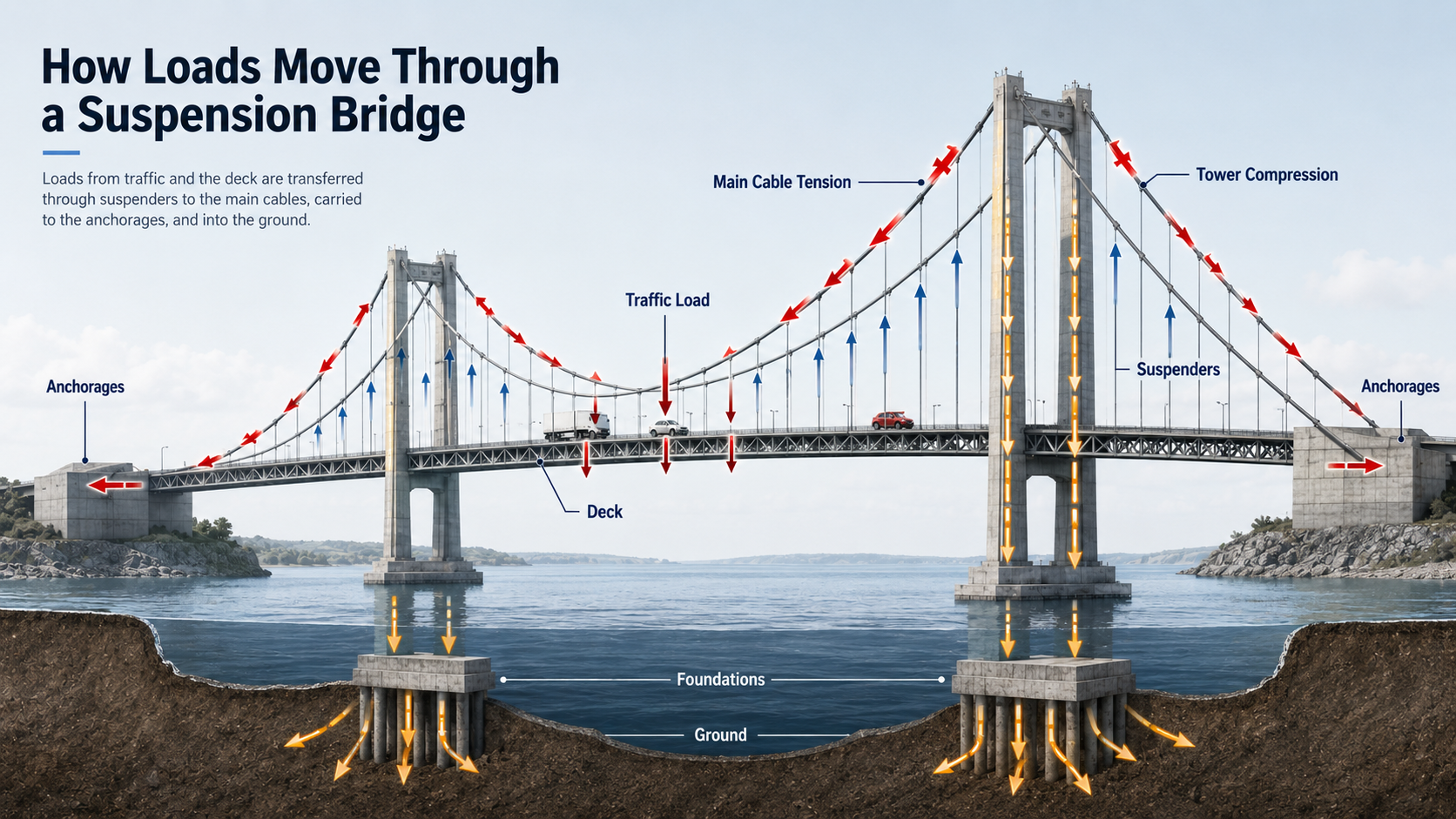
In simple terms, the load moves like this: traffic and deck, to suspenders, to main cables, to towers and anchorages, and finally into the ground.
This system allows the bridge to carry heavy loads across a long span without needing many piers in the water or below the deck. That is one of the main reasons suspension bridges are used for wide rivers, bays, straits, and deep valleys.
Tension in the Cables
The main cables in a suspension bridge work mainly in tension. Tension is a pulling force. When the deck and traffic pull downward through the suspenders, the main cables stretch and resist that pulling action.
This is one of the most important principles of suspension bridge design. Steel cables are extremely strong in tension, which makes them ideal for supporting long spans. Instead of relying on a heavy solid structure under the deck, the bridge uses the strength of the cables above it.
The curved shape of the main cables also helps distribute the load. As the suspenders pull down at many points along the bridge, the main cables carry those forces toward the towers and anchorages.
Because the cables carry so much force, they must be carefully designed, protected, inspected, and maintained. In large modern suspension bridges, the main cables may contain thousands of individual steel wires working together as one powerful support system.
Compression in the Towers
While the cables work mainly in tension, the towers work mainly in compression. Compression is a pushing or squeezing force.
The main cables pass over the tops of the towers and pull downward on them. The towers receive that force and transfer it into the foundations below. This is why suspension bridge towers must be strong, stable, and firmly supported by the ground or by foundations built in water.
The towers do not simply hold the cables in the air. They are part of the main load path of the bridge. Without strong towers, the cables could not maintain the height and shape needed to support the deck across a long span.
In many suspension bridges, the towers are among the most visible and recognizable parts of the structure. Their height is not only for appearance. It allows the main cables to create a long curve, which helps support the deck efficiently across a wide distance.
Why Suspension Bridges Can Span Long Distances
Suspension bridges can span long distances because they use cables to carry loads across wide openings. The main cables can stretch from one side of a crossing to the other, passing over towers and supporting the deck through vertical suspenders.
This design reduces the need for many intermediate supports. That is especially useful over deep water, busy shipping channels, wide rivers, large bays, and steep valleys, where building piers in the middle would be difficult or expensive.
A suspension bridge is also relatively efficient for very long spans because the cables are strong in tension and can carry loads over great distances. The deck hangs from the cable system rather than needing to be supported continuously from below.
This is why many of the world’s most famous long-span bridges are suspension bridges. They are especially useful where engineers need to cross a major obstacle while keeping the area below open for water flow, ships, roads, or natural terrain.
The ability to cross long distances with fewer supports is the main reason suspension bridges remain one of the most important bridge types in modern engineering.
Suspension Bridge vs. Cable-Stayed Bridge
A suspension bridge and a cable-stayed bridge can look similar at first because both use towers and cables. However, they are not the same type of bridge. The main difference is how the cables support the deck and how the forces move through the structure.
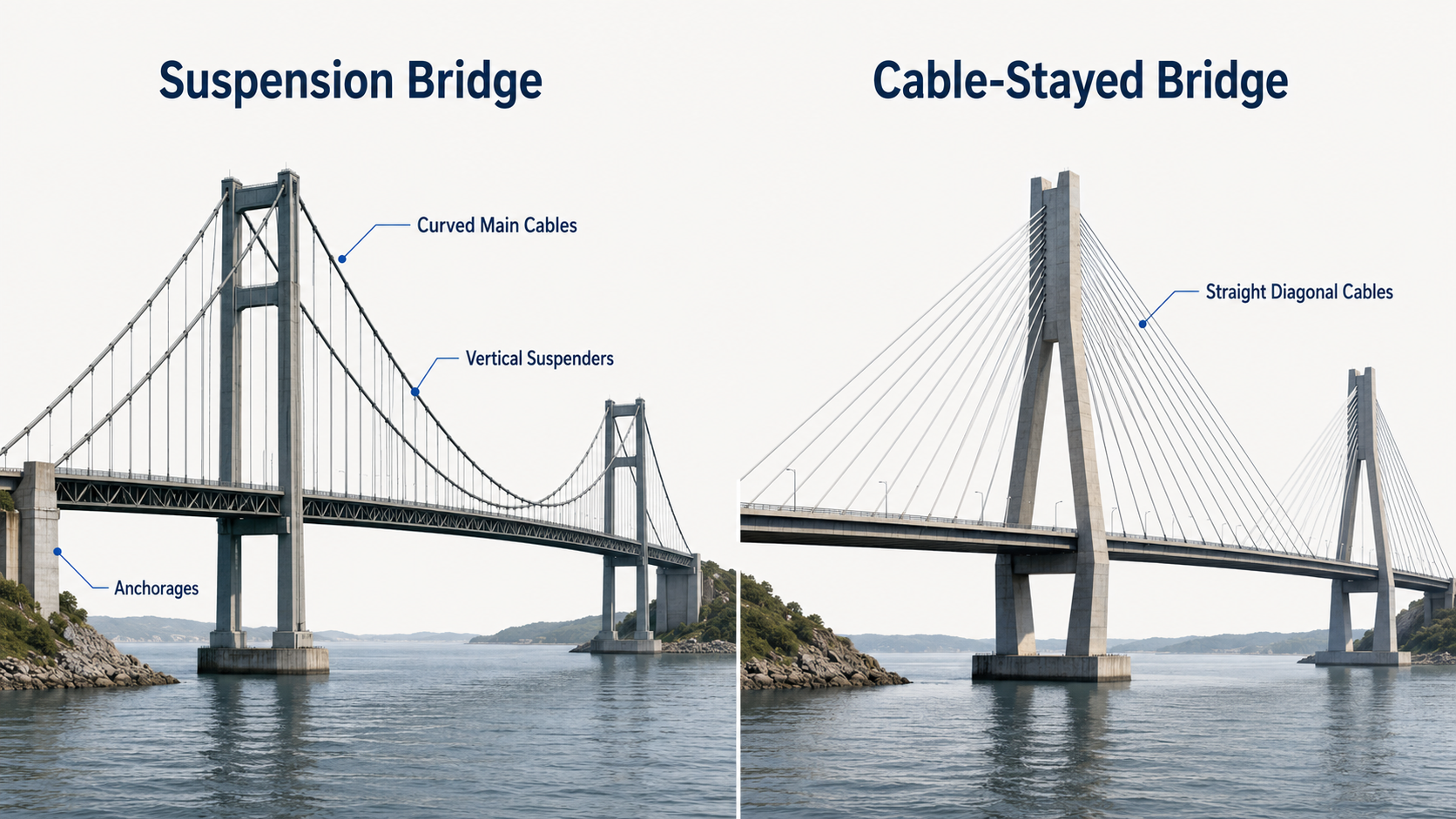
In a suspension bridge, the deck hangs from vertical suspenders attached to large main cables. In a cable-stayed bridge, the cables connect directly from the towers to the deck. This difference affects the bridge’s appearance, span length, construction method, and structural behavior.
Key Structural Differences
The most important structural difference is the cable system. A suspension bridge uses main cables that pass over the towers and continue to anchorages at both ends. Smaller vertical suspenders hang from those main cables and support the deck below.
A cable-stayed bridge works differently. It does not use the same type of long main cable passing over the towers. Instead, individual cables run directly from the towers to the deck. These cables support the deck at several points along the span.
This means a suspension bridge depends heavily on large anchorages to hold the main cables. The anchorages resist the strong pulling forces created by the cable system. In many traditional suspension bridges, these anchorages are massive concrete or rock-based structures located at the ends of the bridge.
A cable-stayed bridge usually transfers more of the load directly into the towers through the stay cables. Because the cables connect straight to the deck, the structure can be more self-contained than a traditional suspension bridge in some site conditions.
The deck support is also different. In a suspension bridge, the deck is suspended from the main cables through vertical suspenders. In a cable-stayed bridge, the deck is held by diagonal cables that connect directly to the towers.
Which Bridge Type Is Better for Long Spans?
Suspension bridges are usually better for very long spans. Their cable system makes them especially useful for crossing wide bays, large rivers, deep valleys, and major straits where placing many supports in the middle would be difficult.
This is why many of the world’s longest main-span bridges are suspension bridges. The main cables can carry loads across great distances, while the towers and anchorages help manage the forces created by the long span.
Cable-stayed bridges are often very efficient for medium and long spans, but they are usually not the first choice for the longest possible crossings. They can be easier or faster to build in some cases, especially where the span is long but not extreme.
The best option depends on the site. A cable-stayed bridge may be more practical when the crossing does not require an exceptionally long main span, when strong anchorages are difficult to build, or when the project benefits from direct cable support from the towers to the deck.
A suspension bridge may be better when the main challenge is crossing a very wide opening with minimal supports below. For major sea crossings, wide navigation channels, or deep valleys, suspension bridge design often provides the greater long-span capability.
Visual Differences for Readers
A suspension bridge is usually easy to recognize because it has large curved main cables. These cables pass over the towers and dip downward between them, creating a smooth hanging curve. The deck hangs below the main cables from many vertical suspenders.
A cable-stayed bridge has a different visual pattern. Its cables run directly from the towers to the deck in straight lines. These cables may form a fan shape, where several cables spread out from the tower, or a harp shape, where the cables appear more parallel.
In simple terms, a suspension bridge has curved main cables with vertical suspenders. A cable-stayed bridge has straight diagonal cables that connect the towers directly to the deck.
This visual difference helps readers identify the two bridge types quickly. If the bridge has large sweeping cables over the towers and many vertical hangers, it is likely a suspension bridge. If the cables go straight from the tower to the deck, it is likely a cable-stayed bridge.
Both bridge types are important in modern engineering, but they solve long-span problems in different ways. Suspension bridges are often chosen for the longest crossings, while cable-stayed bridges are widely used for strong, efficient, and visually striking medium-to-long spans.
Advantages of Suspension Bridges
Suspension bridges have several important advantages, especially when engineers need to cross long distances. Their cable-supported design allows them to span wide openings with fewer supports below the deck, making them one of the most effective bridge types for major crossings.
They are often used where other bridge types would be less practical, more disruptive, or more difficult to build. This includes wide rivers, deep valleys, bays, straits, and areas where water depth, navigation, or terrain makes intermediate piers hard to construct.
Excellent for Long Spans
One of the greatest advantages of a suspension bridge is its ability to cover long spans. The main cables can carry the deck across a wide distance while transferring forces to the towers and anchorages.
This makes suspension bridges especially useful when a crossing must remain open below. For example, a large bay or shipping channel may need enough open space for boats and ships to pass safely. A suspension bridge can provide that clearance without requiring many supports in the water.
Compared with simpler bridge types, a suspension bridge can reach much longer main spans. Beam bridges and many arch bridges are effective in the right settings, but they usually become less practical when the distance becomes very large. Suspension bridges are designed specifically for these long-span challenges.
This is why many of the world’s most famous long-span bridges use suspension bridge design. Their strength comes from using cables in tension, tall towers, and strong anchorages to carry loads across distances that would be difficult for many other bridge systems.
Useful for Deep Water and Wide Crossings
Suspension bridges are very useful in places where building supports in the middle of the crossing would be difficult, expensive, or dangerous. Deep water, strong currents, busy navigation channels, and wide openings can make intermediate piers a major challenge.
In these situations, a suspension bridge can reduce the number of supports needed below the deck. Instead of placing many piers in the water or on unstable ground, engineers can use towers and cables to carry the bridge across the main span.
This is especially valuable for bays, straits, large rivers, and deep valleys. In a wide water crossing, fewer piers can also reduce interference with ships, water flow, and marine conditions.
A suspension bridge may also be useful where the ground below is not suitable for many foundations. If the area includes deep water, soft soil, steep slopes, or difficult terrain, a long-span cable-supported design may be more practical than a structure that needs frequent supports.
This ability to cross difficult sites is one reason suspension bridges are often chosen for major transportation links. They can connect regions that would otherwise be separated by natural barriers.
Efficient Use of Materials
Suspension bridges use materials efficiently for long spans because the main cables work mainly in tension. Steel performs very well under tension, which makes it ideal for carrying large loads across long distances.
Instead of building a massive solid structure under the entire deck, a suspension bridge uses cables to support the deck from above. This allows the bridge to cross wide openings without needing a continuous line of heavy supports below.
The main cables, suspenders, towers, and anchorages each have a specific structural role. The cables carry pulling forces, the suspenders support the deck, the towers transfer vertical loads into the foundations, and the anchorages resist the cable tension.
This does not mean suspension bridges are cheap or simple to build. They are complex structures that require careful design and high-quality materials. However, for very long spans, their cable-based system can be more efficient than trying to support the deck with many piers or heavy structural members.
Material efficiency is one reason suspension bridges remain important in modern engineering. When the crossing is long enough, their design can provide a practical balance between strength, span length, and structural performance.
Iconic Visual Design
Suspension bridges are also known for their iconic visual design. Their tall towers, sweeping main cables, vertical suspenders, and long open spans create a dramatic appearance that is easy to recognize.
Many suspension bridges become landmarks because of this distinctive form. They often define city skylines, coastal views, and major transportation corridors. A suspension bridge can serve a practical purpose while also becoming a symbol of a city, region, or country.
The Golden Gate Bridge in San Francisco is one of the clearest examples. It is famous not only because it is an important crossing, but also because of its setting, color, towers, and elegant suspension form.
This visual appeal gives suspension bridges value beyond transportation. They can attract tourism, appear in photography, represent engineering achievement, and become part of a place’s identity.
For this reason, suspension bridges are often remembered more easily than many other bridge types. Their structure is functional, but their appearance can also make them powerful cultural and architectural landmarks.
Disadvantages of Suspension Bridges
Suspension bridges are powerful and visually impressive, but they also have important disadvantages. Their long-span capability comes with higher cost, more complex engineering, greater sensitivity to movement, and demanding maintenance requirements.
These limitations do not make suspension bridges a poor choice. Instead, they show why this bridge type must be used in the right location and designed with great care. A suspension bridge can be an excellent solution for a major crossing, but it is not always the most practical option for every project.
Higher Construction Cost
One of the main disadvantages of a suspension bridge is its high construction cost. These bridges require large towers, massive main cables, strong anchorages, deep foundations, and a carefully designed deck system.
The towers must be tall and strong enough to support the cable system. The main cables must be manufactured, installed, and protected with high precision. The anchorages must be powerful enough to resist the enormous pulling forces created by the cables.
This makes suspension bridge construction more expensive than many simpler bridge types. A short road crossing, for example, may be more efficiently handled with a beam bridge, arch bridge, or truss bridge. A suspension bridge is usually justified only when the span is long enough or the site conditions are difficult enough to require this type of design.
The cost also includes specialized labor, advanced engineering analysis, heavy equipment, and long construction timelines. Because the structure depends on so many connected systems, mistakes in design or construction can be very serious.
For this reason, suspension bridges are most often used for major crossings where the benefits of a long span outweigh the higher cost.
Sensitivity to Wind and Movement
Suspension bridges are more flexible than many other bridge types. This flexibility helps them span long distances, but it also means they can be sensitive to wind, vibration, and movement.
Wind is especially important. A long bridge deck can be affected by strong gusts, changing air pressure, and aerodynamic forces. If the deck is not properly designed, wind can cause uncomfortable or dangerous movement.
Traffic can also create movement. Heavy vehicles, repeated loads, and changing traffic patterns may cause the deck to vibrate or shift slightly. In most modern bridges, this movement is expected and controlled, but it must still be carefully studied.
This is why modern suspension bridges need aerodynamic deck design, wind tunnel testing, stiffening systems, and structural monitoring. Engineers must consider how the bridge will behave not only under normal traffic, but also during storms, high winds, and unusual load conditions.
The sensitivity to wind and movement is one reason suspension bridges require advanced engineering. A bridge may look elegant and simple from a distance, but its stability depends on careful control of forces that are not always visible.
Complex Maintenance
Suspension bridges require regular and detailed maintenance. Their cables, suspenders, towers, anchorages, deck, bearings, joints, and protective coatings must be inspected and maintained over time.
The main cables are especially important because they carry large tension forces. If moisture, corrosion, or damage affects the cable system, the safety and durability of the bridge can be reduced. For this reason, cable protection systems, dehumidification, painting, and inspection programs are often necessary.
The deck also needs maintenance because it is exposed to traffic, weather, vibration, and temperature changes. Road surfaces, expansion joints, drainage systems, guardrails, and structural elements may need repair or replacement during the bridge’s service life.
Corrosion is another major concern, especially in coastal areas or places exposed to salt, humidity, and harsh weather. Suspension bridges near oceans, bays, or large bodies of water often need strong protective systems to prevent long-term deterioration.
Maintenance can be expensive and technically demanding. It may require lane closures, specialized inspection equipment, rope access, aerial platforms, sensors, or temporary traffic control. This makes the long-term cost of a suspension bridge an important part of the decision-making process.
Not Ideal for Every Location
A suspension bridge is not always the best choice for every site. It needs suitable conditions for towers, foundations, and anchorages. If the ground is weak, unstable, or too difficult to anchor into, the design may become more complicated and expensive.
Traditional suspension bridges depend heavily on strong anchorages at both ends. These anchorages must resist the powerful horizontal pulling forces from the main cables. If the site does not provide good conditions for anchorages, another bridge type may be more practical.
Suspension bridges are also usually unnecessary for short crossings. If the span is small or moderate, a beam bridge, arch bridge, truss bridge, or cable-stayed bridge may provide a simpler and more cost-effective solution.
Location also matters because of wind, seismic activity, navigation needs, environmental limits, and construction access. A suspension bridge may be ideal for a wide bay or deep strait, but less suitable for a small river, narrow road crossing, or site where maintenance access would be difficult.
The key point is that suspension bridges are specialized long-span structures. They are highly effective when the crossing is large and the site supports the design, but they are not always the most efficient answer for smaller or simpler infrastructure needs.
Types and Variations of Suspension Bridges
Suspension bridges can appear in different forms depending on their purpose, location, materials, and structural design. Some are large highway bridges built across bays and straits, while others are smaller pedestrian bridges used on trails, in parks, or in remote areas.
Although these variations may look different, they all share the same basic idea: the deck is supported by cables or tension elements. The difference is in how the cables are arranged, where they are anchored, and what type of deck system is used.
Simple Suspension Bridge
A simple suspension bridge is one of the most basic forms of suspension bridge. It is often used for pedestrian crossings, hiking trails, rural paths, mountain areas, and lightweight crossings over rivers or ravines.
In a simple suspension bridge, the walkway may hang directly from cables or ropes. The structure is usually more flexible than a large modern road bridge, and it may move slightly when people walk across it.
Simple suspension bridges are useful because they can cross difficult terrain with relatively light materials. They are often built in places where constructing a heavy bridge would be too expensive or impractical.
These bridges are common in parks, forest trails, remote villages, and adventure tourism areas. They are not usually designed for heavy vehicles, but they can be very effective for foot traffic when properly built and maintained.
The main advantage of a simple suspension bridge is that it provides a direct crossing with fewer supports below. This makes it useful over streams, gorges, narrow valleys, and areas where building piers would be difficult.
Underspanned Suspension Bridge
An underspanned suspension bridge is a less common variation where the main supporting cables are located below the deck instead of above it. This makes it different from the typical suspension bridge, where the main cables pass over tall towers and the deck hangs below them.
In an underspanned design, the deck is still supported by a cable system, but the arrangement of the cables changes the way the structure looks and behaves. The cables may run underneath the deck and help support it from below.
This type of bridge is usually not used for the largest highway or sea crossings. Instead, it may appear in smaller bridges, pedestrian crossings, or special engineering situations where the site or design calls for a different cable arrangement.
Underspanned suspension bridges are important because they show that not every suspension bridge follows the same visual pattern. A bridge can still belong to the suspension bridge family even if its cables are not placed above the deck in the most familiar way.
For general readers, the easiest way to understand this variation is simple: a standard suspension bridge usually has cables above the deck, while an underspanned suspension bridge uses supporting cables below the deck.
Self-Anchored Suspension Bridge
A self-anchored suspension bridge is a variation where the main cables are anchored to the bridge deck itself rather than to massive anchorages in the ground. This makes it different from a traditional suspension bridge, which usually depends on large external anchorages at both ends.
This design can be useful in locations where building huge ground anchorages is difficult. For example, if the soil conditions, urban setting, or available space do not allow for massive anchor blocks, a self-anchored system may be considered.
In a self-anchored suspension bridge, the deck becomes a more active part of the structural system. It helps resist the forces from the cables, which means the deck must be designed with greater strength and stiffness.
This type of bridge is more complex to design and build than a traditional suspension bridge. The construction sequence can also be more challenging because the cable system and deck depend closely on each other.
However, self-anchored suspension bridges can be useful in certain urban or constrained sites. They allow engineers to use the visual and structural qualities of a suspension bridge even when traditional anchorages are not practical.
Suspension Cable Types
Suspension bridges can use different cable types depending on the period, purpose, and scale of the structure. Early suspension bridges used natural ropes, vines, or chains. Modern suspension bridges usually use steel wire cables.
Rope-based suspension bridges were common in early and remote crossings. They were lightweight and could be built with local materials, but they were not suitable for heavy modern traffic.
Chain suspension bridges were an important historical step. They used metal chains or linked iron elements instead of natural fibers. These bridges were stronger than rope bridges and helped bridge builders move toward more durable suspended structures.
Modern suspension bridges usually rely on wire cables made from many steel wires bundled together. These cables are strong in tension and can support very long spans. In large bridges, the main cables may contain thousands of individual wires working together as one structural element.
The cable type matters because the cables carry some of the most important forces in the bridge. Stronger cable systems allow suspension bridges to become longer, safer, and more reliable.
Deck Structure Types
The deck of a suspension bridge can also vary depending on the type of traffic it carries and the level of stiffness required. Some decks are designed for pedestrians, while others must support cars, trucks, or even rail traffic.
A pedestrian suspension bridge may use a lighter deck made from wood, steel grating, or composite panels. These decks are usually simpler because they carry lighter loads.
Large road suspension bridges need stronger deck systems. They may use stiffening trusses, plate girders, or box girders to help control movement. These systems make the deck more stable under traffic, wind, and vibration.
A stiffening truss is a framework that helps the deck resist bending and twisting. A box girder is a strong enclosed beam-like structure that can provide stiffness and aerodynamic performance. Modern long-span bridges often use deck shapes designed to reduce wind-related movement.
The deck structure is important because suspension bridges are naturally flexible. Without enough stiffness, the deck may move too much under wind or traffic. A well-designed deck helps the bridge remain safe, stable, and comfortable for everyday use.
Forces Acting on a Suspension Bridge
A suspension bridge must handle several forces at the same time. Some forces come from the weight of the bridge itself, while others come from traffic, wind, temperature changes, vibration, and movement.
The most important forces in a suspension bridge include tension, compression, dead load, live load, wind forces, torsion, and vibration. These forces are not separate from the bridge’s design. They are the reason suspension bridges need strong cables, stable towers, secure anchorages, and carefully shaped decks.
Understanding these forces helps explain why suspension bridges can cross long distances, but also why they require advanced engineering and regular inspection.
Dead Load and Live Load
Dead load is the permanent weight of the bridge itself. This includes the deck, towers, main cables, suspenders, anchorages, stiffening system, pavement, railings, and other fixed parts of the structure.
Dead load is always present. Even when no cars, trucks, trains, cyclists, or pedestrians are on the bridge, the structure must still support its own weight. In a large suspension bridge, this permanent load can be enormous.
Live load is the changing weight placed on the bridge during use. This includes vehicles, pedestrians, bicycles, maintenance equipment, and, in some cases, trains. Live load changes throughout the day as traffic increases, decreases, stops, or moves across the span.
A suspension bridge must be designed for both types of load. The dead load creates constant forces in the cables, towers, and anchorages. The live load creates changing forces as traffic moves across the deck.
This is why engineers do not design a suspension bridge only for its empty condition. They must consider how the bridge behaves when it carries heavy traffic, uneven traffic, emergency vehicles, maintenance loads, or crowds of pedestrians.
Wind Forces and Aerodynamics
Wind is one of the most important forces acting on a suspension bridge. Because suspension bridges often have long, flexible decks, they can be sensitive to strong winds, changing air pressure, and aerodynamic movement.
When wind flows around the bridge deck, it can push, lift, twist, or vibrate the structure. The longer and lighter the span, the more important this issue becomes. A bridge that looks stable in calm weather must also perform safely during storms, gusts, and changing wind directions.
Modern suspension bridges are designed with aerodynamics in mind. The shape of the deck, the stiffness of the structure, and the use of dampers or stabilizing systems can help reduce unwanted movement.
Wind tunnel testing is often used for major suspension bridges. Engineers create scale models and study how air moves around the bridge before the final design is built. This helps identify possible vibration, twisting, or instability problems early in the design process.
Aerodynamics matters because a suspension bridge is not just a static structure. It interacts with the air around it. Good aerodynamic design helps the bridge remain stable, safe, and comfortable for traffic.
Torsion, Vibration, and Bridge Movement
Torsion is a twisting force. In a suspension bridge, torsion can occur when wind, uneven traffic, or other forces cause one side of the deck to move differently from the other side.
Vibration is repeated movement. It can be caused by wind, traffic, pedestrians, or mechanical effects. Small movements are normal in large bridges, but excessive vibration must be controlled.
Suspension bridges are naturally more flexible than many shorter bridge types. This flexibility helps them handle long spans, but it also means the deck must be designed to resist too much bending, twisting, or shaking.
To control movement, engineers use several design strategies. A stiffening truss or box girder can make the deck more stable. Aerodynamic deck shapes can reduce wind-related movement. Dampers and structural monitoring systems can also help manage vibration.
Bridge movement is not always dangerous. Large suspension bridges are expected to move slightly under wind and traffic. The key is that the movement must remain within safe and controlled limits.
This is why the deck structure, cable system, towers, and anchorages must work together. A suspension bridge must be strong enough to carry loads, but also stable enough to resist unwanted motion.
Lessons From Bridge Failures
Bridge failures have played an important role in improving suspension bridge design. They have shown engineers that strength alone is not enough. A bridge must also be stable under wind, vibration, torsion, and changing loads.
One of the most important lessons is that long, flexible bridge decks need careful aerodynamic design. If wind causes the deck to twist or vibrate too much, the structure can become unsafe. This is why modern suspension bridges are studied with wind analysis, structural modeling, and detailed testing.
Failures have also shown the importance of maintenance and inspection. Cables, suspenders, anchorages, joints, and deck systems must be checked regularly because small problems can become serious over time.
Today, suspension bridges benefit from improved materials, better engineering standards, wind tunnel testing, computer modeling, and structural health monitoring. These tools help engineers understand how a bridge will behave before and after it is built.
The main lesson is simple: a suspension bridge must be designed not only to carry weight, but also to control movement. That balance between strength, flexibility, and stability is what makes suspension bridge engineering both challenging and impressive.
Suspension Bridge Construction
Suspension bridge construction is a complex process that requires careful planning, strong foundations, precise cable installation, and detailed safety checks. Unlike shorter bridge types, a suspension bridge depends on a large structural system where towers, cables, anchorages, suspenders, and the deck must work together correctly.
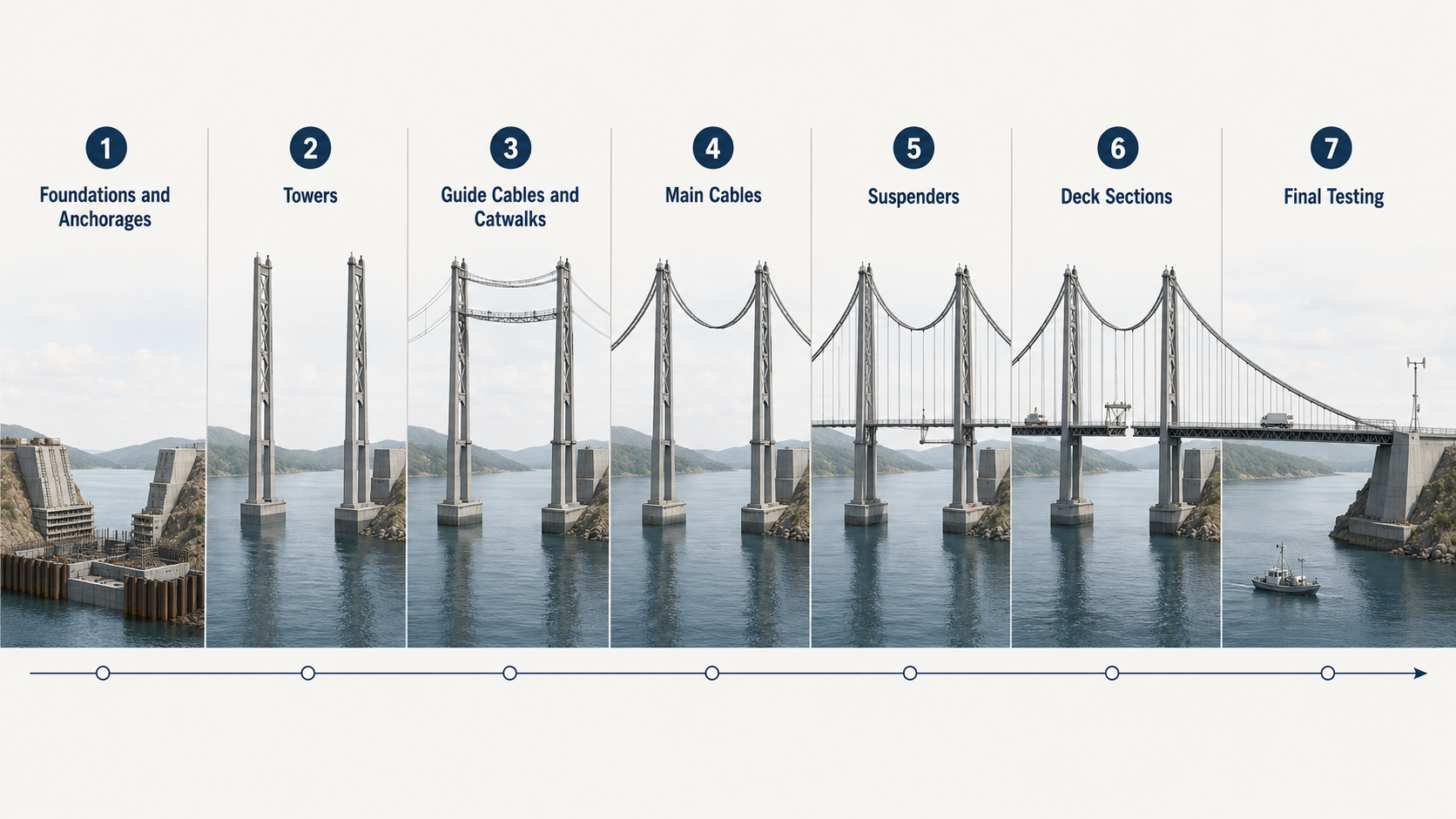
The construction process usually follows a sequence: foundations are built first, then towers and anchorages are constructed, main cables are installed, suspenders are added, deck sections are placed, and the entire structure is inspected and tested before opening to traffic.
Basic Construction Sequence
The first major step in building a suspension bridge is preparing the site and constructing the foundations. These foundations must support the towers, anchorages, and other major structural elements. If the bridge crosses deep water, a bay, or a strait, foundation work can be one of the most difficult parts of the project.
After the foundations are ready, the towers are built. The towers must rise high enough to support the main cables and create the proper cable curve across the span. They are usually made from steel, concrete, or a combination of strong structural materials.
The anchorages are also built during the early stages. In a traditional suspension bridge, anchorages are massive structures at both ends of the bridge that hold the main cables in place. They must resist the powerful pulling forces created by the cable system.
Once the towers and anchorages are complete, temporary guide cables or catwalks may be installed between the towers. These allow workers and equipment to move across the span while the main cables are being built.
The next step is cable installation. In many large suspension bridges, the main cables are not lifted into place as one single piece. Instead, they are formed on-site by spinning or placing many individual wires across the span.
After the main cables are complete, vertical suspenders are attached. These suspenders hang down from the main cables and will later support the deck.
Finally, deck sections are lifted or moved into position and connected to the suspenders. After the deck is installed, crews complete road surfaces, barriers, lighting, drainage, expansion joints, and other finishing elements.
Wire Strand Cable Construction
Wire strand cable construction is one of the most important parts of building a large suspension bridge. The main cables must be strong enough to carry the deck, traffic, wind forces, and other loads over a long span.
In many modern suspension bridges, the main cables are made from thousands of individual steel wires. These wires are grouped together to form strands, and the strands are combined to create the large main cables.
One common method is cable spinning. In this process, wires are carried back and forth across the bridge route between the anchorages. Over time, many wires are gathered into bundles until the full cable is formed.
This method allows engineers to create extremely strong cables directly on the bridge site. It also makes it possible to build cables that are too large and heavy to transport as a single finished piece.
After the wires are placed, the cable is compacted, shaped, wrapped, and protected. Protection is very important because steel cables must be guarded against corrosion, moisture, and long-term environmental damage.
The strength of the main cables is one of the reasons suspension bridges can span such long distances. These cables work mainly in tension, and modern steel wire systems are designed to carry enormous pulling forces safely.
Building the Deck
The bridge deck is usually built after the main cables and suspenders are in place. The deck is the part of the bridge that carries vehicles, pedestrians, bicycles, or other traffic.
In many suspension bridge projects, the deck is built in sections. These sections may be fabricated off-site and transported to the bridge location, or they may be assembled near the site before being lifted into place.
Large cranes, lifting systems, barges, or temporary construction equipment may be used to position each deck section. Once a section is lifted, it is connected to the vertical suspenders that hang from the main cables.
The deck must be installed carefully because its weight changes the forces in the cables and towers. Engineers monitor alignment, balance, and cable behavior as each section is added.
After the structural deck is in place, additional work is completed. This may include the road surface, sidewalks, railings, barriers, drainage systems, lighting, maintenance walkways, and expansion joints.
The deck must be strong enough to carry traffic, but it must also be stable against wind and vibration. For this reason, many suspension bridges use a stiffening truss, box girder, or other structural system to help control movement.
Final Testing and Safety Checks
Before a suspension bridge opens to traffic, it must go through final testing and safety checks. These checks confirm that the bridge was built according to the design and that all major systems are working properly.
Engineers inspect the towers, main cables, suspenders, anchorages, deck, expansion joints, bearings, drainage systems, and protective coatings. They also check whether the bridge is aligned correctly and whether the cable system is carrying loads as expected.
Load testing may be performed to study how the bridge responds under controlled weight. This can involve placing vehicles or test loads on the deck to measure movement, deflection, vibration, and structural behavior.
Wind performance and movement control are also important. For major suspension bridges, aerodynamic behavior is studied during the design stage, but engineers still review how the completed bridge responds in real conditions.
Safety checks also include inspection of access systems, maintenance paths, lighting, signs, traffic barriers, and emergency systems. A suspension bridge is not only a structural project; it must also function safely for everyday users.
After the bridge opens, inspection does not stop. Suspension bridges require long-term monitoring and maintenance because cables, suspenders, deck components, joints, and protective systems can change over time. Regular inspection helps keep the bridge safe, durable, and reliable throughout its service life.
Common Uses of Suspension Bridges
Suspension bridges are most often used when a crossing is too wide, deep, or difficult for simpler bridge types. Their ability to span long distances with fewer intermediate supports makes them useful for major transportation routes, pedestrian crossings, and specialized infrastructure.
Although many people associate suspension bridges with highways, they can serve different purposes. Some carry cars and trucks across bays or rivers, some support pedestrian trails, and others are used for specialized crossings where a lightweight or long-span structure is needed.
Road and Highway Crossings
Road and highway crossings are among the most common uses of large suspension bridges. These bridges are often built across wide rivers, bays, straits, harbor entrances, and major waterways where traffic needs a direct route between two regions.
A suspension bridge is useful in these locations because it can leave a large open space below the deck. This is important when ships, boats, or water traffic need to pass underneath the bridge. Instead of placing many piers in the water, engineers can use towers, cables, and a long main span to keep the navigation channel open.
Many famous suspension bridges carry vehicle traffic. The Golden Gate Bridge in California, the Verrazzano-Narrows Bridge in New York, and the Mackinac Bridge in Michigan are well-known examples in the United States. These bridges are not only transportation links; they are also landmarks because of their scale, location, and visual design.
Suspension bridges are especially valuable when they reduce travel time between cities, islands, ports, or coastal regions. By creating a direct highway connection, they can support commuting, tourism, freight movement, emergency access, and regional economic activity.
Railway Suspension Bridges
Railway suspension bridges exist, but they are less common than road suspension bridges. The main reason is that trains require a high level of stiffness and stability. A railway bridge must handle heavy loads, repeated vibration, and strict alignment requirements.
Suspension bridges are naturally more flexible than many other bridge types. This flexibility can be useful for long spans, but it can create challenges for rail traffic. Trains are heavy and move along fixed tracks, so excessive deck movement can be a serious design concern.
Because of this, many railway bridges use truss, arch, beam, or cable-stayed designs instead. These structures can sometimes provide the stiffness that rail systems need more easily than a traditional suspension bridge.
However, suspension bridges can still be used for rail in certain cases when the design is carefully engineered. They may need a stronger deck, added stiffening systems, and detailed analysis of vibration, wind, and load movement.
In general, railway suspension bridges are possible, but they require more specialized design than ordinary road suspension bridges. This is why they are not as common in everyday rail infrastructure.
Pedestrian Suspension Bridges
Pedestrian suspension bridges are widely used in parks, mountain areas, hiking trails, forests, canyons, tourist destinations, and remote communities. They are often smaller and lighter than highway suspension bridges, but they use the same basic principle of a suspended deck supported by cables.
These bridges are useful where people need to cross rivers, ravines, gorges, steep valleys, or difficult terrain. In many natural areas, a pedestrian suspension bridge can provide access without requiring large foundations or many supports below.
Pedestrian suspension bridges may be built from steel cables, timber decks, metal grating, composite panels, or other lightweight materials. Some are simple and practical, while others are designed as scenic attractions.
In national parks, adventure trails, and mountain regions, pedestrian suspension bridges often become part of the visitor experience. They can offer dramatic views while still serving a practical purpose: helping people cross a natural obstacle safely.
Because these bridges are used by people on foot, comfort and safety are very important. Railings, stable walking surfaces, controlled movement, and regular inspection help make pedestrian suspension bridges safe for daily or recreational use.
Uses Beyond Road and Rail
Suspension bridge design can also be used beyond ordinary road and rail traffic. In some cases, suspension systems support pipelines, utility lines, maintenance walkways, temporary crossings, or lightweight service structures.
A suspended system can be useful when the crossing is difficult but the load is not as heavy as highway or railway traffic. For example, a pipeline may need to cross a river, canyon, or valley where building many supports would be expensive or environmentally disruptive.
Maintenance walkways may also use suspension-style design in industrial sites, dams, bridges, or remote infrastructure areas. These walkways allow workers to access equipment, inspect structures, or move across difficult terrain.
Temporary or lightweight suspension bridges may be used in emergency situations, construction access, rural crossings, or remote locations. Their relative lightness can make them useful where fast access is needed and heavy construction is not practical.
These specialized uses show that suspension bridge principles are not limited to famous landmark bridges. The same basic idea—using cables in tension to support a crossing—can be adapted to many different transportation, utility, and access needs.
Longest Suspension Bridges in the World
The longest suspension bridges in the world are usually ranked by main span, not by total length. The main span is the distance between the two main towers, and it is the most important measurement for comparing long-span suspension bridges.
This matters because a bridge can have a long total length, including approach roads or side spans, without having the longest suspended span. For suspension bridges, the engineering challenge is often concentrated in the main span, where the deck is supported by the cable system across the widest opening.
Ranking by Main Span
The following table ranks major suspension bridges by main span. These bridges are among the most important examples of long-span suspension bridge engineering.
| Rank | Bridge Name | Country | Main Span | Year Opened |
|---|---|---|---|---|
| 1 | 1915 Çanakkale Bridge | Turkey | 2,023 m / 6,637 ft | 2022 |
| 2 | Akashi Kaikyō Bridge | Japan | 1,991 m / 6,532 ft | 1998 |
| 3 | Yangsigang Yangtze River Bridge | China | 1,700 m / 5,577 ft | 2019 |
| 4 | Nansha Bridge, East Span | China | 1,688 m / 5,538 ft | 2019 |
| 5 | Xihoumen Bridge | China | 1,650 m / 5,413 ft | 2009 |
| 6 | Great Belt Bridge, East Bridge | Denmark | 1,624 m / 5,328 ft | 1998 |
| 7 | Osman Gazi Bridge | Turkey | 1,550 m / 5,085 ft | 2016 |
| 8 | Yi Sun-sin Bridge | South Korea | 1,545 m / 5,069 ft | 2012 |
| 9 | Runyang Yangtze River Bridge | China | 1,490 m / 4,888 ft | 2005 |
| 10 | Nanjing Fourth Yangtze Bridge | China | 1,418 m / 4,652 ft | 2012 |
The 1915 Çanakkale Bridge in Turkey currently holds the record for the longest suspension bridge main span in the world. Its main span measures 2,023 meters, or about 6,637 feet.
Before the 1915 Çanakkale Bridge opened, the Akashi Kaikyō Bridge in Japan held the record for many years. It remains one of the most important suspension bridges ever built and is still among the longest by main span.
China also appears several times in the ranking because of its major river crossings and large-scale bridge infrastructure. Bridges such as the Yangsigang Yangtze River Bridge, Xihoumen Bridge, Runyang Yangtze River Bridge, and Nanjing Fourth Yangtze Bridge show how important suspension bridge design remains for wide river crossings.
Why Main Span Matters More Than Total Length
For suspension bridges, main span is usually more important than total length because it measures the longest unsupported distance between the main towers. This is the part of the bridge where the cable system does the most important work.
Total length can include side spans, approach viaducts, ramps, and connecting roads. These parts matter for the full transportation project, but they do not always show the true long-span engineering challenge.
A bridge with a very long total length may not have a record-setting main span. At the same time, a bridge with a shorter total length can be more impressive as a suspension bridge if its main span is longer.
This is why suspension bridge records are usually based on the central span between the towers. The longer that span is, the more demanding the design becomes. Engineers must consider cable tension, tower height, deck stiffness, wind behavior, vibration, and anchorage strength.
Main span also matters because suspension bridges are often built to keep the space below open. A long main span can allow ships to pass through a navigation channel, preserve water flow, or cross deep valleys without placing many supports below.
For readers comparing suspension bridges, the key point is simple: total length tells you how long the full bridge project is, but main span tells you how far the bridge can reach between its main supports.
Longest Suspension Bridge in the United States
The Verrazzano-Narrows Bridge in New York is commonly recognized as the longest suspension bridge in the United States by main span. Its main span is 4,260 feet, or about 1,298 meters.
The bridge connects Staten Island and Brooklyn across the Narrows, the tidal strait between Upper New York Bay and Lower New York Bay. When it opened in 1964, it had the longest suspension bridge span in the world.
For American readers, the Verrazzano-Narrows Bridge is one of the most important examples of suspension bridge engineering in the United States. It remains a major transportation link in New York City and an important landmark in American bridge history.
The Mackinac Bridge in Michigan is also one of the most famous long suspension bridges in the United States. It connects Michigan’s Upper and Lower Peninsulas and is often discussed because of its impressive overall length. However, when ranking suspension bridges by main span, the Verrazzano-Narrows Bridge is the stronger answer for the longest suspension bridge in the U.S.
This distinction is important because “longest” can mean different things. The Mackinac Bridge is famous for its total length and location, while the Verrazzano-Narrows Bridge is especially important for its main span.
Famous Suspension Bridge Examples
Some suspension bridges are famous because of their size, while others are known for their beauty, history, location, or engineering influence. These bridges help show why suspension bridge design is one of the most recognizable forms of bridge engineering in the world.
The examples below include bridges from the United States, Japan, Turkey, and the United Kingdom. Some became landmarks because of their visual design, while others became important because they set records for long-span construction.
Golden Gate Bridge, United States
The Golden Gate Bridge in San Francisco, California, is one of the most famous suspension bridges in the world. It crosses the Golden Gate Strait, connecting San Francisco with Marin County.
When it opened in 1937, the Golden Gate Bridge set the world record for the longest bridge span, with a main span of 4,200 feet, or 1,280 meters. Its towers, sweeping cables, and International Orange color made it one of the most recognizable bridges ever built.
The bridge is important not only as a transportation link, but also as a symbol of San Francisco and American engineering. Its location at the entrance to San Francisco Bay gives it a dramatic visual setting, especially when surrounded by fog, ocean water, and the city skyline.
For readers in the United States, the Golden Gate Bridge is often the first example that comes to mind when thinking about a suspension bridge. It shows how this bridge type can combine function, engineering, tourism, and cultural identity in one structure.
Brooklyn Bridge, United States
The Brooklyn Bridge in New York City is another iconic American bridge, but it should be described carefully. It is often classified as a suspension bridge, but it also includes cable-stayed elements, making it a hybrid structure.
Opened in 1883, the Brooklyn Bridge connects Manhattan and Brooklyn across the East River. At the time, it was one of the most ambitious bridge projects in the world and became a major symbol of New York City.
The bridge uses large main suspension cables, vertical suspenders, and diagonal stays. This combination gives it a distinctive appearance and makes it different from a simple modern suspension bridge.
Its importance comes from more than its structure. The Brooklyn Bridge became a landmark of urban growth, engineering progress, and American history. Its stone towers, elevated walkway, and location in New York City have made it one of the most photographed and recognized bridges in the world.
For an article about suspension bridges, the Brooklyn Bridge is valuable because it shows how bridge design can include transitional or hybrid forms. It belongs in the discussion, but it should not be described as a purely standard suspension bridge without mentioning its cable-stayed features.
Akashi Kaikyō Bridge, Japan
The Akashi Kaikyō Bridge in Japan is one of the greatest modern examples of long-span suspension bridge engineering. It connects the city of Kobe with Awaji Island across the Akashi Strait.
When it opened in 1998, it became the world’s longest suspension bridge by main span. Its main span measures 1,991 meters, or about 6,532 feet, making it one of the most impressive long-span bridges ever built.
The bridge was designed for a challenging environment. The Akashi Strait has strong currents, busy shipping traffic, and seismic activity, so the bridge required advanced engineering and careful structural design.
The Akashi Kaikyō Bridge is important because it shows how modern suspension bridges can solve major geographic and transportation challenges. It is not only long; it is also an example of how suspension bridge design can adapt to demanding natural conditions.
Although it is no longer the world record holder for the longest main span, it remains one of the most respected suspension bridges in the world.
Çanakkale 1915 Bridge, Turkey
The 1915 Çanakkale Bridge in Turkey is currently recognized as the suspension bridge with the longest main span in the world. Its main span measures 2,023 meters, or about 6,637 feet.
The bridge crosses the Dardanelles Strait and connects the European and Asian sides of Turkey. It opened in 2022 and became a major symbol of modern Turkish infrastructure.
This bridge is especially important because it surpassed the Akashi Kaikyō Bridge in main span length. For suspension bridges, main span is the key record because it measures the distance between the two main towers.
The 1915 Çanakkale Bridge also shows how suspension bridge engineering continues to evolve. Modern materials, advanced cable systems, aerodynamic deck design, and improved construction methods allow engineers to build spans that were once considered impossible.
For readers comparing famous suspension bridges, this bridge is important because it represents the current frontier of long-span suspension bridge design.
Humber Bridge, United Kingdom
The Humber Bridge in the United Kingdom is another important suspension bridge example. It crosses the Humber Estuary and connects areas of East Yorkshire and North Lincolnshire.
When it opened to traffic in 1981, the Humber Bridge became the world’s longest single-span suspension bridge. Its main span is 1,410 meters, making it a major achievement in British civil engineering.
The bridge held global record status until it was surpassed by the Akashi Kaikyō Bridge in 1998. Even after losing the record, it remained an important landmark because of its scale, setting, and regional impact.
The Humber Bridge is significant because it improved travel and connectivity across the Humber region. Before the bridge, crossing between the two sides required longer road routes or ferry connections. The bridge made movement easier for residents, businesses, and regional transportation.
As a famous suspension bridge example, the Humber Bridge shows that record-setting bridges often remain important long after newer bridges surpass them. Their historical value, engineering role, and regional identity continue to matter.
Notable Suspension Bridge Collapses and Failures
Suspension bridge failures have played an important role in the history of bridge engineering. They have helped engineers understand that a bridge must be designed not only for strength, but also for movement, wind, vibration, torsion, and long-term maintenance.
These failures should not be viewed only as disasters. They are also lessons that changed how modern suspension bridges are designed, tested, inspected, and maintained. Today, long-span bridges benefit from improved aerodynamic analysis, better materials, stronger design standards, and more advanced monitoring systems.
Tacoma Narrows Bridge Collapse
The Tacoma Narrows Bridge collapse is one of the most famous failures in suspension bridge history. The original Tacoma Narrows Bridge opened in Washington State on July 1, 1940, and collapsed on November 7, 1940.
The bridge became known as “Galloping Gertie” because of the visible movement of its deck in the wind. Its narrow, flexible design made it vulnerable to wind-induced motion. On the day of the collapse, the bridge experienced severe twisting movement before the main span failed and fell into Puget Sound.
The Tacoma Narrows failure became an important turning point because it showed that suspension bridges must be studied for aerodynamic stability, not only for vertical strength. A bridge can be strong enough to carry traffic and still be unsafe if wind causes excessive twisting or vibration.
This collapse is often simplified as a story about resonance, but the real engineering lesson is more complex. The failure involved aerodynamic instability and torsional movement of the deck. That distinction matters because modern bridge design must consider how wind interacts with the shape, stiffness, and flexibility of the entire structure.
What Engineers Learned From Failures
Suspension bridge failures taught engineers that long-span bridges behave dynamically. They do not simply stand still under load. They move, bend, vibrate, twist, expand, contract, and interact with wind and traffic.
One major lesson is that deck shape matters. A deck that is too flexible or poorly shaped for wind can experience dangerous movement. This is why modern suspension bridges often use aerodynamic deck profiles, stiffening systems, and detailed wind analysis.
Another lesson is that stiffness and flexibility must be balanced. A suspension bridge needs some flexibility to handle long spans and changing loads, but too much movement can create structural and safety problems.
Failures also showed the importance of testing before construction is complete. Wind tunnel testing, scale models, and computer simulations help engineers predict how a bridge may respond to wind, traffic, vibration, and unusual loading conditions.
Inspection and maintenance became another key lesson. Even a well-designed bridge can develop problems over time if cables, suspenders, joints, bearings, protective coatings, or anchorages are not properly maintained.
Modern Safety Improvements
Modern suspension bridges are much safer because engineers now understand the risks of wind, vibration, torsion, corrosion, and fatigue more clearly. These risks are addressed through better design methods, stronger materials, and more detailed testing.
Wind tunnel testing is now an important tool for major long-span bridges. Engineers can test bridge models under different wind conditions before construction begins. This helps identify potential problems with deck shape, twisting, vibration, and aerodynamic stability.
Modern bridge decks are also designed with aerodynamics in mind. Box girders, stiffening trusses, open deck forms, fairings, and other design features can help reduce unwanted wind movement.
Structural health monitoring is another major improvement. Sensors can track movement, cable behavior, wind conditions, temperature changes, vibration, and stress levels. This allows bridge owners to detect problems earlier and plan maintenance more effectively.
Materials and protective systems have also improved. Modern cables, coatings, dehumidification systems, corrosion protection, and inspection methods help extend the life of suspension bridges and reduce long-term risk.
The main lesson from past failures is clear: a suspension bridge must be designed as a living structure that responds to forces around it. When engineers account for wind, movement, materials, maintenance, and real-world conditions, suspension bridges can remain safe, reliable, and effective for generations.
Frequently Asked Questions About Suspension Bridges
Suspension bridges are among the most recognizable bridge types, but many readers still have questions about how they work, why they are used, and whether they are safe. These answers summarize the key points in a simple and direct way.
What is a suspension bridge?
A suspension bridge is a bridge whose deck hangs from vertical suspenders connected to large main cables. These main cables pass over tall towers and are anchored at both ends of the bridge.
This design allows suspension bridges to cross long distances with fewer supports below the deck.
How does a suspension bridge work?
A suspension bridge works by transferring loads through a cable system. The weight from traffic and the deck moves into the suspenders, then into the main cables, then into the towers and anchorages.
The towers carry vertical forces down into the foundations, while the anchorages resist the pulling forces from the main cables. This load path allows the bridge to support long spans over water, valleys, or difficult terrain.
What is the longest suspension bridge in the world?
The longest suspension bridge in the world by main span is the 1915 Çanakkale Bridge in Turkey. Its main span is approximately 2,023 meters, or 6,637 feet.
It crosses the Dardanelles Strait and opened in 2022. It surpassed the Akashi Kaikyō Bridge in Japan, which had previously held the record for the longest suspension bridge main span.
What are the main parts of a suspension bridge?
The main parts of a suspension bridge are the towers, main cables, suspenders, deck, anchorages, and foundations.
The towers support the cables, the main cables carry the load, the suspenders connect the deck to the cables, the deck carries traffic, and the anchorages hold the cable forces at both ends.
Why are suspension bridges good for long spans?
Suspension bridges are good for long spans because their main cables work very well in tension. This allows the bridge to carry loads across wide openings with fewer supports in the middle.
That makes suspension bridges useful for crossing bays, straits, wide rivers, deep valleys, and navigation channels where many piers would be difficult or expensive to build.
Are suspension bridges safe?
Yes, suspension bridges are safe when they are properly designed, constructed, inspected, and maintained. Modern suspension bridges use advanced engineering, aerodynamic design, wind testing, strong materials, and regular inspection programs.
Like all major bridges, they require ongoing maintenance. Cables, suspenders, decks, towers, anchorages, joints, and protective systems must be checked over time to keep the bridge safe and reliable.
Final Thoughts on Suspension Bridges
Suspension bridges are among the most impressive structures in modern engineering. They combine strong cables, tall towers, secure anchorages, and carefully designed decks to cross large obstacles such as bays, straits, wide rivers, deep valleys, and difficult terrain.
Their greatest value is their ability to span long distances with fewer supports below the deck. This makes them especially useful where deep water, navigation channels, unstable ground, or wide crossings make other bridge types less practical.
At the same time, suspension bridges require complex design, precise construction, and continuous maintenance. Wind, vibration, cable tension, deck movement, corrosion, and long-term wear must all be carefully controlled to keep the structure safe and reliable.
This balance between strength, flexibility, function, and visual impact is what makes the suspension bridge so important. It is not only a way to connect two sides of a crossing; it is also a symbol of how engineering can solve major transportation challenges while creating some of the world’s most recognizable landmarks.
Related Entries: