
List of Famous Bridges Around the World
Bridges are more than structures built to cross rivers, bays, valleys, or city streets. Around the world, famous bridges have become symbols of engineering progress, cultural identity, historic memory, and unforgettable travel experiences. Some are ancient stone aqueducts that reveal the skill of early civilizations, while others are modern landmarks known for record-breaking spans, bold architecture, or dramatic scenic views.
This List of Famous Bridges explores some of the most iconic bridges around the world, from the Golden Gate Bridge in San Francisco and Tower Bridge in London to the Pont du Gard in France, Brooklyn Bridge in New York City, and Golden Bridge in Vietnam. Each one tells a different story about how people connect places, shape cities, and turn practical infrastructure into landmarks recognized across generations.
Quick Facts About Famous Bridges
The world’s most famous bridges are more than transportation structures. They are landmarks of engineering, symbols of national identity, historic monuments, and major tourist attractions. This List of Famous Bridges includes ancient stone aqueducts, medieval crossings, record-breaking suspension bridges, modern cable-stayed designs, and scenic pedestrian bridges known around the world.
| Bridge Name | Location | Year Completed | Bridge Type | Why It Is Famous |
|---|---|---|---|---|
| Tower Bridge | London, England | 1894 | Bascule and suspension bridge | Known for its twin Gothic-style towers and movable central span over the River Thames. |
| Ponte Vecchio | Florence, Italy | 1345 | Medieval stone arch bridge | Famous for its historic shops built along the bridge and its connection to Renaissance Florence. |
| Pont du Gard | Vers-Pont-du-Gard, France | 1st century AD | Roman aqueduct bridge | One of the best-preserved examples of ancient Roman engineering. |
| Charles Bridge | Prague, Czech Republic | 1402 | Stone arch bridge | Known for its Baroque statues, medieval history, and views of Prague Castle. |
| Golden Gate Bridge | San Francisco, USA | 1937 | Suspension bridge | One of the most recognizable bridges in the world, famous for its orange color and dramatic bay setting. |
| Brooklyn Bridge | New York City, USA | 1883 | Hybrid cable-stayed and suspension bridge | A historic symbol of New York and one of America’s most iconic bridges. |
| Sydney Harbour Bridge | Sydney, Australia | 1932 | Steel arch bridge | Famous for its massive arch, harbor views, and connection to Sydney’s skyline. |
| Akashi Kaikyo Bridge | Kobe–Awaji Island, Japan | 1998 | Suspension bridge | Known for having one of the longest central spans of any suspension bridge in the world. |
| Millau Viaduct | Millau, France | 2004 | Cable-stayed bridge | Celebrated for its extraordinary height, elegant design, and advanced modern engineering. |
| Golden Bridge | Ba Na Hills, Vietnam | 2018 | Pedestrian bridge | Famous for its giant stone-like hands holding the walkway above the mountains. |
What Makes a Bridge Famous?
A bridge becomes famous when it does more than connect two places. The most famous bridges usually stand out because of their history, design, engineering achievement, cultural meaning, or visual impact. Some bridges are remembered because they changed how cities grew. Others became famous because they pushed the limits of construction, crossed difficult landscapes, or became symbols of a country or city.
Historical importance is one of the strongest reasons a bridge becomes widely known. Ancient structures such as the Pont du Gard show how early engineers solved complex problems with stone, arches, and gravity-fed water systems. Medieval bridges such as Ponte Vecchio and Charles Bridge remain famous because they preserve the character of older European cities while still attracting millions of visitors.
Architecture also plays a major role. A bridge with a distinctive shape, unusual materials, or a memorable skyline presence is easier to recognize. Tower Bridge is famous partly because its two towers make it look almost like a castle over the River Thames. The Golden Gate Bridge is recognized instantly because of its Art Deco details, long suspension span, and bold International Orange color.
Engineering records can also make a bridge famous. Some bridges are known for being especially long, tall, complex, or difficult to build. Modern examples such as the Millau Viaduct and Akashi Kaikyo Bridge attract attention because they represent major achievements in structural design, wind resistance, seismic planning, and large-scale transportation infrastructure.
Tourism and cultural identity are equally important. A bridge often becomes a landmark when people associate it with a specific destination. The Brooklyn Bridge is closely tied to New York City, the Sydney Harbour Bridge is part of Sydney’s global image, and the Golden Gate Bridge is one of the strongest visual symbols of San Francisco. In this sense, famous bridges are not only useful structures; they become part of how people remember a place.
Some bridges are famous because they are visually unusual or emotionally memorable. The Golden Bridge in Vietnam, with its giant hands, became globally recognizable through photography and social media. Living root bridges in India are admired because they combine nature, tradition, and human adaptation. These examples show that fame can come from innovation, beauty, heritage, or a story that captures public imagination.
Where to Find the Famous Bridges on This List
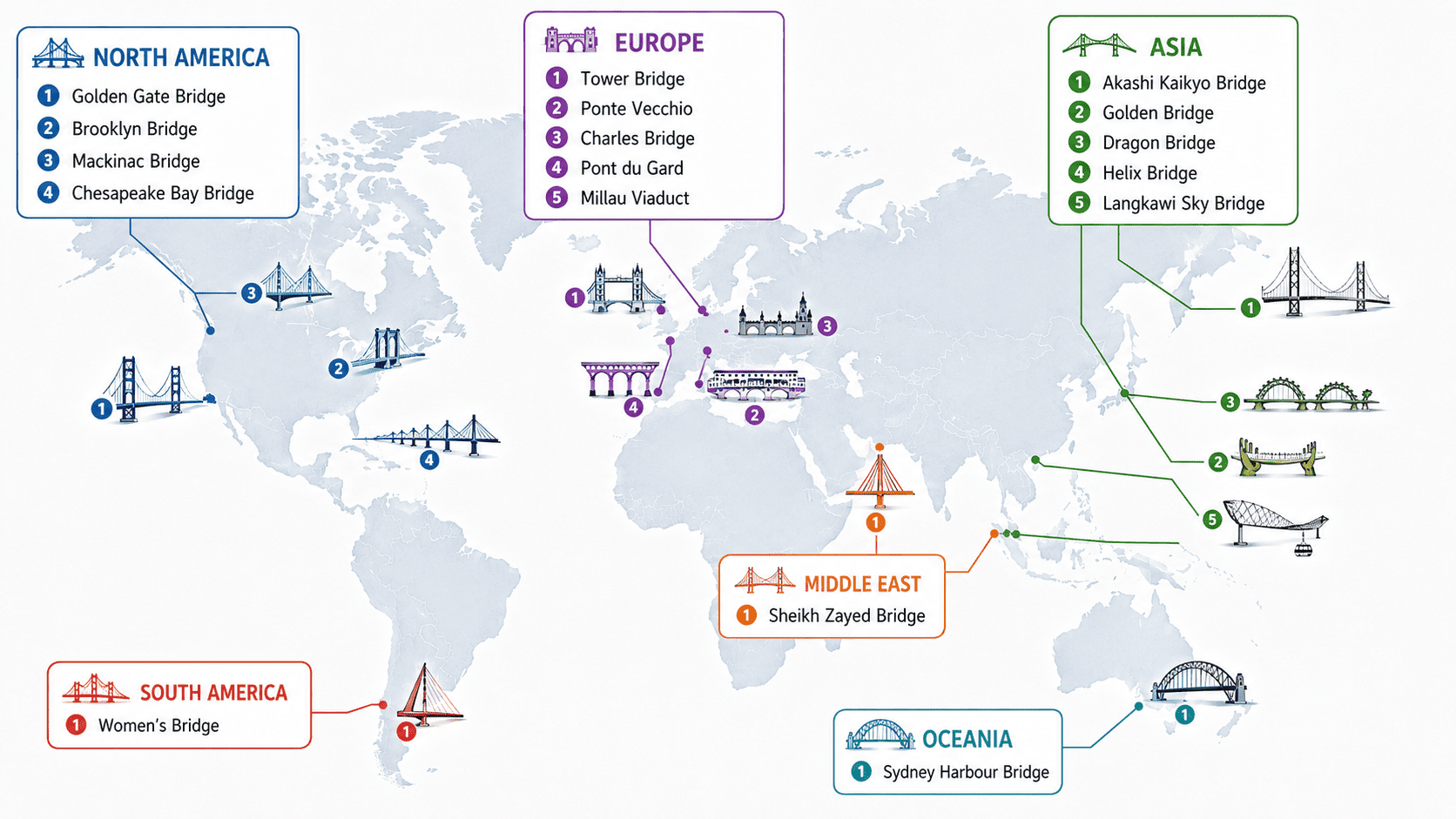
The famous bridges on this list are spread across several continents, from historic European cities to modern Asian skylines and iconic American destinations. Many of them are located in major travel hubs, while others stand out because they cross dramatic landscapes, rivers, bays, canals, or mountain areas.
| Region | Famous Bridges Featured |
|---|---|
| Europe | Tower Bridge, Ponte Vecchio, Charles Bridge, Rialto Bridge, Pont du Gard, Millau Viaduct |
| Asia | Akashi Kaikyo Bridge, Golden Bridge, Dragon Bridge, Helix Bridge, Langkawi Sky Bridge |
| North America | Golden Gate Bridge, Brooklyn Bridge, Chesapeake Bay Bridge, Coronado Bridge, Mackinac Bridge |
| South America | Women’s Bridge in Buenos Aires |
| Oceania | Sydney Harbour Bridge |
| Middle East | Sheikh Zayed Bridge in Abu Dhabi |
Famous Bridges by Region
Europe has the strongest concentration of historic bridges, especially in cities shaped by Roman, medieval, and Renaissance architecture. Asia stands out for modern engineering, scenic pedestrian bridges, and record-breaking structures. North America includes some of the most recognizable bridges in the United States, especially those tied to major cities such as San Francisco and New York. Together, these regions show why a List of Famous Bridges should include both ancient landmarks and modern engineering icons.
Tower Bridge in London, England
Tower Bridge is one of the most recognizable landmarks in London and one of the most famous bridges in the world. Completed in 1894, it crosses the River Thames near the Tower of London and was designed to solve a major transportation problem in Victorian London: the city needed a new crossing that could handle road traffic without blocking tall ships from reaching the busy docks upstream.
The bridge is often confused with London Bridge, but they are different structures. Tower Bridge is the dramatic bridge with two towers, high-level walkways, and a central section that can lift for river traffic. London Bridge, located farther upstream, has a much simpler design.
Why Tower Bridge Is Famous
Tower Bridge is famous because it combines practical engineering with a powerful architectural identity. Its bascule design allows the central spans to rise, while its suspension elements help support the roadway. Visually, its twin towers and Neo-Gothic details make it look older than it really is, blending with the nearby medieval Tower of London.
For visitors, Tower Bridge is more than a crossing. It is a London icon, a photo landmark, and a historic engineering attraction. Its elevated walkways and glass-floor sections give travelers views of the Thames, the city skyline, and the moving bridge mechanism below.
Python Bridge in Amsterdam, Netherlands
Python Bridge, also known as Pythonbrug and officially called Hoge Brug, is a striking pedestrian bridge in Amsterdam’s Eastern Docklands. Its bright red color and twisting, snake-like shape make it one of the most photogenic modern bridges in the Netherlands. Unlike many historic bridges in central Amsterdam, which are known for stone arches, canals, and traditional urban scenery, Python Bridge stands out for its playful contemporary design.
Completed around 2000–2001, the bridge crosses the Spoorwegbassin and connects the Sporenburg peninsula with Borneo Island. Designed by West 8 / Adriaan Geuze as part of the Borneo-Sporenburg redevelopment, it reflects Amsterdam’s modern approach to waterfront urban planning. The bridge is not famous because of age or monumental scale, but because it turns a simple pedestrian crossing into a bold visual landmark.
Design and Architectural Style
Python Bridge is famous for its snake-like form, which explains its name. Its curved red structure rises and falls in a way that feels almost sculptural, creating a strong contrast with Amsterdam’s traditional canal architecture. For travelers exploring modern Amsterdam, it offers a different kind of landmark: colorful, functional, and distinctly urban.
Ponte Vecchio in Florence, Italy
Ponte Vecchio is one of the most famous bridges in Europe and one of the defining landmarks of Florence. Completed in 1345, it crosses the Arno River at one of the city’s most historic points. Unlike most bridges, Ponte Vecchio is not known only for its structure, but also for the shops built directly along both sides of the crossing.
For centuries, the bridge has been associated with commerce. Butchers and food sellers once occupied the shops, before goldsmiths and jewelers became the bridge’s most recognizable merchants. Today, those small storefronts help preserve the bridge’s medieval character and make it one of the most memorable stops in Florence.
Historical Importance of Ponte Vecchio
Ponte Vecchio is famous because it connects everyday urban life with Renaissance history. Its enclosed shops, stone arches, and position near Florence’s historic center make it feel less like a simple crossing and more like a living street over the river. In any list of famous bridges, Ponte Vecchio stands out as a rare example of a medieval bridge that still functions as both landmark and commercial space.
Chapel Bridge in Lucerne, Switzerland
Chapel Bridge, or Kapellbrücke, is one of the most recognizable landmarks in Lucerne and one of Switzerland’s most famous historic bridges. Built in the 14th century, it crosses the Reuss River and connects parts of Lucerne’s old town with a covered wooden walkway. Its angled form, riverside setting, and nearby Water Tower make it one of the most photographed places in the city.
The bridge is especially important because it reflects Lucerne’s medieval character. Unlike massive stone or steel bridges, Chapel Bridge is admired for its warmth, craftsmanship, and close relationship with the surrounding old town. It feels less like a monument standing apart from the city and more like a preserved piece of Lucerne’s daily history.
The Wooden Bridge and Its Paintings
Chapel Bridge is famous for the triangular paintings displayed beneath its roof. These historic panels illustrate scenes from Lucerne’s past, religious stories, and regional identity. Although parts of the bridge were damaged by fire in 1993, it was carefully restored, preserving its role as a cultural symbol and one of the most distinctive wooden bridges in Europe.
Orb Aqueduct in Béziers, France
The Orb Aqueduct in Béziers, France, is an unusual entry in a List of Famous Bridges because it was designed to carry water traffic rather than regular road or pedestrian movement. Built in the 19th century, it allows the Canal du Midi to cross over the Orb River, creating the striking effect of one waterway passing above another.
This makes the aqueduct an important example of practical engineering within France’s historic canal network. Instead of simply linking two riverbanks, it helped improve navigation and made travel along the canal safer and more reliable.
Why This Aqueduct Bridge Is Unique
The Orb Aqueduct is unique because it works as both a bridge and a canal structure. Boats can travel across it while the river flows below, showing how bridge engineering can serve transportation in more than one form. Its value comes from function, precision, and its connection to the long history of European inland navigation.
Magdeburg Water Bridge in Magdeburg, Germany
The Magdeburg Water Bridge is one of the most unusual bridges in the world because it carries boats instead of cars, trains, or pedestrians. Located in Magdeburg, Germany, it allows vessels to cross over the Elbe River as part of a larger canal system. This makes it a standout example of modern waterway engineering and a valuable addition to any list of famous bridges.
Completed in 2003, the bridge was designed to connect the Elbe-Havel Canal with the Mittelland Canal, improving inland navigation across Germany. For travelers, its appeal comes from the surprising visual experience of seeing boats move across a bridge high above another body of water.
Engineering Purpose and Design
The Magdeburg Water Bridge functions like a navigable aqueduct. Instead of forcing boats to descend into the river and rise again through locks, it provides a direct water channel across the gap. Its design saves time, supports commercial transport, and shows how bridges can solve logistical challenges beyond ordinary road travel.
Rialto Bridge in Venice, Italy
Rialto Bridge is one of the most famous bridges in Venice and one of the most photographed landmarks on the Grand Canal. Completed in 1591, it replaced earlier wooden crossings and became the main link between important commercial areas of the city. Its single stone arch, central portico, and rows of small shops make it instantly recognizable.
Unlike many bridges that are admired mainly for their scale, Rialto Bridge is famous for its setting. It rises over the busiest waterway in Venice, surrounded by gondolas, historic palaces, markets, and constant pedestrian movement. For visitors, it is both a scenic viewpoint and a living part of the city’s daily rhythm.
Rialto Bridge and the Grand Canal
Rialto Bridge became historically important because of its location near the old Rialto market, once the commercial heart of Venice. Merchants, residents, and travelers used this crossing to move through one of Europe’s most active trading cities. Today, it remains a key stop in any List of Famous Bridges because it represents Venice’s blend of architecture, commerce, and canal-based urban life.
Pont du Gard in Vers-Pont-du-Gard, France
Pont du Gard is one of the most impressive ancient bridges in Europe and a masterpiece of Roman engineering. Built in the 1st century AD, it was part of an aqueduct system designed to carry water to the Roman city of Nîmes in southern France. Instead of serving as a typical road bridge, Pont du Gard was created to move water across the Gardon River valley with remarkable precision.
Its three tiers of stone arches make it visually powerful and structurally elegant. The bridge has survived for nearly two thousand years, which is one reason it remains one of the essential landmarks in any List of Famous Bridges focused on history and engineering.
Roman Engineering and Historical Legacy
Pont du Gard is famous because it shows how advanced Roman builders were in surveying, stone construction, and water management. Its scale, symmetry, and durability make it more than an archaeological site; it is a lasting example of how infrastructure could shape ancient urban life. Today, visitors admire it for both its technical achievement and its monumental presence in the French landscape.
Charles Bridge in Prague, Czech Republic
Charles Bridge is one of the most famous bridges in Central Europe and a defining landmark of Prague. Commissioned by King Charles IV and begun in 1357, it crosses the Vltava River and connects Prague’s Old Town with the Lesser Town near Prague Castle. For centuries, it served as one of the city’s most important crossings and helped shape Prague’s political, religious, and commercial life.
The bridge is especially memorable because it feels like an open-air historic corridor. Its stone arches, Gothic bridge towers, and river views make it one of the most atmospheric places in the city, especially at sunrise or in the evening.
Statues, History, and Old Town Views
Charles Bridge is famous for the Baroque statues that line both sides of the walkway. Many depict saints and religious figures, giving the bridge a strong cultural and spiritual identity. For travelers, it is also one of the best places to view Prague Castle, the Old Town skyline, and the Vltava River, making it an essential stop in any List of Famous Bridges focused on historic European landmarks.
Sheikh Zayed Bridge in Abu Dhabi, United Arab Emirates
Sheikh Zayed Bridge is one of the most distinctive modern bridges in the Middle East. Located in Abu Dhabi, it connects the island of Abu Dhabi with the mainland and serves as both a transportation link and an architectural landmark. Completed in 2010, the bridge was designed by Zaha Hadid, one of the most influential architects of the 21st century.
Its sweeping curves were inspired by the rolling shapes of desert dunes, giving the structure a fluid and futuristic appearance. Unlike historic stone bridges, Sheikh Zayed Bridge is famous for its sculptural form, dramatic lighting, and strong visual identity.
Modern Design and Visual Identity
Sheikh Zayed Bridge stands out because it turns infrastructure into urban art. At night, its lighting system emphasizes the bridge’s wave-like silhouette and makes it one of Abu Dhabi’s most recognizable modern landmarks. In a List of Famous Bridges, it represents contemporary design, regional ambition, and the growing role of architecture in shaping city identity.
Langkawi Sky Bridge in Langkawi, Malaysia
Langkawi Sky Bridge is one of the most scenic pedestrian bridges in Southeast Asia. Located high above the rainforest on Langkawi Island, Malaysia, this 125-meter curved cable-stayed pedestrian bridge is famous for its elevated position, sweeping walkway, and panoramic mountain views. The bridge is reached by the Langkawi Cable Car, followed by access via the SkyGlide inclined lift or a walking path, which makes the experience feel more like a mountain attraction than a typical city crossing.
Unlike historic bridges built mainly for trade or transportation, Langkawi Sky Bridge is known for its dramatic natural setting. Suspended near Gunung Mat Cincang, it gives visitors open views of the surrounding peaks, rainforest, islands, and coastline, making it a strong visual entry in any list of famous bridges.
Mountain Views and Visitor Experience
The bridge’s curved design allows travelers to see the landscape from different angles as they walk across it. Its height, narrow profile, viewing platforms, and glass-floor sections added during later upgrades create a memorable visitor experience, especially for those interested in photography, nature, and scenic viewpoints.
Dragon Bridge in Da Nang, Vietnam
Dragon Bridge, also known as Cầu Rồng, is one of the most eye-catching modern bridges in Vietnam and a major landmark in the coastal city of Da Nang. Opened in 2013, it crosses the Han River and is instantly recognizable because its steel structure is shaped like a dragon, an important symbol of power, prosperity, growth, and good fortune in Vietnamese culture.
Unlike bridges that become famous mainly because of age, length, or technical records, Dragon Bridge is known for its theatrical design and public appeal. Its bright yellow dragon structure, night lighting, and central location make it one of the most photographed attractions in Da Nang.
Why the Dragon Bridge Attracts Visitors
Dragon Bridge attracts visitors because it turns a normal river crossing into a cultural and visual experience. On selected evenings, especially weekends and major holidays, the dragon head breathes fire and sprays water, creating a public show that draws crowds along the riverfront. In a list of famous bridges, it stands out as a bridge where architecture, symbolism, and entertainment come together.
Helix Bridge in Singapore
Helix Bridge is a modern pedestrian bridge in Singapore, located near Marina Bay. Completed in 2010, it connects key waterfront areas and gives visitors access to some of the city’s most recognizable attractions, including Marina Bay Sands and the surrounding promenade.
Its fame comes from its unusual structure. Instead of using a traditional straight or arched profile, the bridge features a spiraling steel design inspired by the double helix shape of DNA. This makes it one of the most visually distinctive modern bridges in Asia and a strong example of how urban infrastructure can also become a public landmark.
Symbolism and Modern Engineering
Helix Bridge is famous because its design combines science, architecture, and city planning. The DNA-inspired form suggests life, growth, and connection, while its covered walkway and viewing platforms make it practical for pedestrians. In a List of Famous Bridges, it represents Singapore’s focus on modern design, walkable waterfront spaces, and visually memorable public architecture.
Golden Bridge in Ba Na Hills, Vietnam
Golden Bridge is one of the most visually recognizable entries in any List of Famous Bridges. Located in the Ba Na Hills near Da Nang, Vietnam, this pedestrian bridge became internationally famous soon after opening in 2018 because of its extraordinary design. Rather than relying on size, age, or engineering records, Golden Bridge stands out because it appears to be held up by two enormous stone hands rising from the mountainside.
Its narrow golden walkway curves gently through the landscape, creating a dramatic contrast with the surrounding hills, clouds, and gardens. That combination of architecture and scenery has made it one of Vietnam’s most photographed attractions.
The Giant Hands and Scenic Setting
The bridge’s giant hands are the main reason it attracts so much attention. They give the structure a surreal, almost mythic appearance, turning a simple pedestrian path into a landmark with strong visual identity. Set high above the landscape, Golden Bridge also offers sweeping views that enhance its appeal for visitors, photographers, and travelers looking for one of the world’s most unusual modern bridges.
Sydney Harbour Bridge in Sydney, Australia
Sydney Harbour Bridge is one of Australia’s most recognizable landmarks and one of the most famous steel arch bridges in the world. Completed in 1932, it crosses Sydney Harbour and connects the city’s central business district with the North Shore. Its massive arch has made it a defining part of Sydney’s skyline for nearly a century.
The bridge is often seen together with the Sydney Opera House, creating one of the most iconic urban views in the world. While it serves an important transportation role for vehicles, trains, cyclists, and pedestrians, its cultural value goes far beyond daily movement across the harbor.
Australia’s Most Iconic Bridge
Sydney Harbour Bridge is famous because it combines engineering scale with national identity. Its steel arch design gives it a powerful visual presence, while its location over the harbor makes it central to the image of Sydney. In a List of Famous Bridges, it stands out as a landmark that represents both Australian engineering ambition and the city’s connection to its waterfront.
Chengyang Wind and Rain Bridge in Chengyang, China
Chengyang Wind and Rain Bridge is one of the most beautiful examples of traditional bridge architecture in China. Located in Chengyang, in Guangxi Province, it was built by the Dong people and is known for combining practical engineering with cultural craftsmanship. Unlike steel or concrete bridges, this structure is made primarily from wood and stone, giving it a warm, handcrafted appearance.
The bridge crosses the Linxi River and serves more than one purpose. It is a crossing, a shelter, a viewpoint, and a gathering place for the local community. Its covered design protects people from sun and rain, which helps explain the name “Wind and Rain Bridge.”
Traditional Dong Architecture
Chengyang Wind and Rain Bridge is famous for its layered roofs, carved wooden details, and pavilion-like form. In a List of Famous Bridges, it stands out because it shows how a bridge can function as architecture, infrastructure, and community space at the same time.
Danyang-Kunshan Grand Bridge in Jiangsu Province, China
Danyang-Kunshan Grand Bridge is one of the most extraordinary engineering achievements in modern bridge construction. Located in Jiangsu Province, China, it forms part of the Beijing–Shanghai High-Speed Railway and was completed in 2010, before opening in 2011. Unlike many famous bridges known for dramatic towers or tourist views, this bridge is famous mainly because of its enormous scale.
The bridge stretches across a long section of eastern China’s lowland terrain, including rivers, canals, lakes, rice paddies, and agricultural areas. Its purpose is highly practical: to support fast, efficient rail travel across challenging ground while keeping the railway stable and direct.
One of the Longest Bridges in the World
Danyang-Kunshan Grand Bridge is widely recognized as the longest bridge in the world by total length, measuring about 102.4 miles, or 164.8 kilometers. In a list of famous bridges, it represents a different kind of fame: not visual ornament or ancient history, but large-scale infrastructure, precision engineering, and the ambition behind China’s high-speed rail network.
Living Root Bridges in Meghalaya, India
The Living Root Bridges of Meghalaya, India, are among the most unusual bridges in the world because they are grown rather than built in the conventional sense. Found mainly in the rainforest regions of northeastern India, these bridges are formed by guiding the living roots of rubber fig trees across streams and ravines over many years.
Unlike stone, steel, or concrete bridges, living root bridges become stronger as the roots continue to grow and interweave. Their fame comes from the way they combine natural materials, local knowledge, and long-term patience. They are especially associated with communities in Meghalaya, where heavy rainfall and dense forest landscapes shaped this remarkable bridge-building tradition.
Natural Engineering and Indigenous Knowledge
Living root bridges are famous because they show how infrastructure can work with nature instead of replacing it. Local communities train the roots into usable crossings, creating structures that are flexible, durable, and adapted to the wet environment. In a List of Famous Bridges, they stand out as rare examples of natural engineering, cultural heritage, and sustainable design.
Golden Gate Bridge in San Francisco, USA
The Golden Gate Bridge is one of the most famous bridges in the United States and one of the most recognizable landmarks in the world. Completed in 1937, it spans the Golden Gate Strait, connecting San Francisco with Marin County. Its location, dramatic towers, and sweeping suspension cables make it a defining symbol of California and the San Francisco Bay Area.
The bridge was an extraordinary engineering achievement for its time, especially because it had to withstand strong winds, deep water, fog, and powerful ocean currents. Yet its fame is not based only on construction difficulty. The Golden Gate Bridge is also known for its visual beauty. Its Art Deco details and bold International Orange color create a striking contrast against the blue water, green hills, and frequent coastal fog.
Why the Golden Gate Bridge Is World Famous
The Golden Gate Bridge is world famous because it combines engineering, design, geography, and cultural identity in one unforgettable structure. It appears in films, postcards, travel guides, and countless photographs, making it one of the strongest visual symbols of the American West Coast.
For visitors, the bridge is both a scenic attraction and an experience. People can drive across it, walk or bike along designated paths, and view it from places such as Battery Spencer, Crissy Field, and Fort Point. In any List of Famous Bridges, the Golden Gate Bridge deserves a leading place because it represents American innovation, urban identity, and the emotional power a bridge can have beyond transportation.
Brooklyn Bridge in New York City, USA
Brooklyn Bridge is one of the most important historic bridges in the United States and one of New York City’s most enduring symbols. Completed in 1883, it crosses the East River and connects Manhattan with Brooklyn. At the time of its completion, it was considered a major engineering achievement and one of the most ambitious bridge projects in the world.
The bridge is famous for its stone towers, pointed Gothic arches, steel cables, and elevated pedestrian walkway. Its design gives it a powerful architectural presence, while its location places it at the center of New York’s urban identity. Unlike bridges known mainly for scenery or unusual design, Brooklyn Bridge is closely tied to the growth of the modern city.
History, Architecture, and New York Identity
Brooklyn Bridge is famous because it helped transform movement between Manhattan and Brooklyn, supporting the economic and social expansion of New York. Its hybrid suspension and cable-stayed design made it innovative for its era, while its granite towers became part of the city’s visual language.
For visitors, walking across Brooklyn Bridge is one of the classic New York experiences. The walkway offers views of Lower Manhattan, the East River, and the surrounding skyline. In a List of Famous Bridges, Brooklyn Bridge stands out as a landmark of American engineering, immigration-era New York, and the rise of the modern metropolis.
Women’s Bridge in Buenos Aires, Argentina
Women’s Bridge, or Puente de la Mujer, is one of the most recognizable modern landmarks in Buenos Aires. Located in Puerto Madero, the city’s redeveloped waterfront district, the bridge crosses Dock 3 and connects pedestrian areas on both sides of the old port. Completed in 2001, it was designed by Spanish architect Santiago Calatrava.
The bridge is known for its white, asymmetrical form and rotating mechanism, which allows boats to pass through the dock. Its sharp profile and single leaning mast give it a sculptural appearance that stands apart from the historic architecture often associated with Buenos Aires.
Symbolism and Modern Urban Design
Women’s Bridge is famous because it combines movement, symbolism, and contemporary design. Its form is often interpreted as a couple dancing tango, connecting the structure to one of Argentina’s most important cultural traditions. In a List of Famous Bridges, it represents South America’s modern architectural identity and the transformation of Puerto Madero into one of Buenos Aires’ most visited urban areas.
Millau Viaduct in France
Millau Viaduct is one of the most impressive modern bridges in Europe and a major achievement in cable-stayed bridge design. Located near Millau in southern France, it carries the A75 motorway across the Tarn Valley and was completed in 2004, opening to traffic on December 16 of that year. The bridge was designed by French engineer Michel Virlogeux and British architect Norman Foster, combining structural efficiency with a clean, elegant profile.
Its fame comes largely from its height and visual lightness. Instead of dominating the valley with heavy supports, the bridge uses tall slender pylons, long cables, and a streamlined roadway that appears to float above the landscape. This makes it both a transportation structure and a modern architectural landmark.
Why the Millau Viaduct Is an Engineering Landmark
Millau Viaduct is famous because it pushed the limits of bridge construction while remaining visually graceful. Its highest mast reaches 343 meters, or about 1,125 feet, above the valley floor, while the roadway deck rises about 270 meters above the Tarn Valley. In a list of famous bridges, it represents modern European engineering, long-span cable-stayed design, and the ability to build major infrastructure that respects the surrounding landscape.
Akashi Kaikyo Bridge in Japan
Akashi Kaikyo Bridge, also known as the Pearl Bridge, is one of Japan’s greatest engineering landmarks and one of the most famous suspension bridges in the world. Completed and opened in 1998, it connects the city of Kobe with Awaji Island across the Akashi Strait. The bridge was built in a challenging marine environment known for strong winds, deep water, busy shipping routes, and seismic activity.
Its scale is one of the main reasons it belongs in any list of famous bridges. The bridge has a central span of 1,991 meters, or about 6,532 feet, making it one of the longest suspension bridge spans ever built. Its long, elegant profile also gives it a powerful visual presence over the strait.
A Record-Breaking Suspension Bridge
Akashi Kaikyo Bridge is famous because it combines record-breaking length with advanced engineering resilience. During construction, the 1995 Kobe earthquake slightly changed the bridge’s span lengths and required engineers to adjust the final alignment, making its completion even more notable. Today, it remains a vital transportation link between Honshu and Shikoku through the Kobe-Awaji-Naruto Expressway, representing Japan’s precision engineering and ability to build infrastructure in demanding natural conditions.
Bridge of Sighs in Venice, Italy
The Bridge of Sighs is one of the most famous small bridges in Venice, known less for its size and more for its dramatic history. Built in the early 17th century, it connects the Doge’s Palace with the old prison across a narrow canal. Its enclosed limestone design, arched windows, and elegant Baroque style make it one of the most recognizable architectural details in the city.
Unlike Rialto Bridge, which was tied to commerce and public movement, the Bridge of Sighs had a more solemn function. It was part of the route prisoners took after leaving the interrogation rooms of the palace.
History Behind the Name
The bridge’s name comes from the idea that prisoners would sigh as they caught a final glimpse of Venice before entering confinement. Although the story has a romanticized quality, it helped turn the bridge into a powerful symbol of beauty, loss, and legend. In a List of Famous Bridges, it stands out because its fame comes from atmosphere, storytelling, and its connection to Venetian history.
Stari Most in Mostar, Bosnia and Herzegovina
Stari Most, meaning “Old Bridge,” is one of the most meaningful historic bridges in Europe. Located in Mostar, Bosnia and Herzegovina, it was originally built in the 16th century during the Ottoman period and became the defining landmark of the city. Its graceful stone arch crosses the Neretva River and connects the two sides of Mostar’s old town.
The bridge is admired for its elegant shape, pale stone, and dramatic setting above the turquoise river. However, its fame also comes from its modern history. Stari Most was destroyed in 1993 during the Bosnian War and later reconstructed using traditional materials and methods.
A Symbol of History and Reconciliation
Stari Most is famous because it represents both cultural loss and restoration. Reopened in 2004, the rebuilt bridge became a symbol of reconciliation, heritage, and resilience. In a List of Famous Bridges, it stands out as a landmark whose importance goes beyond architecture, reflecting the power of a bridge to connect communities, histories, and identities.
Si-o-se-pol Bridge in Isfahan, Iran
Si-o-se-pol Bridge, also known as the Bridge of Thirty-Three Arches, is one of the most celebrated landmarks in Isfahan, Iran. Built between 1599 and 1602 during the Safavid era, it crosses the Zayandeh River and is known for its long, rhythmic sequence of arches. Its name refers to the 33 arches that define the bridge’s elegant profile.
Unlike bridges famous mainly for height or modern engineering records, Si-o-se-pol is admired for its balance, symmetry, and role in city life. Made of stone and brick, it reflects the refined architectural character of Safavid Isfahan and remains one of the city’s most important historic gathering places.
Persian Architecture and Urban Life
Si-o-se-pol is famous because it is both a bridge and a social space. Its double-level design, shaded passages, and repeated arches create places for walking, resting, and viewing the river. In a List of Famous Bridges, it stands out as a masterpiece of Persian architecture, showing how infrastructure can also shape public life, beauty, and cultural identity.
Forth Bridge in Scotland
Forth Bridge is one of the most famous railway bridges in the world and a major landmark of industrial engineering. Located near Edinburgh, Scotland, it crosses the Firth of Forth and connects the areas of South Queensferry and North Queensferry. Completed in 1890, the bridge became a powerful symbol of Victorian-era engineering ambition.
Its massive red steel structure makes it instantly recognizable. Unlike suspension or arch bridges, Forth Bridge uses a cantilever design, with large projecting arms that support the central spans. This gave the bridge the strength needed to carry heavy railway traffic across a wide and challenging estuary.
A Landmark of Industrial Engineering
Forth Bridge is famous because it represents the confidence and technical progress of the late 19th century. Its exposed steel framework, repeated triangular forms, and monumental scale show how engineering itself became part of the visual identity of the structure. In a List of Famous Bridges, it stands out as a historic railway bridge that helped define modern steel construction.
Iron Bridge in Shropshire, England
Iron Bridge in Shropshire, England, is one of the most important bridges in the history of engineering. Completed in 1779, it crosses the River Severn in the village of Ironbridge and is widely recognized as the first major bridge in the world made of cast iron. Its location in the Ironbridge Gorge connects it directly to the early development of the Industrial Revolution.
Before this bridge, large bridges were commonly built from stone, brick, or wood. Iron Bridge showed that metal could be used as a serious structural material, opening the way for new forms of bridge construction during the 19th century.
The First Major Cast-Iron Bridge
Iron Bridge is famous because it marked a turning point in engineering history. Its cast-iron ribs created a strong arched structure while demonstrating the possibilities of industrial materials. In a List of Famous Bridges, it stands out not because of size or decoration, but because it helped change how bridges were designed, built, and imagined in the modern age.
Chesapeake Bay Bridge in Maryland, USA
Chesapeake Bay Bridge is one of the most important transportation bridges on the East Coast of the United States. Located in Maryland, it crosses the Chesapeake Bay and connects the state’s western shore with the Eastern Shore. For many travelers, it is the main route between the Baltimore-Washington region and popular coastal destinations such as Maryland’s beaches and the Delmarva Peninsula.
The bridge is famous not only for its length, but also for the driving experience it creates. Crossing the wide bay gives drivers open views of the water, ships, and distant shoreline, while the bridge’s height and exposure make it memorable for many visitors.
Importance for Transportation in the United States
Chesapeake Bay Bridge is famous because it plays a major role in regional mobility. It supports tourism, commuting, freight movement, and access to coastal communities. In a List of Famous Bridges, it stands out as a practical American landmark: less ornamental than some historic bridges, but essential to how people move across Maryland and the Mid-Atlantic region.
Coronado Bridge in San Diego, USA
Coronado Bridge, officially known as the San Diego–Coronado Bridge, is one of the most recognizable bridges in Southern California. Located in San Diego, it crosses San Diego Bay and connects San Diego with the city of Coronado. Opened in 1969, the bridge is known for its long, sweeping curve and its elevated position above the water.
Unlike many famous bridges that rely on towers or dramatic cables, Coronado Bridge stands out because of its graceful roadway shape. Its curve was designed in part to create enough length for the roadway to rise to the required clearance of about 200 feet, allowing large naval vessels and other ships to pass beneath while also giving the bridge a distinctive visual identity.
San Diego Skyline and Curved Design
Coronado Bridge is famous for the views it offers of San Diego Bay, the downtown skyline, naval facilities, and Coronado. Its blue-and-gray painted structure and elegant curve make it especially memorable from the waterfront. In a list of famous bridges, it represents a scenic American bridge where transportation, coastal geography, and city views come together.
Mackinac Bridge in Michigan, USA
Mackinac Bridge is one of the most important suspension bridges in the United States. Located in Michigan, it crosses the Straits of Mackinac and connects the state’s Lower Peninsula with the Upper Peninsula. Completed in 1957, the bridge transformed regional travel by replacing a slower ferry-dependent connection with a direct highway route.
Its long suspension span, open-water setting, and northern location make it one of the most memorable bridges in the Midwest. For many travelers, crossing Mackinac Bridge is not just a practical route, but a defining part of visiting northern Michigan.
Connecting Michigan’s Peninsulas
Mackinac Bridge is famous because it physically and symbolically connects two major parts of Michigan. Its scale, exposed setting, and role in regional identity give it a special place among American bridges. In a List of Famous Bridges, it stands out as a landmark of transportation, state pride, and large-scale suspension bridge engineering.
Famous Bridges in Europe
Europe has some of the richest bridge history in the world, with landmarks that reflect Roman engineering, medieval trade, Renaissance cities, industrial innovation, and modern infrastructure. Many of the bridges on this list are located in historic urban centers, where they shaped how people moved, traded, gathered, and experienced the city.
Historic Bridges in Europe
Historic European bridges are especially important because they show how bridge design evolved across centuries. Pont du Gard represents ancient Roman water engineering, while Ponte Vecchio, Rialto Bridge, and Charles Bridge reflect the commercial, artistic, and religious life of medieval and early modern cities. Tower Bridge adds a Victorian example with a distinctive movable design, while Iron Bridge and Forth Bridge show how industrial materials changed bridge construction.
Modern Bridges in Europe
Modern European bridges continue that tradition through advanced engineering and bold design. Millau Viaduct is the clearest example, combining height, efficiency, and visual elegance. In a List of Famous Bridges, Europe stands out because its bridges tell a long story of architecture, technology, and cultural identity.
Famous Bridges in Asia
Asia includes some of the most diverse bridges in the world, ranging from record-breaking transportation structures to scenic pedestrian landmarks and culturally symbolic designs. The continent’s famous bridges often reflect rapid urban growth, challenging geography, advanced engineering, and strong visual storytelling.
Modern and Scenic Bridges in Asia
Modern Asian bridges stand out for both function and experience. Akashi Kaikyo Bridge in Japan represents large-scale suspension bridge engineering and regional connectivity. Danyang-Kunshan Grand Bridge in China shows the scale of modern high-speed rail infrastructure. In Singapore, Helix Bridge turns a pedestrian route into a science-inspired urban landmark.
Asia is also home to bridges that became famous because of scenery and visual impact. Golden Bridge in Vietnam, Dragon Bridge in Da Nang, and Langkawi Sky Bridge in Malaysia attract visitors through dramatic design, mountain views, lighting, and memorable forms. In a List of Famous Bridges, Asia adds a strong mix of innovation, scale, tourism, and cultural identity.
Famous Bridges in North America
North America is home to some of the world’s most recognizable bridges, especially in the United States. Many of these bridges are famous because they connect major cities, cross large bodies of water, or represent important moments in American engineering and urban development. Unlike some regions where fame is tied mainly to ancient history, North American bridges often stand out for scale, transportation value, skyline presence, and cultural identity.
Famous Bridges in the United States
The United States has several essential landmarks in any List of Famous Bridges. Golden Gate Bridge represents San Francisco and the West Coast with its dramatic suspension design and bay setting. Brooklyn Bridge reflects New York City’s history, architecture, and metropolitan growth. Chesapeake Bay Bridge, Coronado Bridge, and Mackinac Bridge are also important because they connect regions, support tourism, and create memorable travel experiences. Together, these bridges show how American infrastructure can become part of national identity, local pride, and everyday movement.
Famous Bridges by Type
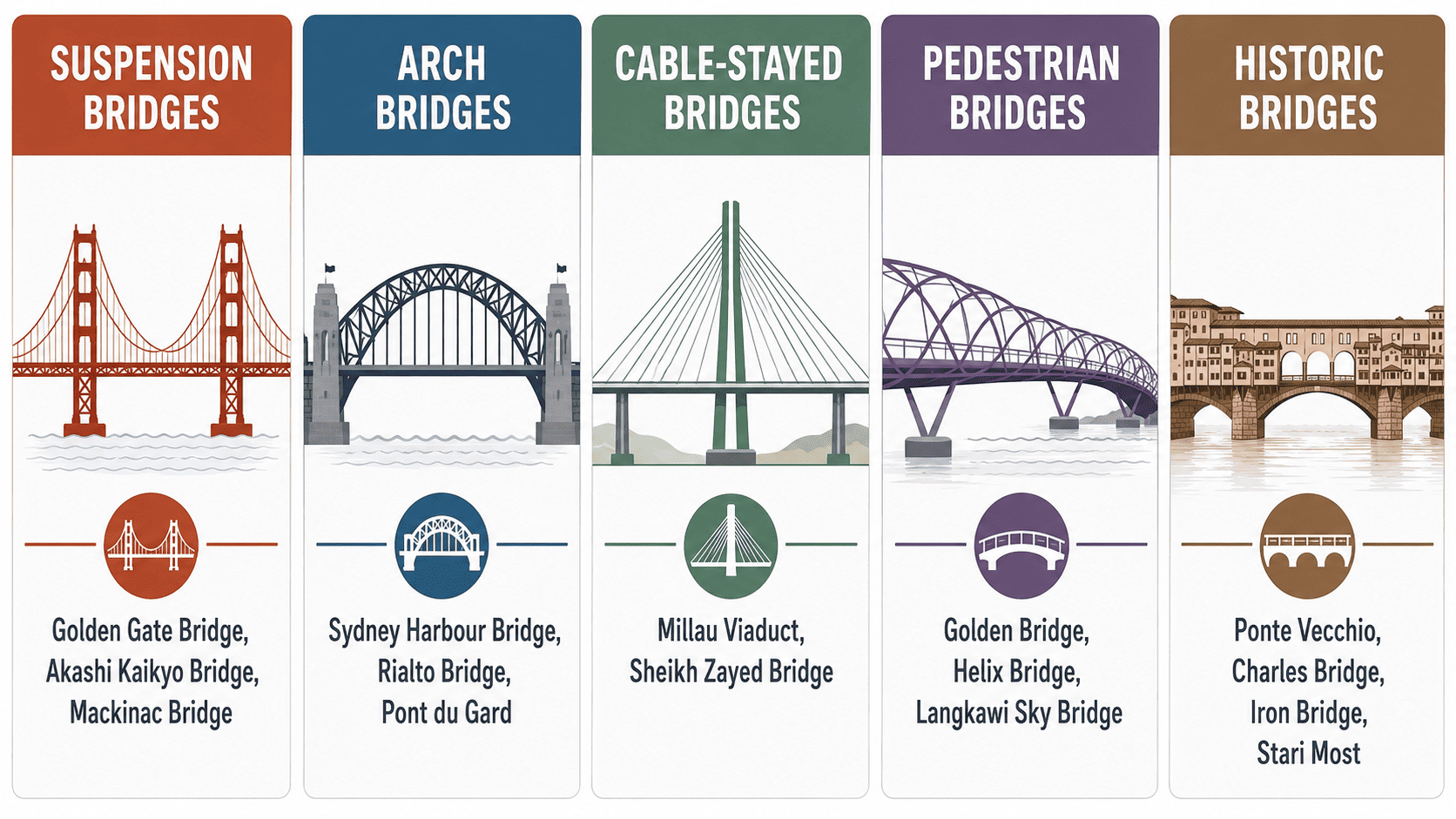
Famous bridges can also be understood by their structural type. This helps show why different bridges became important: some are admired for long spans, others for historic materials, elegant arches, pedestrian design, or modern cable systems.
Famous Suspension Bridges
Suspension bridges are often recognized for their long spans, tall towers, and sweeping cables. Golden Gate Bridge, Brooklyn Bridge, Akashi Kaikyo Bridge, and Mackinac Bridge are strong examples. They are famous because they cross wide bodies of water while creating some of the most memorable bridge silhouettes in the world.
Famous Arch Bridges
Arch bridges use curved forms to carry weight and create visual strength. Sydney Harbour Bridge, Rialto Bridge, and Pont du Gard show how arch design appears across very different periods, from Roman infrastructure to historic city crossings and modern steel construction.
Famous Cable-Stayed Bridges
Cable-stayed bridges use cables connected directly to towers or pylons. Millau Viaduct and Sheikh Zayed Bridge are famous examples because they combine engineering efficiency with bold architectural identity.
Famous Pedestrian Bridges
Some famous bridges are designed mainly for walkers and visitors. Helix Bridge, Golden Bridge, Langkawi Sky Bridge, and Python Bridge are known for scenic views, unusual forms, and strong photo appeal.
Famous Historic Bridges
Historic bridges such as Ponte Vecchio, Charles Bridge, Iron Bridge, Stari Most, and Si-o-se-pol are famous because they preserve cultural memory, older construction methods, and the identity of the places they serve.
What Is the Most Famous Bridge in the World?
The Golden Gate Bridge is often considered the most famous bridge in the world because of its global recognition, dramatic location, and strong connection to San Francisco. Its International Orange color, Art Deco towers, long suspension span, and frequent appearance in movies, photography, and travel media make it instantly recognizable.
However, the answer can depend on how fame is measured. Tower Bridge may be the most famous bridge in London, Brooklyn Bridge is one of the most iconic in the United States, and Sydney Harbour Bridge is closely tied to Australia’s national image. Still, in most global discussions, the Golden Gate Bridge stands out as the leading answer.
For that reason, it deserves a central place in any List of Famous Bridges, especially for readers looking for the world’s most recognizable bridge landmark.
What Is the Oldest Famous Bridge on This List?
The oldest famous bridge on this list is Pont du Gard in France, which dates back to the 1st century AD. Although it functioned as part of a Roman aqueduct rather than a standard road bridge, it remains one of the most important ancient bridge structures still standing today.
Other historic bridges on this list are much newer by comparison. Ponte Vecchio in Florence was completed in 1345, Charles Bridge in Prague was begun in 1357, and Rialto Bridge in Venice was completed in 1591. These bridges are extremely important in European history, but they belong to the medieval and early modern periods rather than the ancient world.
In a List of Famous Bridges, Pont du Gard stands out because it connects bridge history with Roman engineering, archaeology, and long-lasting infrastructure.
What Is the Longest Famous Bridge on This List?
The longest famous bridge on this list is the Danyang-Kunshan Grand Bridge in China. With a total length of about 102.4 miles, or 164.8 kilometers, it is widely recognized as the longest bridge in the world by total length. Unlike bridges that are famous mainly for their towers, views, or historic setting, Danyang-Kunshan Grand Bridge is known for its enormous scale and its role in China’s high-speed rail system.
Other bridges on this list are also notable for length, but in different ways. Akashi Kaikyo Bridge is famous for its exceptionally long suspension span of 1,991 meters, while Mackinac Bridge is one of the most important long suspension bridges in the United States and the longest suspension bridge in the Western Hemisphere.
In a list of famous bridges, Danyang-Kunshan Grand Bridge stands out because its fame comes from total distance, infrastructure scale, and modern transportation engineering.
Final Thoughts on the World’s Most Famous Bridges
The world’s most famous bridges show how a simple crossing can become a landmark of history, culture, engineering, and identity. Some bridges are admired because they are ancient, like Pont du Gard. Others are famous because they changed modern transportation, such as Brooklyn Bridge, Golden Gate Bridge, Akashi Kaikyo Bridge, and Danyang-Kunshan Grand Bridge.
Many of these landmarks also prove that bridges can be emotional and symbolic. They can represent a city, preserve a tradition, frame a skyline, or turn a difficult landscape into a memorable travel experience. That is why a strong List of Famous Bridges should include more than the longest or oldest structures. The most famous bridges are the ones that connect places while also telling stories people remember.
Related Entries: