
Pratt Truss Bridge: Design, Structural Mechanics, and Historical Significance
The Pratt truss bridge is a cornerstone of American civil engineering, renowned for its rational structural design and adaptability to both rail and highway infrastructure. Characterized by diagonals in tension and verticals in compression, the Pratt truss efficiently transfers loads through a triangulated framework, minimizing material use while maintaining rigidity and stability under heavy and dynamic loads.
Developed in the mid-19th century by Thomas and Caleb Pratt, this design addressed the limitations of earlier timber and Howe trusses, providing longer spans, predictable force distribution, and compatibility with emerging iron and steel construction. Its combination of mechanical efficiency and ease of fabrication made the Pratt truss one of the most widely adopted bridge systems in the United States, particularly during the rapid expansion of the railroad network. The design’s balance of structural performance, economic material use, and adaptability ensured its role in both railroad and roadway crossings, leaving a lasting legacy in American infrastructure and bridge engineering.
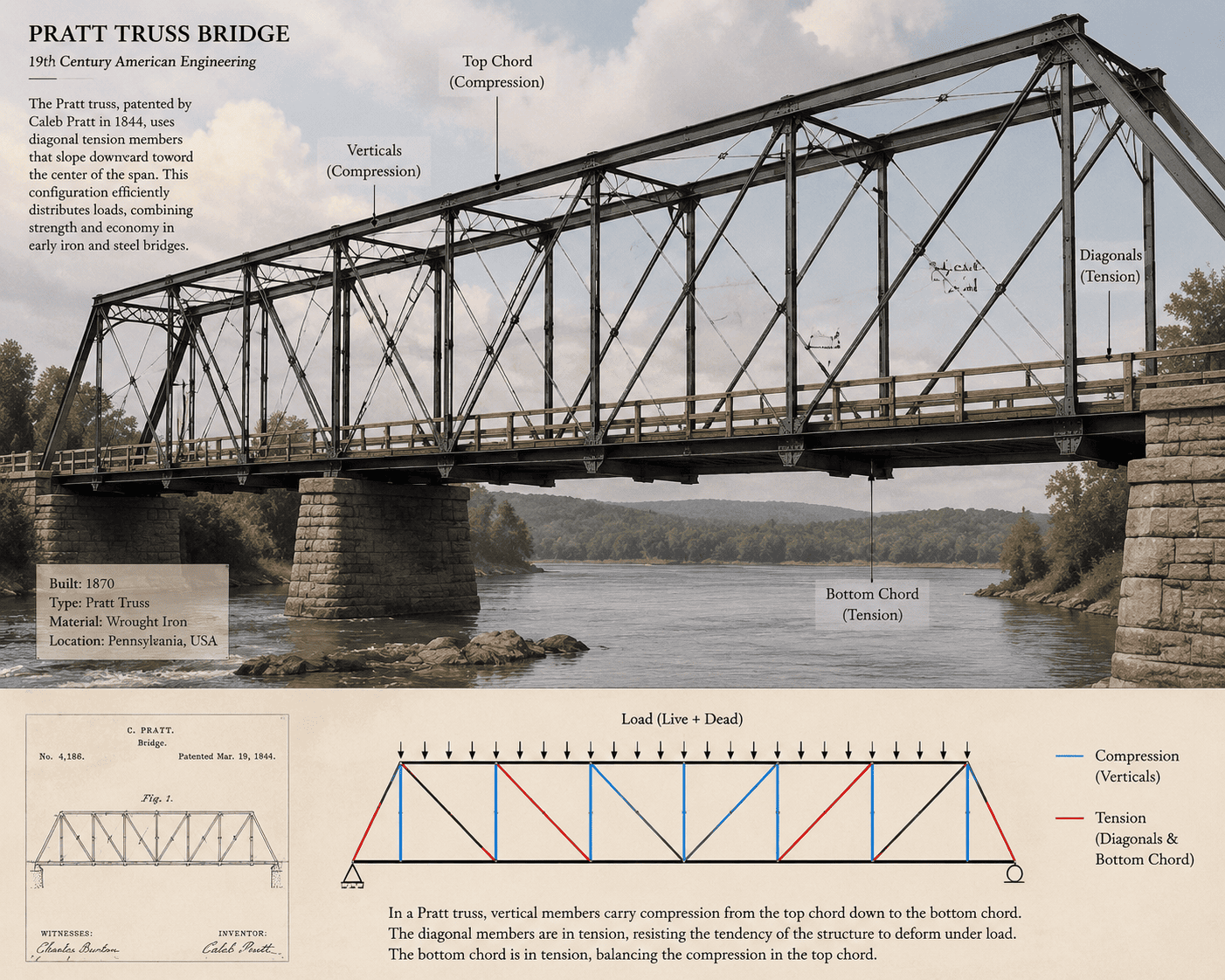
What Is a Pratt Truss Bridge?
The Pratt truss bridge became one of the most influential bridge designs in American civil engineering during the expansion of the railroad era. Known for its efficient distribution of tension and compression forces, the system offered a practical solution for longer spans, heavier rail traffic, and increasingly industrialized construction methods during the nineteenth and early twentieth centuries.
Definition of a Pratt Truss
A Pratt truss is a structural bridge configuration defined by diagonal members that primarily resist tension and vertical members that carry compression under normal gravity loading. The diagonals typically slope downward toward the center of the span, creating a force pattern that efficiently transfers loads from the deck into the truss framework and ultimately into the supports.
The design relies on the interaction between the upper chord, lower chord, vertical posts, and diagonal braces to maintain rigidity and structural equilibrium. Because tensile forces dominate in the diagonal members, the Pratt truss became especially effective once iron and later steel replaced heavy timber construction. This arrangement reduced unnecessary material usage while maintaining high load-carrying capacity, particularly for railroad bridges subjected to repetitive dynamic loading.
Origin and Historical Development
The Pratt truss was patented in 1844 by Thomas Pratt and his father Caleb Pratt during a period of rapid transportation development in the United States. At the time, railroad companies required bridge systems capable of spanning greater distances while supporting heavier locomotives than earlier timber trusses could reliably handle.
The design quickly gained acceptance because it aligned well with advances in wrought iron fabrication and industrial bridge manufacturing. By the late nineteenth century, major American bridge companies were producing standardized Pratt truss components for rail corridors, highway crossings, and industrial infrastructure throughout the country. As structural steel became commercially available in the 1880s, the Pratt configuration adapted easily to stronger and lighter materials, extending its practical span length and service life.
Why the Pratt Truss Became Widely Used
The widespread adoption of the Pratt truss resulted from its balance of structural efficiency, simplicity, and economic practicality. Engineers found the force behavior easier to analyze than many competing truss forms, which improved reliability in design calculations and fabrication.
Its geometry also matched the mechanical properties of iron and steel exceptionally well. Since slender metal members perform efficiently in tension, the diagonal elements could remain relatively lightweight while still resisting substantial loads. Compression forces were concentrated in shorter vertical and chord members, reducing the risk of buckling compared with earlier bridge systems.
Railroad companies particularly favored the Pratt truss because it tolerated repetitive moving loads with consistent structural performance. The design could also be adapted into through truss, deck truss, and pony truss configurations, allowing engineers to use the same fundamental structural concept across a wide range of site conditions and transportation needs.
Structural Design of a Pratt Truss Bridge
The structural effectiveness of a Pratt truss bridge depends on the coordinated interaction of multiple members designed to resist specific internal forces. Unlike simpler beam bridges, the Pratt truss distributes loads through a triangulated framework that separates tension and compression into different structural elements. This arrangement improves efficiency, reduces unnecessary material weight, and allows the bridge to maintain rigidity under variable live loads such as railroad traffic or highway vehicles.
Top Chord and Bottom Chord
The top chord forms the upper horizontal boundary of the truss and functions primarily as a compression member. Under loading, compressive stresses travel longitudinally along this upper section toward the supports. Because compression members are vulnerable to buckling, top chords were often constructed using heavier built-up iron sections or later rolled steel components with increased lateral stiffness.
The bottom chord serves as the primary tension member of the truss. As loads are transferred through the structure, tensile forces develop along the lower chord, resisting the tendency of the span to deform downward. In metal Pratt trusses, the bottom chord commonly consisted of eyebars or steel plates connected through pin assemblies or riveted gusset plates.
Vertical Members
Vertical members connect the upper and lower chords at panel points and typically carry compressive forces in a Pratt truss configuration. Their role is to transfer deck loads into the truss system while maintaining geometric stability between adjacent panels.
In railroad bridges, verticals were especially important because concentrated axle loads generated high localized stresses at floor beam connections. Depending on span length and bridge era, these members could be fabricated from rolled sections, laced built-up columns, or paired steel channels.
Diagonal Members in Tension
The diagonal members are the defining structural feature of the Pratt truss. Under standard gravity loading, these diagonals primarily resist tensile forces as loads move across the span. Their orientation allows the bridge to channel stresses efficiently toward the supports while minimizing compressive instability in slender elements.
Because tension members are less susceptible to buckling, engineers could design the diagonals with relatively lightweight iron or steel sections without compromising structural capacity. This contributed significantly to the economic efficiency of Pratt truss bridges during the railroad expansion era.
Compression Members
Compression forces within a Pratt truss are concentrated mainly in the upper chord and selected vertical elements. These members require greater cross-sectional rigidity because compressive loading can produce lateral deflection or buckling if insufficiently braced.
To improve resistance, bridge builders frequently used built-up compression members assembled from plates, angles, and lattice bars. This fabrication method increased stiffness while reducing overall structural weight compared with massive solid sections.
Connections and Joints
The performance of a Pratt truss depends heavily on the integrity of its joints, commonly known as panel points. These connections transfer forces between intersecting members and must maintain accurate geometric alignment under changing loads.
Nineteenth-century Pratt trusses often used pinned connections, which simplified fabrication and field assembly while allowing slight rotational movement between members. By the early twentieth century, riveted gusset plate connections became more common because they provided greater rigidity and improved resistance to vibration generated by heavier railroad traffic.
How a Pratt Truss Bridge Works
A Pratt truss bridge works by converting vertical loads into a controlled pattern of axial forces within a triangulated framework. Instead of relying on a solid beam to resist bending, the truss divides structural demand among chords, verticals, diagonals, and joints, allowing each member to perform a specific mechanical role.
Load Distribution
Loads enter the bridge through the deck, floor beams, or stringers, depending on the bridge type. These loads may include the bridge’s own weight, vehicles, trains, pedestrians, wind, and occasional environmental forces. From the deck system, the load is transferred to the panel points of the truss, where forces are distributed through the connected members rather than being carried by a single continuous beam.
This panelized load path is essential to the Pratt system. Each triangular bay helps redirect vertical pressure into axial force, reducing bending stress in individual members and improving overall structural efficiency.
Tension and Compression Forces
Under typical gravity loading, the Pratt truss separates tension and compression in a predictable way. The diagonal members generally carry tension, while the vertical members and top chord resist compression. The bottom chord works mainly in tension as it counteracts the downward deflection of the span.
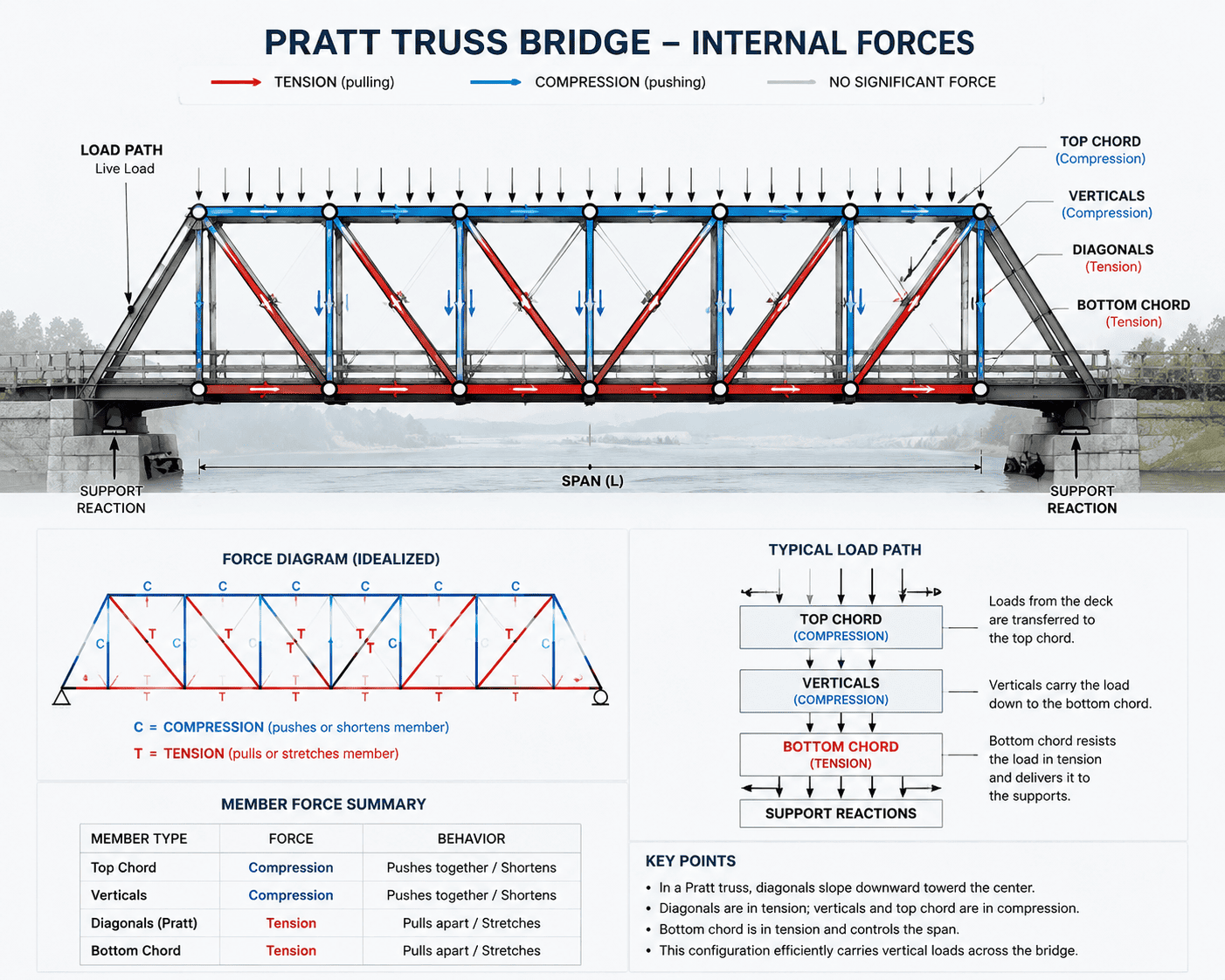
This clear division of force behavior is one reason the Pratt truss was so effective with metal construction. Iron and steel perform well in tension, while compression members can be made stronger through deeper sections, bracing, and built-up shapes.
Structural Stability
Stability comes from the repeated triangular geometry of the truss. Triangles resist distortion more effectively than rectangular frames because their shape cannot change without altering member length. In a Pratt truss, this geometry helps the bridge maintain alignment as loads move across the span.
Static System and Force Transfer
Mechanically, a Pratt truss behaves as a system of interconnected axial members. Forces move from loaded panel points through diagonals, verticals, and chords toward the end supports, where reactions are developed. The bridge remains stable when internal member forces and external support reactions reach equilibrium.
Types of Pratt Truss Bridges
Pratt truss bridges were adapted into several structural arrangements to meet different site conditions, clearance requirements, span lengths, and traffic needs. Each type keeps the essential Pratt force pattern, with diagonals generally working in tension and verticals contributing to compression and load transfer, but the position of the deck and the height of the truss change how the bridge is used.
Through Pratt Truss
A through Pratt truss carries the roadway or railroad track between two main trusses, with overhead lateral bracing connecting the top chords. Vehicles or trains pass “through” the structural frame, which allows the trusses to rise above the deck and provide greater depth for longer spans. This configuration was especially common in railroad bridges because it offered strong lateral stability and efficient load transfer under heavy moving loads.
Deck Pratt Truss
In a deck Pratt truss, the deck sits on top of the truss framework. The main structural members are positioned below the traffic surface, making this arrangement useful where the bridge crosses a deep valley, river channel, or rail corridor and vertical clearance beneath the deck is available. Because the truss depth extends downward, deck Pratt bridges can achieve substantial strength without overhead bracing above the roadway.
Pony Pratt Truss
A pony Pratt truss has side trusses that rise above the deck but are not connected by overhead bracing. This type was commonly used for shorter highway spans where a full through truss was unnecessary or where overhead clearance needed to remain open. Since pony trusses lack top lateral bracing, their vertical and top chord members must be proportioned carefully to resist lateral movement.
Baltimore Pratt Truss Variant
The Baltimore Pratt truss is a reinforced variation developed for longer and heavier spans. It adds sub-diagonals and additional vertical elements within the lower panels, improving load distribution under concentrated forces. This made the design particularly useful for railroad bridges carrying heavy locomotives, where intermediate support within each panel helped reduce bending in floor beams and better manage moving loads.
Materials Used in Pratt Truss Bridges
The materials used in Pratt truss bridges evolved alongside technological advancements and the increasing demands of American infrastructure. Each material phase directly influenced span capability, structural efficiency, and the adoption of the Pratt design in railroad and highway networks.
Early Wood Construction
The earliest Pratt trusses were often constructed from timber, leveraging abundant American forests and familiar carpentry techniques. Wooden trusses used sawn beams for chords and braces, joined with iron bolts or wooden pegs. While suitable for short spans and lighter loads, timber members were prone to decay, fire, and limited tensile capacity. These limitations restricted the length and load-carrying capacity of early Pratt truss bridges, making them more appropriate for rural or secondary routes.
Iron Pratt Trusses
With the industrialization of the mid-19th century, wrought iron became a practical material for Pratt trusses. Iron offered significantly higher tensile and compressive strength than timber, enabling longer spans and heavier railroad traffic. Early iron Pratt bridges often combined cast iron compression members with wrought iron tension members, reflecting the mechanical properties of each metal. The use of iron also allowed for prefabricated members, speeding up construction and reducing the need for extensive on-site carpentry.
Steel Pratt Truss Bridges
The advent of structural steel in the late 19th century revolutionized Pratt truss design. Steel’s superior strength-to-weight ratio allowed bridges to span greater distances while reducing the cross-sectional size of members. The transition from iron to steel coincided with the rapid expansion of American railroads, facilitating standardized fabrication and modular assembly. Riveted steel connections replaced older pin or bolted joints, improving stiffness, durability, and resistance to dynamic loads from increasingly powerful locomotives.
Modern Structural Materials
Contemporary Pratt trusses may incorporate high-strength alloy steels, weathering steel, or composite materials such as fiber-reinforced polymers in specialized applications. These materials extend service life, resist corrosion, and reduce maintenance needs, allowing Pratt truss principles to remain viable in niche industrial, pedestrian, or heritage rehabilitation projects. The evolution from timber to modern metals illustrates how material innovation directly expanded the structural capacity and geographic reach of Pratt truss bridges throughout U.S. history.
Common Uses of Pratt Truss Bridges
Pratt truss bridges became a versatile solution in the United States because their structural efficiency accommodated a wide range of transportation and industrial needs. The predictable force distribution, adaptability to different materials, and ease of assembly made the design suitable for both heavy railroads and lighter vehicular or pedestrian applications.
Railroad Bridges
Railroads were the primary driver of Pratt truss adoption in the 19th and early 20th centuries. Iconic examples include the Vandalia Railroad bridges in Illinois and the First Vandalia Railroad Bridge over the Kaskaskia River, where steel Pratt trusses allowed longer spans and heavier locomotives than earlier timber bridges. The design’s ability to channel concentrated axle loads into tension diagonals and compression verticals made it ideal for continuous railroad traffic with minimal maintenance interruptions.
Highway Bridges
Highway applications emerged as the Pratt truss’s reliability became evident. Steel Pratt trusses supported vehicular traffic on notable crossings such as the Hawkeye Creek Bridge in Iowa and the Cottonwood River Pratt Truss Bridge in Kansas, where these designs carried automobiles and local traffic across rivers and rural roads. The through and deck truss variants allowed engineers to adjust deck elevation and clearance for different roadway conditions, making the design flexible for both urban and rural highways.
Pedestrian and Utility Bridges
Lighter Pratt trusses were adapted for pedestrian walkways and secondary crossings in smaller communities and rural areas, particularly after heavier rail and highway service was retired. Examples such as the Elk Falls Pratt Truss Bridge in Kansas, which later carried pedestrians after its vehicular service ended, demonstrate the system’s scalability from heavy rail and highway applications to localized service infrastructure. The design’s straightforward fabrication and efficient span made it well suited to both modest pedestrian loads and utility functions in settings where heavier bridge types were not necessary.
Industrial Applications
Pratt truss bridges were also employed within industrial complexes, including mining and manufacturing sites. Internal rail lines often relied on short-span Pratt trusses to carry ore, coal, or raw materials across site obstacles. Their modular assembly and clear structural logic simplified construction in confined industrial environments, while maintaining safety and load capacity. These uses highlight the adaptability of the Pratt truss beyond public infrastructure into private industrial networks.
Advantages and Disadvantages of Pratt Truss Bridges
Pratt truss bridges have endured as a favored design due to their well-understood force distribution and adaptability, yet they also exhibit specific limitations that influence material choice, span length, and maintenance requirements.
Structural Advantages
The Pratt truss excels in efficiently separating tensile and compressive forces. Diagonal members, working primarily in tension, can be made lighter while still resisting significant loads, whereas verticals and top chords carry compression without excessive material use. This clear force allocation reduces the risk of member buckling and allows engineers to scale the design for short or moderate spans without compromising structural integrity. Additionally, the triangulated geometry provides inherent lateral stability, distributing dynamic and concentrated loads predictably, which is particularly advantageous for railroad traffic and heavy vehicles.
Structural Limitations
Despite its efficiency, the Pratt truss has limitations for extremely long spans. Compression members, including the top chord and vertical posts, become increasingly susceptible to buckling as span length grows, necessitating larger or more complex built-up sections. The design also requires precise fabrication and careful attention to member connections to ensure load paths remain consistent. In some cases, through truss configurations may impose height restrictions or require additional lateral bracing, complicating construction in constrained urban or navigable waterways.
Maintenance Considerations
Maintenance of Pratt truss bridges focuses on inspecting connections, diagonal tension members, and compression members for fatigue, corrosion, and joint degradation. Pinned or riveted connections in older bridges may loosen over time, while steel members are susceptible to rust if protective coatings deteriorate. Regular monitoring of gusset plates, floor beams, and bracing ensures continued structural performance, particularly on railroad bridges subjected to repetitive dynamic loading. The simplicity of member roles, however, often makes replacement or reinforcement more straightforward than in more complex truss systems, sustaining the Pratt’s long-term usability.
Pratt Truss Bridge Analysis
Analyzing a Pratt truss bridge requires understanding how external loads are translated into internal forces and ultimately resisted by the supports. The system behaves as a statically determinate truss in its simplest form, meaning internal member forces can be calculated using equilibrium equations at nodes and along member segments, allowing precise prediction of tension and compression under applied loads.
Reaction Forces
At the supports, reaction forces develop to balance the vertical and horizontal components of applied loads. Typically, a simple Pratt truss employs one pinned support and one roller support, enabling rotation at one end while preventing horizontal displacement. This arrangement ensures the truss can transfer both vertical loads from traffic and horizontal forces generated by wind or thermal expansion without overconstraining the system.
Internal Force Distribution
Within the truss, loads applied at panel points are distributed axially through the members. Diagonal members experience tension as they pull the span toward the supports, while vertical members and the top chord carry compression. Floor beams and stringers transfer concentrated loads from the deck into panel points, where the triangulated geometry ensures that each member carries predictable portions of the total load. This distribution minimizes bending moments in individual members and emphasizes axial forces, which is ideal for metal construction.
Tension vs Compression Behavior
The defining feature of a Pratt truss is the segregation of tension and compression. Diagonals, primarily in tension, remain slender and economical, while compression members, especially the top chord and verticals, are designed to resist buckling through increased depth, built-up sections, or lateral bracing. The predictable tension-compression pattern simplifies both design and analysis, reducing structural uncertainty even under dynamic railroad or vehicular loads.
Structural Efficiency in Long Spans
For longer spans, the Pratt truss demonstrates high structural efficiency compared with many contemporary truss types. By concentrating tension in diagonals and limiting compression to shorter verticals and top chords, material use is optimized without sacrificing rigidity. The modular panel system also facilitates standardized fabrication, allowing large bridges to be constructed from prefabricated sections. However, as spans increase, careful attention must be paid to slenderness ratios of compression members and joint stiffness to prevent lateral-torsional instability.
Famous Pratt Truss Bridges in the United States
Pratt truss bridges occupy a prominent place in American engineering history, representing both the technological evolution of metal bridge construction and the rapid expansion of rail and road networks. Several examples remain iconic, illustrating the adaptability and durability of the design.
Historic Railroad Bridges
Railroads were the primary beneficiaries of the Pratt truss, and many notable railroad bridges employed the design. The Vandalia Railroad Bridge over the Kaskaskia River in Illinois exemplifies an early steel Pratt through truss engineered to accommodate increasingly heavy locomotives in the late 19th and early 20th centuries. Similarly, the Norfolk Southern Six Mile Bridge No. 58 near Lynchburg, Virginia, demonstrates how riveted steel Pratt truss construction provided long‑span strength and efficient force distribution for continuous rail traffic over challenging crossings. The adaptability of Pratt truss bridges made them a backbone of railroad expansion during this era.
Preserved Pratt Truss Bridges
Many Pratt trusses have been preserved as part of historical heritage and local infrastructure. Examples include the Lower Elgin Road Bridge at Wilbarger Creek in Bastrop County, Texas, a rare nineteenth-century pin-connected Pratt through truss later repurposed for pedestrian use, and the Smiths Crossing / Bailey Bridge in Michigan, a two-span pin-connected Pratt through truss slated for restoration as a non-motorized trail crossing. These preservation efforts often focus on retaining character-defining materials and details, such as pin connections, built-up metal members, lattice bracing, and original truss configurations, while adapting the bridges to contemporary safety and accessibility standards.
Pratt Truss Bridges Listed on Historic Registers
Numerous Pratt truss bridges are officially recognized for their historical and engineering significance. Examples include the Hanover Bridge in Minnesota, a pin-connected Pratt through truss built in 1885 and listed for its engineering and transportation significance, and the Dodd Ford Bridge in Minnesota, a steel pin-connected Pratt through truss erected in 1901 and recognized as an important surviving example of early twentieth-century bridge construction. These listings underscore the Pratt truss’s enduring influence and provide valuable case studies in 19th- and early 20th-century bridge design, fabrication, and material use. Through these examples, the Pratt truss continues to demonstrate its structural legacy and cultural importance.
Pratt Truss vs Other Truss Designs
The Pratt truss is often compared to other historically significant truss systems, such as the Howe and Warren trusses, each developed to address similar structural challenges but with differing force distributions and material efficiencies.
Pratt vs Howe Truss
The Howe truss, patented in 1840 by William Howe, reverses the force pattern of the Pratt truss: its diagonal members are in compression while verticals carry tension. This configuration made the Howe truss more suitable for timber construction, where compression members could be readily fabricated from heavy wood, and iron or steel tension rods were used for verticals. In contrast, the Pratt truss optimizes metal construction by placing diagonals in tension and verticals in compression, allowing lighter, more efficient members in iron and steel bridges. For railroads and longer metal spans, the Pratt’s tension-focused diagonals offered better performance and reduced material costs, which explains its widespread adoption in industrial-era America.
Pratt vs Warren Truss
The Warren truss, patented in 1848 by James Warren and Willoughby Monzani, features a series of equilateral triangles without vertical members. This creates a nearly uniform distribution of axial forces, but members are subjected to alternating tension and compression depending on load position, which can complicate analysis and design. By comparison, the Pratt truss provides a more predictable pattern: diagonals almost always resist tension, and verticals resist compression. This predictability simplifies calculations, fabrication, and maintenance, especially for heavily loaded railroad and highway bridges. While the Warren truss excels in simple, repetitive spans where bending moments are minimal, the Pratt truss remains advantageous for varied live loads and dynamic traffic conditions.
In summary, the Pratt truss differentiates itself by combining structural efficiency with adaptability to metal construction and dynamic loading. Its tension-compression arrangement delivers predictable internal forces, whereas the Howe and Warren trusses offered alternatives better suited to timber or uniform-span requirements. This balance of efficiency, simplicity, and material optimization is why the Pratt truss became one of the most widely implemented designs in U.S. infrastructure.
Why Pratt Truss Bridges Remain Important Today
Pratt truss bridges continue to be valued for their combination of structural efficiency, durability, and historical significance. Their design principles remain relevant in both heritage preservation and modern engineering applications.
Structural Efficiency
The defining feature of the Pratt truss—the separation of tension and compression members—ensures that materials are used optimally. Tension diagonals and compression verticals allow for lighter construction without compromising load capacity, making the system exceptionally efficient for spans ranging from short highway crossings to long railroad bridges. Modern engineers still reference these principles when designing modular truss systems or retrofitting older bridges to handle contemporary traffic loads.
Durability and Adaptability
Many Pratt truss bridges built in the late 19th and early 20th centuries remain in service today, a testament to their durability. The straightforward axial force distribution allows for relatively easy inspection, maintenance, and reinforcement. Adaptations of the Pratt truss also accommodate modern materials, including high-strength steel and corrosion-resistant alloys, extending the life of both new and rehabilitated structures. Its versatility enables applications from vehicular and railroad bridges to pedestrian walkways and industrial crossings.
Historical Importance in American Infrastructure
Beyond engineering, Pratt truss bridges represent a pivotal era in U.S. infrastructure development. They facilitated the rapid expansion of railroads, connected rural and urban regions, and standardized bridge construction techniques across the country. Preserved examples serve as educational and cultural landmarks, illustrating the evolution of material science and industrial fabrication. Today, the Pratt truss bridges are appreciated not only for their mechanical efficiency but also as enduring symbols of American ingenuity in civil engineering.
Frequently Asked Questions About Pratt Truss Bridges
What is a Pratt truss bridge used for?
Pratt truss bridges are used for railroad, highway, pedestrian, and industrial crossings. They efficiently support heavy loads over moderate to long spans and are adaptable to both vehicular and rail traffic.
Why is the Pratt truss efficient?
The Pratt truss efficiently separates forces: diagonal members carry tension, while vertical members carry compression. This allows materials to be used optimally, reducing weight without compromising strength.
What materials are used in Pratt truss bridges?
Historically, Pratt trusses were built with timber, then wrought iron and steel. Modern versions use structural steel, high-strength alloys, or composite materials, improving durability and load capacity.
Are Pratt truss bridges still used today?
Yes. They remain in service for heritage railroad bridges, roadway crossings, pedestrian walkways, and industrial applications, often refurbished with modern materials for extended life.
What makes the Pratt truss structurally effective?
Its triangular geometry provides stability, predictable force distribution, and efficient load transfer from the deck to supports. This design minimizes bending moments, optimizes material use, and ensures long-term structural reliability.
Related Entries: